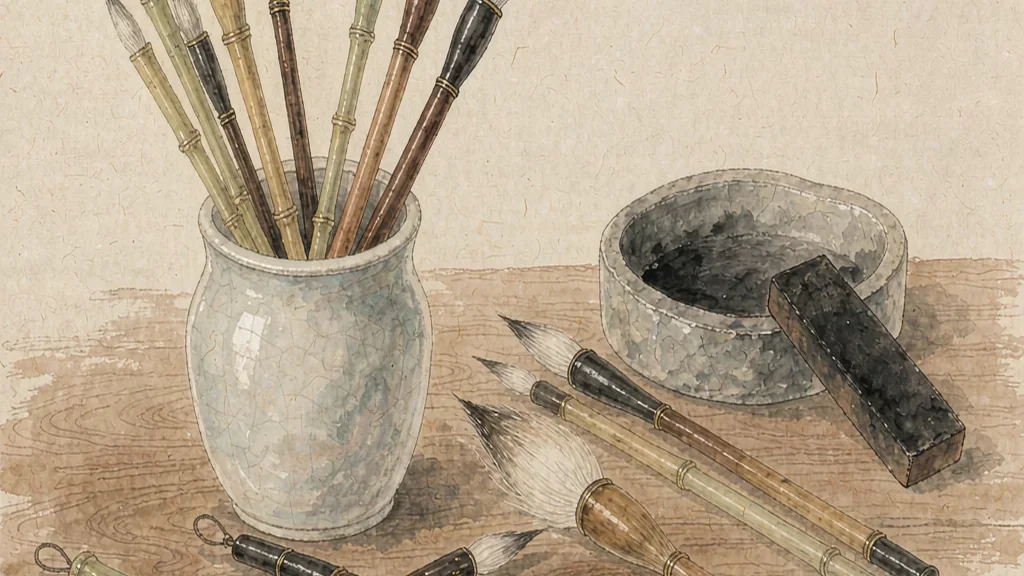
The brush (bi) is the first of the “Four Treasures of the Study” and the tool that gives Chinese calligraphy its life. Unlike a pen, a Chinese brush is a bundle of animal hair set in a bamboo or wooden handle, and the kind of hair, the shape of the tip, and the stiffness of the bristles change everything about how a line behaves. Knowing brush types is therefore the first practical step for any student, because the right brush makes a desired effect possible and the wrong one makes it hard.
The Basic Structure of a Brush
A brush has two parts: the handle and the head. The head is a tapering bundle of hair, usually in two layers—a core of stiffer hair for spring and an outer layer of softer hair for ink-holding and smoothness. The point where head meets handle is often bound with string and sealed with lacquer. The very tip, called the “tip” or “needle,” is what the writer keeps centered for even lines.
Handles are commonly bamboo, valued for lightness and grip, but finer brushes may use lacquered wood, ivory, jade, or bamboo with decorative carving. For daily practice, however, a simple bamboo handle is preferred; what matters is the hair, not the luxury of the shaft.
Hair Types: Hard, Soft, and Mixed
The most basic division is by hair. “Hard” brushes use animal hairs with spring and resilience—such as weasel (often called “wolf” in trade terms), horse, or boar bristle. “Soft” brushes use plant-eating animal hairs like goat, rabbit, or sheep, which are more absorbent and yielding. A “mixed” or “combined” brush blends stiff and soft hair to get both spring and ink capacity.
Hard brushes are favored for precise regular script and for fine detail, because they snap back and hold a sharp point. Soft brushes suit large characters, cursive flourish, and expressive ink play, because they hold more liquid and move with less resistance. Mixed brushes are the all-round choice for students learning several styles.
Weasel (Wolf) Hair Brushes
The so-called “wolf hair” brush is actually made from the tail hair of the weasel (sometimes referred to by the misnomer “yellow wolf”). It is stiff, elastic, and keeps a fine point, which is why it is the classic choice for regular and running script where control matters. Northern centers such as Jingzhou and some areas of Jiangxi became famous for quality weasel-hair brushes.
Because weasel hair is comparatively scarce and durable, a good wolf-hair brush is prized and cared for. Beginners often start with a small wolf-hair brush for regular script, since its resistance teaches correct pressure and prevents the floppy, uneven lines a too-soft brush can encourage.
Goat Hair Brushes
Goat (or sheep) hair brushes are the standard soft brush. They are highly absorbent, producing broad, soft, and varied lines ideal for large regular characters, cursive, and free ink painting. A big goat-hair brush loaded with ink can make a single stroke that shades from dark to pale as the moisture leaves the hair.
The famous “Hu brush” and the brushes of places like Shanlian are often goat-hair based. Because soft hair has little spring, it demands a confident hand; used well, it gives calligraphy a warm, generous quality that stiff brushes cannot match. Many artists keep both kinds and switch by mood and task.
Rabbit Hair and Ancient Preferences
Historically, rabbit hair—especially the winter coat of a mountain rabbit—was highly valued, and the legendary brushes of the Tang and earlier periods were often rabbit-hair. Such hair is fine and springy, good for small, exact characters. References in old texts to “purple hair” usually mean a dark rabbit hair prized for its strength.
Today rabbit hair is less common than weasel or goat, but it survives in specialty brushes and in combined brushes where a little rabbit hair adds spring. Its historical importance reminds us that the ideal brush material has shifted with what was available and with changing aesthetic taste.
Brush Sizes and Shapes
Brushes come in sizes from tiny “small regular” brushes for letter-sized characters to huge house-painter’s brushes for banner-sized works. Shape also varies: most are round and tapering, but some are flattened for certain painting effects. The choice of size follows the size of the characters one intends to write.
For calligraphy, the round, pointed brush is standard, because its symmetry lets the writer rotate it and use any side. A brush that is too large for the hand encourages sloppy, uncontrolled strokes; one too small cramps the arm. Teachers advise matching brush to task rather than buying the biggest or finest on display.
Choosing and Caring for a Brush
A good new brush should have a sharp point, a tidy belly, and hair that returns to shape after being pressed. Before first use the sizing (a gum that holds the tip) must be washed out gently in water. After use, the brush should be cleaned of ink and hung or laid to dry with the tip down or flat, never capped wet, or the hair will rot at the base.
Proper care lets a quality brush last for years. A writer may keep a small wolf-hair for regular script, a large goat-hair for cursive and painting, and a mixed brush for general running script—three tools covering most needs. The relationship between calligrapher and favorite brush is often affectionate, almost personal.
Brushes in the Broader Tradition
The brush is inseparable from the other three treasures—ink stick, ink stone, and paper—and the whole set defines the calligraphic workspace. The type of brush also interacts with paper: a soft brush on absorbent paper gives very different results from a hard brush on sized paper. Mastery means knowing how brush, ink, and paper cooperate.
Finally, the brush is more than a tool in Chinese culture; it is a symbol of the scholar’s craft and, by extension, of civilized life. To “hold the brush” is to take part in a tradition stretching back two millennia, and choosing one’s first brush is a small rite of entry into that world.
❓ Frequently Asked Questions
What is a Chinese calligraphy brush made of?
It is a bundle of animal hair set in a bamboo or wooden handle, usually with a stiff inner core and a softer outer layer for ink-holding.
What is the difference between hard and soft brushes?
Hard brushes (weasel hair) are stiff and precise; soft brushes (goat hair) are absorbent and expressive; mixed brushes combine both qualities.
Which brush should a beginner use?
A small wolf-hair (weasel) brush for regular script is common, because its resistance teaches correct pressure and control.
What does “wolf hair” really mean?
Despite the name, it refers to weasel tail hair, valued for its spring and ability to hold a sharp point.
How should I care for a brush?
Wash out the sizing before first use, clean ink after each session, and dry it tip-down or flat—never store it wet in a cap.
Why does brush choice matter?
The hair type, size, and stiffness change how lines behave and interact with ink and paper, so the right brush makes a desired effect possible.