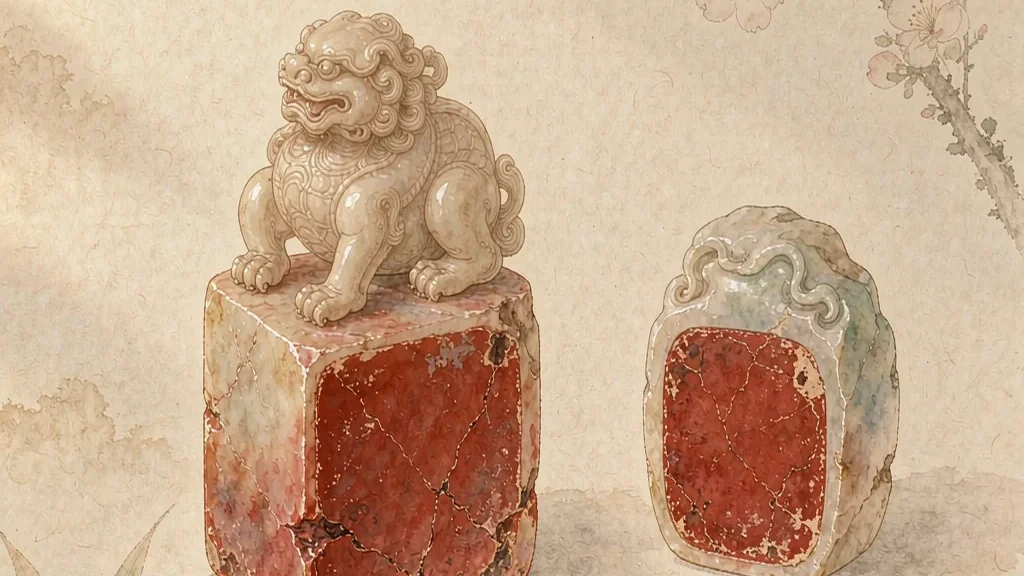
Seal Carving: The Sibling Art of Calligraphy
篆刻 · 867 words
When a Chinese calligrapher finishes a work, he or she affixes a crimson seal (印章, yìn zhāng) to the paper — a small square or rectangle of carved stone that declares the artist's name, studio, or artistic motto. This seal is not a mere signature but an integral part of the composition, a point of red that balances the black ink and empty white space. The art of seal carving (篆刻, zhuàn kè) is considered a sister art to calligraphy, sharing its principles of composition, balance, and expressive power. A fine seal is a miniature calligraphic masterpiece, and the study of seal carving is an essential component of a complete calligraphy education.
The History of the Chinese Seal
Seals have been used in China for over three thousand years. The earliest known seals date from the Shang dynasty and were used to mark ownership of goods. By the Warring States period, seals were used for official authentication — a sealed document was an authenticated document. The Qin dynasty standardized the seal script and established the use of seals as official credentials for government officials.
The imperial seal of state — the "Seal Transmitting the Kingdom" (传国玺, chuán guó xǐ) — was the most important seal in Chinese history. Carved from the legendary He family jade (和氏璧), it passed through successive dynasties and was considered proof of the Mandate of Heaven. The seal was lost during the Five Dynasties period, and its fate remains one of the great mysteries of Chinese history. Its loss did not diminish the importance of seals in Chinese culture; every subsequent dynasty created new imperial seals, and the practice of sealing documents, letters, and artworks became universal.
The Materials of Seal Carving
Seals are carved from a variety of materials, the most prized being four types of stone: Shoushan (寿山), Qingtian (青田), Changhua (昌化), and Balin (巴林). Shoushan stone, from Fujian Province, is the most famous — a soft, waxy stone in colors ranging from pure white to deep red. The finest Shoushan stone, known as "tianhuang" (田黄, "field yellow"), is more valuable than gold. Qingtian stone is greenish and prized for its even grain. Changhua stone includes the rare "cinnabar" (鸡血石, jī xuè shí) variety, with vivid red spots that look like drops of blood.
Other materials include jade, ivory, wood, bamboo, horn, and ceramic. Each material requires different carving techniques. Jade is extremely hard and must be ground rather than carved. Wood and bamboo are relatively easy to carve but less durable. The choice of material depends on the carver's skill and the patron's budget.
The Art of Seal Carving
Seal carving begins with the design. The characters — almost always in seal script — must be arranged within the square or rectangular space of the seal face. The carver writes the characters in reverse on the face of the stone, using either a brush or a direct transfer from a paper design. The negative space (白文, bái wén) — the areas that will remain white on the impression — must be balanced against the positive space (朱文, zhū wén) — the red characters.
The carving itself is done with small knives of various shapes. The carver must work with precision, as mistakes are difficult to correct. The depth of the cut controls the thickness of the lines in the impression. Seal carving requires a steady hand, a sharp eye, and a deep understanding of seal script. A master carver can create a seal that looks as if it were written with a brush rather than cut with a knife — the highest compliment in the art.
The Seal in Calligraphic Composition
In a finished calligraphic work, the seal serves several purposes. It authenticates the work, identifying the artist and sometimes the date of composition. It balances the visual composition — the red of the seal provides a contrasting color point that can anchor or enliven the black-and-white design. It also carries symbolic and personal meaning: the text of the seal might be the artist's name, a studio name, a poetic phrase, or a personal motto.
The placement of seals on a calligraphic work follows conventions. The "name seal" (名章, míng zhāng) is placed below or beside the artist's signature. The "leisure seal" (闲章, xián zhāng) is placed at the beginning of the work or in a corner. The "corner seal" (压角章, yā jiǎo zhāng) is placed in a lower corner to stabilize the composition. Collectors also add their own seals to works they have owned, creating a history of ownership that records the work's provenance.
Learning Seal Carving
Seal carving is typically studied after the calligrapher has achieved some competence in writing seal script. The aspiring carver first learns to draw the seal-script characters with a brush, then practices carving on soft stone or wood. The tools are simple: a small knife with a wooden handle, a fine brush for the design, and an ink pad for testing impressions.
The first seal a student carves is usually a name seal. The student writes the characters in reverse, carves them into the stone, and tests the impression. The process requires patience — a single seal can take days or weeks to complete. But the result is deeply personal: a seal is not just a tool but a statement of identity, a mark that carries the maker's character in every line.
Reading the Seal in a Painting
On a finished scroll, a seal is never decorative alone; it is part of the reading. A name seal beneath the signature confirms authorship, while a leisure seal placed at the start or in a corner sets a mood with a poem or a studio name. Collectors add their own seals over time, so the red marks trace a work's journey through hands and centuries, a kind of ownership diary in vermilion. The placement follows unwritten rules: too many seals crowd the composition, too few leave it unanchored. Connoisseurs actually study the sequence of collector seals to verify authenticity, since a fake often betrays itself by an impossible or muddled history of impressions. In this sense the seal is both signature and archive, binding the painting to a chain of witnesses.
The Carver's Hand and the Brush
Although seal carving is done with a knife, the highest praise is that a seal looks written, not cut. The carver first writes the characters in seal script with a brush, studies their balance, and only then transfers the design to stone in reverse. During cutting, the wrist pivots much as it does in calligraphy, and the depth of each incision is varied to imitate the swelling and thinning of a real stroke. A heavy line reads as a pressed brush; a light one as a lifted one. Masters such as Wu Changshuo blurred the boundary between the two arts so completely that the same hand might carve a seal in the morning and write a couplet in the afternoon, using one sense of rhythm for both. The seal, then, is calligraphy compressed into a tiny, permanent square.
Frequently Asked Questions
Chinese Vocabulary
印章 — : Seal: a carved stamp used to authenticate documents and artworks.
篆刻 — : Seal carving: the art of carving characters into stone to create seals.
寿山石 — : Shoushan stone: the most famous seal-carving stone, from Fujian Province.
田黄 — : Field yellow: the rarest and most valuable variety of Shoushan stone.
闲章 — : Leisure seal: a seal bearing a poetic phrase or personal motto.
朱文 — : Raised-seal script, a seal carved in relief so that the characters appear red on a white ground.
白文 — : Intaglio seal script, a seal cut into the stone so that the characters appear white within a red field.
印泥 — : The cinnabar paste, made from ground red mineral and oil, used to stamp a seal onto paper.
Fun Facts
- The 'Seal Transmitting the Kingdom' was carved from the He family jade, which was said to weep tears of blood when recognized by the king of Zhao.
- Emperor Qianlong owned over 1,800 personal seals, each with a different name, poem, or phrase.
- Some modern Chinese painters use seals so often that their works look like 'spotted' documents, with dozens of collector seals covering every available space.
- A seal carved in relief reads as red characters on white, while an intaglio seal leaves red around white characters; masters often paired the two for visual balance.
- The cinnabar paste used to stamp seals is made from mercuric sulfide mixed with silk or plant oil, and a well-kept cake can stay vivid for generations.
- Seal-carving knives are held almost like a brush, and the finest cuts are judged by whether the carved line still suggests the pressure of a writing hand rather than a mechanical groove.