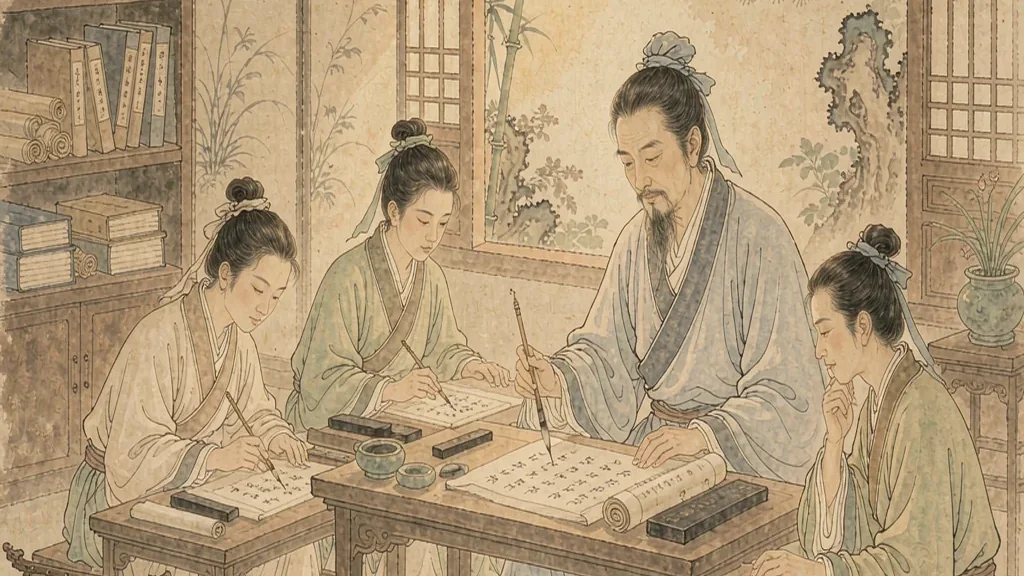
Calligraphy education in China is the long, living tradition through which the art of writing Chinese characters with a brush has been passed from one generation to the next. Far more than handwriting drills, it has historically been a core component of literacy, moral cultivation, and entry into officialdom. From the copybooks of imperial academies to the tracing sheets of village schools, and now to studios and online courses around the world, the methods of teaching brush writing reveal how Chinese culture has balanced discipline with personal expression.
Origins in the Imperial Academy
In imperial China, the ability to write a respectable hand was inseparable from being considered educated. The state school system and the imperial academy trained candidates not only in the classics but in regular-script brush writing, because the examination essays and official memorials had to be legible and dignified. A clumsy hand could undermine an otherwise brilliant candidate.
Calligraphy instruction therefore occupied a formal place in the curriculum. Students began with the most structured scripts and only later explored freer running and cursive forms. The brush was treated as an instrument of both communication and character, and the teacher's approval of a student's writing carried real social weight.
The Private Academy and Tutorial Tradition
Beyond the state system, private academies and family tutoring formed the backbone of everyday instruction. A respected local scholar might take on a handful of boys, and later girls in some households, guiding them through the basic strokes before any longer text. The relationship between master and pupil was personal and often lifelong.
This tutorial model allowed regional styles to survive. A student in one province might learn a squared, upright manner associated with a local stele, while another absorbed the flowing habits of a favorite model. The diversity of Chinese calligraphy owes much to these intimate, place-based transmissions.
Copying and Tracing Methods
The single most enduring method of learning is model copying. The beginner first traces over a printed or carved character with red guidelines, a practice called tracing the red. Once the hand is steady, the student moves to freehand copying beside or beneath a model, training eye and wrist together.
Two broad approaches developed: rubbing-based models taken from stone inscriptions, and ink-trace models reproducing a master's original strokes. Each trained different skills. Rubbings taught structure and monumentality; ink traces taught the living rhythm of the brush. Good teachers insisted on both.
The Role of the Teacher
In the traditional view, the teacher did more than correct strokes. The instructor demonstrated posture, breath, and the angle of the brush, then watched the student write and offered immediate correction. A single misplaced comment could fix a habit or, poorly put, entrench one.
Because calligraphy was linked to self-cultivation, teachers also used it to discuss patience, restraint, and respect. The famous saying that the brush reveals the person meant that instruction was implicitly moral as well as technical, and many students remembered their first teacher's words for decades.
Children's Brush Practice
Young learners typically started with grid sheets. The nine-grid and rice-grid frameworks helped position each stroke within the invisible architecture of a character. Large characters were practiced first, because controlling a big movement builds the foundation for smaller, finer writing later.
Parents valued early practice not only for school success but for temperament. The quiet concentration required to fill a grid neatly was believed to calm restless children. In many households the morning brush lesson was a fixed ritual, and progress was measured by the stack of sheets produced each week.
The Examination System and Calligraphy
For centuries the civil service examinations made neat, confident regular-script writing practically mandatory. Candidates who could produce a clean, uniform hand held a real advantage, since graders worked through enormous numbers of papers and favored clarity.
This pressure produced both excellence and rigidity. Some examination hands became so stylized that critics complained they valued surface polish over spirit. Yet the system also guaranteed that calligraphy remained a mass skill rather than a rarefied one, because so many families had a direct stake in it.
Materials as the First Lesson
No student could begin without the brush, ink, paper, and ink stone, together honored as the four treasures of the study. Learning to grind ink slowly, to judge the right water ratio, and to care for a soft brush was itself a lesson in patience and respect for tools.
Teachers used the preparation of materials to slow the student down before the first stroke. A child who rushed the ink grinding was likely to rush the writing too. Mastery of the implements was considered the prerequisite, not the obstacle, to mastery of the line.
Regional Styles and Their Transmission
China's vast geography bred distinct local habits of writing, often tied to a revered regional master or a famous local inscription. A southern student might grow up imitating a graceful, slightly slanted running script, while a northern student worked on the bold, squared manner of frontier steles.
These lineages were preserved through teacher-to-student chains and through the local copybooks printed or carved in each area. Even as transportation and printing spread models more widely, regional accents in brushwork persisted well into the modern period.
Calligraphy as Self-Cultivation
Perhaps the deepest aim of traditional instruction was not production of beautiful scrolls but formation of the person. Daily writing was a form of quiet discipline, a way to train attention and composure that paralleled meditation or seated meditation practices.
Many literati kept a lifelong habit of morning practice, not to exhibit but to steady themselves. The education system thus framed calligraphy less as an art elective and more as a daily ethical exercise, a view that still shapes how the art is taught by traditional-minded instructors today.
Modern School Instruction
In the twentieth century, with the spread of the ballpoint pen and later the computer, formal brush training largely left the ordinary classroom. It survived in dedicated art classes, children's weekend studios, and the homes of enthusiasts who feared the skill would vanish.
Today many primary schools offer optional brush calligraphy clubs, and textbooks present the standard scripts with grid practice. The tone has shifted from obligation to heritage, but the core method, copy the model, then write freely, remains strikingly close to that of a thousand years ago.
The Global Classroom Today
Chinese calligraphy is now taught on every continent, in university departments, community centers, and online video channels. Learners who do not speak Chinese often begin with stroke order and balance, discovering that the art opens a door into the language and philosophy at the same time.
This globalization has sparked debate about authenticity and adaptation, yet it has also kept the tradition vibrant. The same tracing sheets and model copies that trained imperial exam candidates now guide students in cities far from China, a remarkably continuous chain of teaching.
❓ Frequently Asked Questions
Why was calligraphy so important in imperial education?
Because official writing had to be legible and dignified, and examination essays were judged partly on the hand. Good brush writing signaled that a candidate was properly educated and disciplined.
What is the difference between tracing and copying?
Tracing means writing over red guideline characters to learn shape, while freehand copying means reproducing a model beside it, which trains the eye and wrist together.
At what age do Chinese children usually start?
Historically very young, often in early childhood, beginning with large characters and grid sheets before moving to smaller, freer work.
Do students still learn calligraphy in school?
Formal daily practice mostly left ordinary classrooms in the modern era, but many schools offer optional clubs and heritage classes using the same copybook methods.
What are the four treasures of the study?
They are the brush, ink stick, paper, and ink stone, the basic implements every student learned to prepare and care for.
Is calligraphy taught outside China now?
Yes, it is taught in universities, community centers, and online courses worldwide, often as a route into Chinese language and culture.