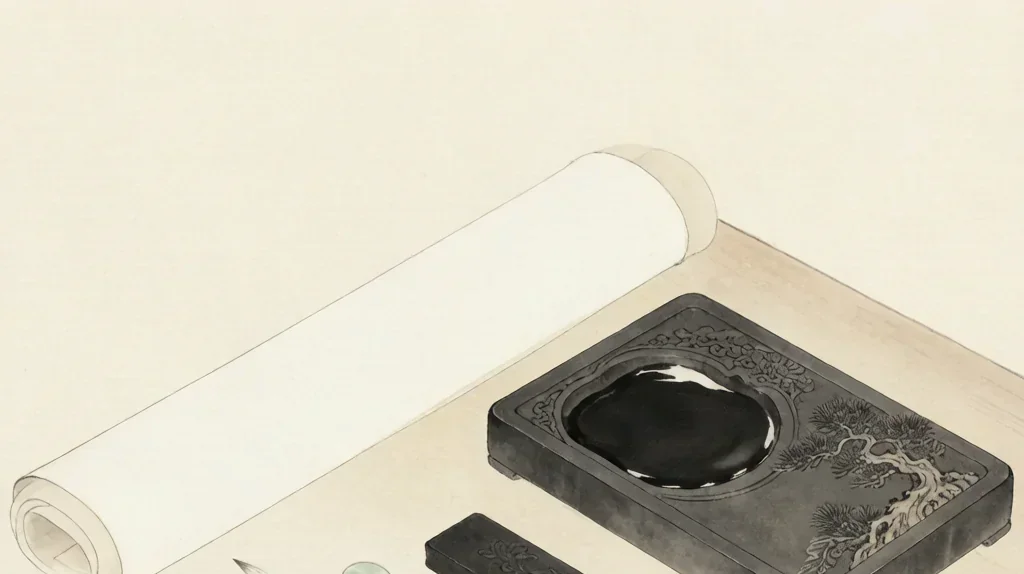
No calligrapher works with a pen. The Chinese tradition depends instead on a small set of hand-made implements whose quality can decide the fate of a stroke. Collectively these are the Four Treasures of the Study (文房四宝, wén fáng sì bǎo): the brush (笔, bǐ), ink (墨, mò), paper (纸, zhǐ), and inkstone (砚, yàn). For a thousand years a scholar's desk was judged by them, and the finest examples from famous workshops were treasured, gifted, and passed down like heirlooms. To understand the art, one must first understand its tools.
The Brush (Bi 笔)
The brush (笔, bǐ) is the most personal of the four treasures. At its heart is a tapered tuft of animal hair set into a handle of bamboo, wood, porcelain, or lacquered horn. The hair determines the character of the line. Goat hair (羊毫, yáng háo) is soft and holds a great deal of ink, producing rounded, warm strokes good for large characters and painting. Weasel or martin hair (狼毫, láng háo, though "wolf" here is a misnomer for the yellow weasel) is stiff and springy, giving crisp, precise lines favored for small regular script. The finest brushes blend the two so the tip stays sharp yet the belly stays full.
The making of a brush is itself a craft. Hairs are sorted by length and taper, aligned so the tips meet in a single point, bound with thread, and fixed with lacquer before being seated in the handle. A well-made brush is said to have four virtues: 尖 (jiān, a sharp tip), 齐 (qí, an even edge when spread), 圆 (yuán, a rounded belly), and 健 (jiàn, resilience). The term "four treasures" for these implements is recorded as early as the Southern Tang (937–975), when the court named the best brush from Anhui's Xuancheng, the best ink from Huizhou, the best paper from Shezhou, and the best inkstone from Wuyuan.
Because the brush is flexible in every direction, control comes from the wrist and the breath, not from a rigid nib. A beginner learns to keep the tip centered (中锋, zhōng fēng) within the stroke, a discipline that takes years. The brush, more than any other tool, is why Chinese writing became an art rather than a mere notation.
Ink (Mo 墨)
In the age before bottled ink, a writer began not by uncapping a pen but by making ink. Ink (墨, mò) came as a solid stick or cake, usually a rectangle molded with a maker's mark and often decorated with gold designs. The body was made from soot—pine soot (松烟, sōng yān) for a deep, matte black, or lacquer or oil soot (油烟, yóu yān) for a shinier, bluer tone—bound with animal glue and pressed in a mold. Some costly sticks included musk or herbs for fragrance.
To use it, the calligrapher placed a few drops of water in the inkstone's well and ground the stick in slow circles, adding water as needed, until the liquid was dense enough that a drop held its shape. Grinding was a meditative prelude to writing; it settled the mind and set the pace of the session. The resulting ink, once dried on paper, is remarkably stable: works from the Tang and Song still show crisp black lines more than a millennium later.
The inkstick centers of Huizhou in Anhui (徽墨, Huī mò) and, later, Shanghai's Cao Sugong (曹素功, Cáo Sùgōng) workshop became legendary. A fine stick was as much a collector's object as a writing supply, and emperors commissioned inscribed commemorative cakes. Liquid ink (墨汁, mò zhī) in bottles appeared only in the modern period and is convenient but considered by purists to lack the depth of ground ink.
Paper (Zhi 纸)
Paper (纸, zhǐ) was a Chinese invention, attributed in tradition to Cai Lun (蔡伦, Cài Lún) at the Han court around 105 CE, though earlier paper fragments survive from the 2nd century BCE. For calligraphy the supreme material is xuan paper (宣纸, xuān zhǐ), named for Xuanzhou in Anhui where it was perfected. Its base fiber is the bark of the blue sandalwood tree (青檀, qīng tán), often blended with rice straw, beaten and laid by hand into thin, tough sheets.
What makes xuan paper special is its "rice responsiveness" (晕染, yùn rǎn): it drinks ink and lets it spread in graded tones, so a single stroke can show light and dark within itself, and a dry brush can leave "flying white" (飞白, fēi bái) streaks. It is also extraordinarily durable—properly stored, it resists insects and yellowing for centuries, which is why so many old masterpieces survive. Paper is further classed as 生宣 (shēng xuān, raw, highly absorbent) for free running and cursive styles, and 熟宣 (shú xuān, sized with alum to slow absorption) for fine regular script and detailed painting.
Other famous papers include the tough, golden-toned 麻纸 (má zhǐ, hemp paper) of the Tang, the 楮纸 (chǔ zhǐ) made from paper mulberry in Sichuan, and the decorative 薛涛笺 (Xuē Tāo jiān) tinted letter papers associated with the Tang poetess Xue Tao. The choice of paper shapes the whole feel of a work, so a serious writer keeps several kinds on hand.
The Inkstone (Yan 砚)
The inkstone (砚, yàn) is the one treasure that does not wear out; a good stone can serve several generations. It is a flat slab, usually with a shallow depression or well to hold water and a flat area for grinding. The ideal stone is fine-grained and slightly "thirsty"—it holds a little moisture so the ink does not dry too fast, yet is hard enough to grind smoothly without scratching the ink stick or shedding grit that would ruin the brush.
Two stones dominate the tradition. Duan inkstones (端砚, Duān yàn) come from Zhaoqing in Guangdong and are famous for a warm, purple-tinged stone with natural "eyes" (石眼, shí yǎn), spots prized as beauty marks. She inkstones (歙砚, Shè yàn) come from Wuyuan in Jiangxi (historically Anhui) and are admired for a silvery, finely textured stone with shimmering threads. Both have been quarried and carved since the Tang dynasty, and the best become sculptural objects in their own right, with landscapes or dragons worked into the unused areas.
Care of an inkstone is a small ritual. One should rinse it promptly after use and never leave ink to harden in the well, lest the surface roughen. A well-kept stone develops a gentle patina and, connoisseurs say, grinds ink more sweetly with age. For the scholar, the inkstone was the anchor of the desk—the quiet tool that made all the others work.
Beyond the Four
The four treasures are only the core of a working desk. Around them gathered a host of lesser implements, sometimes called the "gentleman's companions." The 水盂 (shuǐ yǔ) is a small water pitcher for sprinkling the inkstone; the 笔洗 (bǐ xǐ) a bowl for rinsing the brush; the 笔架 (bǐ jià) a rest shaped like a mountain to hold a wet brush; the 镇纸 (zhèn zhǐ) a paperweight, often a pair of carved bronzes or stones, to keep the sheet flat; and the 印章 (yìn zhāng), a personal seal in stone or jade, pressed in red cinnabar paste to sign a finished work.
Seals deserve a special note. A calligraphy scroll is not complete until the artist stamps it with a name seal (姓名章, xìng míng zhāng) and often a leisure seal (闲章, xián zhāng) carrying a favorite phrase. The red of the seal against black ink and white paper is the classic closing chord of a Chinese work on paper, tying the maker's identity to the moment of creation.
Together, the four treasures and their companions describe a whole way of working—slow, deliberate, and deeply material. To sit at a scholar's desk was to enter a small world of hand-made objects, each chosen with care, none of which could be hurried. That patience is part of what the brush finally records.