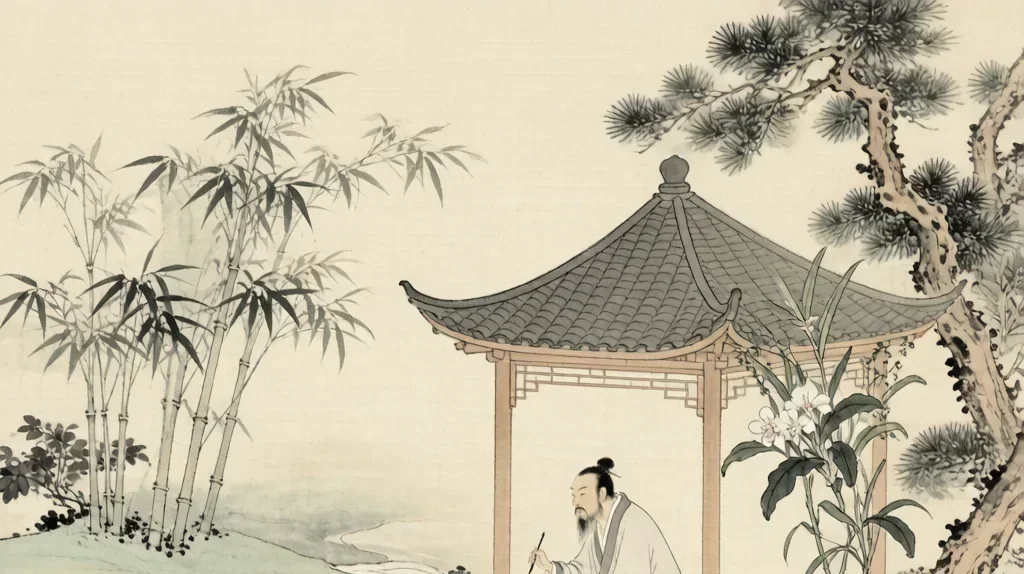
No single name is more revered in Chinese calligraphy than Wang Xizhi (王羲之, Wáng Xīzhī). A gentleman of the Eastern Jin dynasty, he earned the title Sage of Calligraphy (书圣, shū shèng), a honor given to no other. His reputation rests above all on one short manuscript written in a single sitting in the year 353 CE—the Orchid Pavilion Preface (兰亭序, Lán Tíng Xù). Small, informal, and seemingly casual, it has been studied, copied, and worshipped for seventeen centuries as the supreme model of running script.
The Sage of Calligraphy
Wang Xizhi was born around 303 CE in Langya (琅邪, Lángyá), in what is now Shandong province, into one of the great aristocratic clans that had fled north to the Yangtze region when the Western Jin collapsed. The Wang family was celebrated for its learning, and calligraphy was a family craft: his uncle Wang Dao (王导, Wáng Dǎo) was himself a noted writer of the brush. From childhood Wang showed an unusual feel for the art, practicing so diligently that legend says he wore a pool hollow with the water he used to rinse his brushes.
He held minor official posts, including governor of Kuaiji (会稽, Kuàijī), but he preferred the company of mountains, friends, and wine to the routines of administration. By his own account he was awkward in conversation yet at ease with a brush. What set his work apart was a quality the Chinese call 自然 (zì rán, "self-so"), an appearance of having been done without effort or artifice. Later critics contrasted his ease with the stricter, more contrived manner of earlier masters.
His influence was sealed by imperial taste. The Tang emperor Taizong (唐太宗, Táng Tàizōng, r. 626–649) became a devoted admirer, commissioning the finest copyists of the realm to reproduce Wang's works and writing a lengthy tribute to him. Because what the court honored, the educated class imitated, Wang's style became the orthodox standard for more than a thousand years of Chinese writing.
The Orchid Pavilion Gathering (353 CE)
The work was born on a spring day—the third of the third lunar month in 353 CE—at a place called the Orchid Pavilion (兰亭, Lán Tíng), in the hills near present-day Shaoxing in Zhejiang. Wang Xizhi, then in his early fifties, hosted a 修禊 (xiū xì) ceremony, a traditional riverside purification rite held at the turn of spring. More than forty guests, among them relatives and literary friends, gathered to enjoy the breeze, the flowing water, and the young orchids.
The centerpiece of the entertainment was the game of 曲水流觞 (qū shuǐ liú shāng, "winding water and floating cups"). A wine cup was set adrift in a narrow channel of spring water; where it came to rest, the guest seated there was obliged to compose a poem, or drink a forfeit cup of wine. Of the company, twenty-six men managed verses. The day produced some thirty-seven poems, and Wang was asked to write a preface binding the collection together.
He took up his brush, slightly warmed by wine, and wrote the preface in one continuous outpouring. What began as a polite introduction to a poetry album became, almost by accident, the most famous single work in the history of Chinese writing. The setting—clear stream, tall bamboo, a gathering of cultivated friends—was woven into the text itself, so that the place and the page have never been separated in memory.
The Preface Itself
The Orchid Pavilion Preface runs to only 324 characters in 28 lines, yet it moves through several moods. It opens with a bright description of the scene: "Here are lofty mountains and majestic peaks, thick forests and tall bamboo, and a clear stream, bright and swift." Wang evokes the pleasure of sitting beside the water, drinking, and listening to the lute of the wind. The tone is relaxed, almost playful.
Then, midway, the mood darkens. Contemplating the gathered friends, Wang reflects that "what one delights in during the morning may be discarded by evening," and that life is brief and death certain. He mourns how later readers will look back on this very day as already past. This turn from joy to melancholy, from the particular spring afternoon to the universal fact of mortality, is what gives the piece its depth. It is not a display of skill but a record of a mind thinking.
Stylistically, the preface shows running script (行书, xíng shū) at its most supple. Characters vary in size and lean; some strokes connect, others lift and pause. Wang reportedly repeated certain characters—the word 之 (zhī, "of") appears more than twenty times—and gave each a different shape, a feat generations of students have pored over. The variety within unity is exactly the quality later writers tried, and mostly failed, to imitate.
"A Copy Beyond the Original"
A famous story tells that the next morning Wang Xizhi looked at his preface and, pleased, tried to make a cleaner copy. He wrote it again and again—dozens of times—but none matched the first. The wine-loosened, unrepeatable inspiration of that afternoon could not be summoned by will. The original, he conceded, was a gift of the moment, and "a copy could not surpass the original" because the original was already unrepeatable.
The fate of the true original is itself a legend. The Tang emperor Taizong so desired the Lán Tíng Xù that, according to later accounts, he obtained it through a monk and, at his death, had it buried in his tomb (昭陵, Zhāo Líng) so that no one else could possess it. Whether or not that story is exact, no autograph by Wang Xizhi survives anywhere today. Everything we know of his hand comes from traced copies (摹本, mó běn) made by pressing thin paper over the original and carefully following each line, and from engraved stone rubbings (拓本, tà běn).
The most admired surviving copy is the "Shenlong" version (神龙本, Shénlóng běn), attributed to the Tang copyist Feng Chengsu (冯承素, Féng Chéngsù), which preserves the liveliness of Wang's line rather than merely its shape. For students, these copies are not second-best stand-ins but the very texts through which the Sage's spirit has been handed down.
Legacy and Reverence
The reverence for Wang Xizhi shaped Chinese art for millennia. The Orchid Pavilion Preface became the first text every serious student of running script copied; emperors inscribed its lines on palace walls, and painters made the "Orchid Pavilion gathering" a recurring subject of handscrolls. To know calligraphy was, in large part, to know this one preface by heart.
His descendants carried the art forward, most famously his son Wang Xianzhi (王献之, Wáng Xiànzhī, 344–386), whose freer, more cursive manner formed a complementary school. Together the father and son are spoken of as the "Two Wangs" (二王, èr Wáng), the joint fountainhead of the classical tradition. Even today, a child learning to write is quietly joining a line that runs straight back to that spring day by the stream.
In the end, Wang Xizhi's greatness lies in a paradox he would have appreciated: the most admired work in Chinese calligraphy was never meant to be a masterpiece at all. It was a thank-you note to friends, written once, and never improved. That it became eternal is the truest proof of the art he perfected—where the trace of a moment, honestly made, outlives every monument of stone.