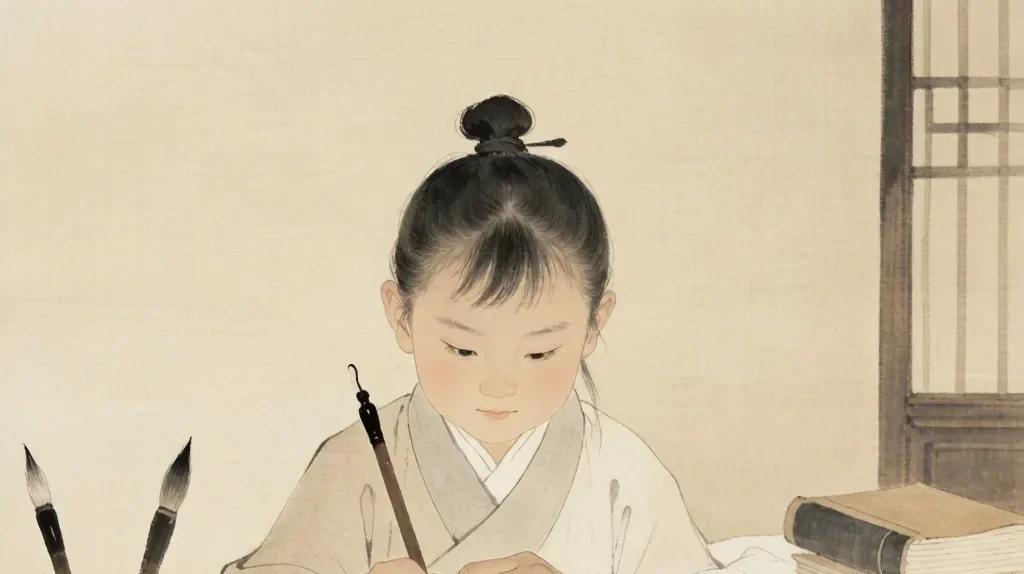
If a Chinese child learns to write by copying one of a handful of historical hands, that hand almost certainly belongs to one of the Four Masters of Regular Script (楷书四家, kǎi shū sì jiā). The group—Ouyang Xun, Yan Zhenqing, Liu Gongquan, and Zhao Mengfu—spans six centuries from the Tang to the Yuan dynasty. Between them they fixed the forms of the square, upright characters still used today, and each left a personal style so distinctive that a trained eye can name the master from a single stroke. Their works are less four men's handwriting than the shared alphabet of Chinese refinement.
What Is Regular Script?
Regular script (楷书, kǎi shū), often called "standard script" or "true script," is the upright, squared form of Chinese writing taught in every classroom. It evolved from clerical script (隶书, lì shū) during the Wei-Jin period (220–420 CE) as writers sought a clearer, more regular alternative to the flat, wide official style. By the early Tang dynasty the form had stabilized: strokes are written in a fixed order, each has a defined start and stop, and the character is composed within an imaginary square.
What makes regular script the foundation of learning is its transparency. Unlike cursive (草书, cǎo shū), where strokes fuse beyond recognition, or even running script (行书, xíng shū), where connections blur, regular script shows every stroke separately. The student must learn the eight basic strokes and their order (笔顺, bǐ shùn), because the sequence itself shapes the balance of the finished character. For this reason the great regular-script masters are the first models a beginner meets.
The script also happens to be where individual style is most exposed. Because the structure is fixed, any deviation—a thicker horizontal, a tighter waist, a more open frame—reads as a personal signature. The Four Masters are thus celebrated not for inventing the script but for pushing its fixed grid in four different directions, each a complete aesthetic world.
Ouyang Xun
Ouyang Xun (欧阳询, Ōuyáng Xún, 557–641) lived through the end of the Chen dynasty and into the early Tang, serving as a scholar and calligrapher at the court of Tang Taizong. His regular script, the "Ouyang style" (欧体, Ōu tǐ), is famous for danger and tension: characters are tall and narrow, with sharply angled strokes and dramatic contrasts of thick and thin. A famous saying describes his work as "stern as a drawn bow, perilous as a falling cliff" (险劲, xiǎn jìng).
His masterpiece is the inscribed stele 九成宫醴泉铭 (Jiǔchéng Gōng Lǐquán Míng, "The Liquan Inscription at the Jiucheng Palace"), carved in 632 to record the discovery of a sweet spring at a Tang summer palace. The stele survives, and rubbing copies of it have been a beginner's textbook for over a thousand years. Ouyang's precision and control made him the model for those who valued discipline and structural cleverness above warmth.
Notably, Ouyang Xun was also a scholar of the older scripts and helped compile a classified dictionary, the 艺文类聚 (Yìwén Lèijù). His calligraphy and his erudition together made him the first of the Tang masters to define the new dynasty's upright, learned manner.
Yan Zhenqing
Yan Zhenqing (颜真卿, Yán Zhēnqīng, 709–784) is the most beloved of the four, and the one most Chinese children copy first. A statesman and general as much as a calligrapher, he served the Tang through the An Lushan rebellion and was eventually executed for refusing to betray the court. His life of loyalty fed the reading of his brush as morally upright—a case where biography and handwriting were felt to be one.
His style, “Yan style” (颜体, Yán tǐ), deliberately broke from the slender elegance of Ouyang and the Wang Xizhi tradition. Yan built characters from thick, straight, "mantle-like" strokes (屋漏痕, wū lòu hén, "the mark of a leaking roof") with a wide, full, squared frame. The effect is monumental and weight-bearing, as if each character were a small building. Later critics said his script "used the brush as a halberd," so forceful and direct was its pressure.
His great works include the rubbings of 多宝塔碑 (Duōbǎo Tǎ Bēi, "Stele of the Many Treasures Pagoda") for learners and the solemn 祭侄文稿 (Jì Zhí Wéngǎo, "Draft Elegy for My Nephew"), written in grief after his family was killed in the rebellion. The latter, in running script, is ranked among the greatest emotional outpourings in Chinese calligraphy. Yan's robust, generous forms became the default schoolbook hand because they are clear and, crucially, forgiving to imitate.
Liu Gongquan
Liu Gongquan (柳公权, Liǔ Gōngquán, 778–865) came a generation after Yan and deliberately set himself against the master's fullness. His "Liu style" (柳体, Liǔ tǐ) is lean, bony, and sharply articulated: thin, wiry strokes cross a sparse, taut frame, giving characters a clean, almost architectural severity. The contrast gave rise to the paired phrase "Yan's flesh, Liu's bone" (颜筋柳骨, Yán jīn Liǔ gǔ)—Yan the full-bodied, Liu the clean-limbed.
Liu was a court calligrapher who inscribed steles for emperors and was once asked the secret of good writing. He answered that the brush is upright only when the mind is upright (心正则笔正, xīn zhèng zé bǐ zhèng), turning a technical question into a lesson in conduct—a story that sealed his reputation as a moralist of the brush. His most studied stele is the 玄秘塔碑 (Xuánmì Tǎ Bēi, "Stele of the Mysterious Pagoda"), a model of disciplined, knife-clean regular script.
Together, Yan and Liu bracket the Tang achievement in regular script: one opening the form outward into weight and warmth, the other tightening it into precision and restraint. A student who masters both has learned the full range of the standard hand.
Zhao Mengfu
Zhao Mengfu (赵孟頫, Zhào Mèngfǔ, 1254–1322) stands apart as the only master outside the Tang, living under the Mongol Yuan dynasty. A descendant of the Song imperial family, he was persuaded to serve the new rulers, a choice that drew some criticism but also let him become the age's great arbiters of taste. He was a painter, poet, and seal-carver as well as calligrapher, the archetype of the later literatus (文人, wén rén).
Zhao led a conscious revival of the classical manner of Wang Xizhi after centuries in which regular script had hardened into monumentality. His "Zhao style" (赵体, Zhào tǐ) is rounded, fluent, and graceful, with a gentle, even flow that feels closer to running script than to the carved severity of steles. He insisted that calligraphy and painting share one principle—that both are governed by the moving line—and his soft, musical regularity became the refined standard of the Ming and Qing.
His surviving works, such as the 胆巴碑 (Dǎnbā Bēi) and many letters, show a man deliberately easing the stiffness of his predecessors. Where Ouyang was perilous, Yan massive, and Liu bony, Zhao is lithe. The four together map the possibilities of the square character, from tension to warmth to severity to grace.
The Enduring Model
The Four Masters are more than a list; they form a curriculum. A traditional education moved a child from Yan's sturdy clarity to Liu's discipline, then to Ouyang's precision, and finally, for the gifted, to Zhao's fluent elegance. Each master left inscribed steles whose rubbings (拓本, tà běn) were printed and sold for centuries as copybooks (字帖, zì tiè), the literal scaffolding of literacy.
Their influence reached far beyond China. Korean and Japanese calligraphers adopted the same models, and the “Yan style” in particular became the standard hand taught across East Asia. Even the printed typefaces of classical books echo these masters' proportions. In a real sense, to read Chinese in any formal context is to read the Four Masters.
What endures is not merely a set of pretty shapes but a lesson in how form carries character. The square characters these four fixed are still the ones written by a billion people; behind every clean schoolbook stroke stands a thousand-year argument about tension, weight, bone, and grace—an argument the Four Masters won so completely that we no longer notice it is there.