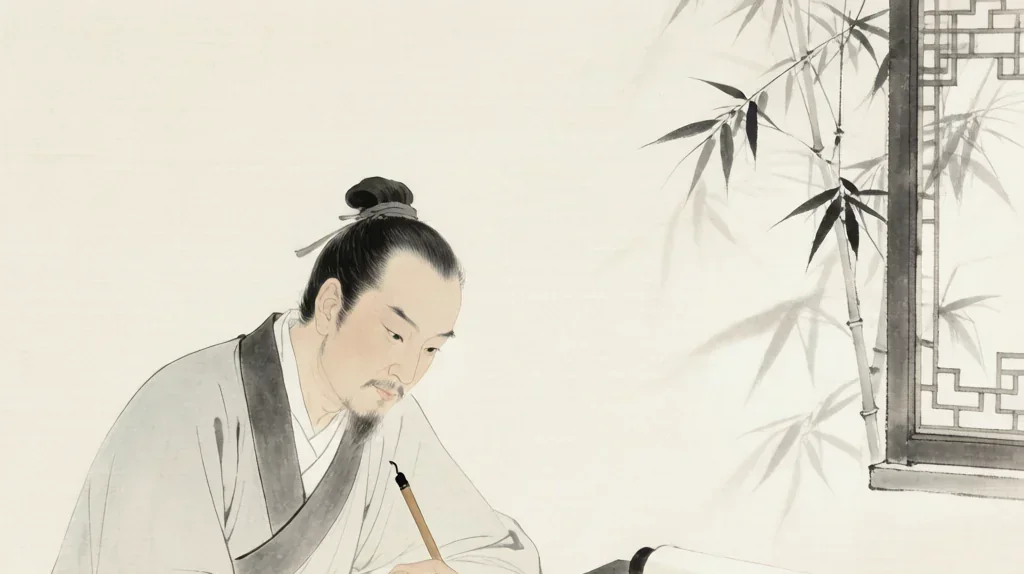
If Regular Script is calligraphy standing at attention and Grass Script is it sprinting flat out, then Running Script, or xing shu (行书, xíng shū), is the art of the walking hand — a graceful, fluid middle path that for nearly two millennia has been the default script of Chinese literate culture. The character 行 (xíng) means "to walk" or "to move," and that is precisely what the strokes do: they move, flow, and connect without breaking into the wild abbreviation of cao shu. Running Script is arguably the most treasured script in Chinese calligraphy, the style in which the greatest masterpieces of the tradition were written.
The Origins of Running Script in the Eastern Han
Like Grass Script, Running Script emerged from the practical needs of the Han bureaucracy, but it developed along a different path. While scribes who needed extreme speed pushed toward the abbreviated loops of cao shu, others wanted a script that was faster than Clerical Script (隶书, lì shū) yet remained legible to a general reader. The result was a semi-cursive script — not as formal as li shu, not as chaotic as cao shu — that the great early calligraphy theorist Liu Xizai (刘熙载, Liú Xīzài, 1813–1881) later described as "Regular Script loosened and given breath."
The traditional inventor of Running Script is Liu Desheng (刘德升, Liú Déshēng, late 2nd century CE), a calligrapher of the late Eastern Han whose works have not survived but whose name is recorded in every early history of the art. His student Zhong Yao (钟繇, Zhōng Yáo, 151–230 CE), who also perfected Regular Script, transmitted the Running Script tradition to the next generation. But it was Wang Xizhi (王羲之, Wáng Xīzhī) who raised Running Script from a convenient hand to the highest art. His "Orchid Pavilion Preface" (兰亭序, Lán Tíng Xù), written in 353 CE, is not only the most famous work of Running Script but arguably the single most celebrated piece of calligraphy in Chinese history.
The story of the Orchid Pavilion is central to Chinese calligraphy mythology. On the third day of the third lunar month, Wang Xizhi and forty-one friends gathered at the Orchid Pavilion in Shaoxing for the spring purification ritual. Wine cups were floated down a winding stream; each man was supposed to compose a poem before the cup reached him. Wang Xizhi, tipsy and inspired, wrote the preface in a spontaneous burst. The characters vary in size, angle, and density — some are large and bold, others tiny and delicate — yet the whole scroll breathes with a unified, joyful rhythm. When Wang Xizhi tried to reproduce the work sober at home, he could not. The preface, he realized, was a perfect moment that could not be recaptured.
The Golden Age: Song Dynasty Running Script
While Wang Xizhi defined Running Script, the Song dynasty (宋朝, Sòng Cháo, 960–1279 CE) was its golden age. Song literati culture placed unprecedented value on personal expression, and Running Script became the vehicle through which scholars expressed their individuality. The four great masters of Song calligraphy — Su Shi (苏轼, Sū Shì, 1037–1101), Huang Tingjian (黄庭坚, Huáng Tíngjiān, 1045–1105), Mi Fu (米芾, Mǐ Fú, 1051–1107), and Cai Xiang (蔡襄, Cài Xiāng, 1012–1067) — all excelled in xing shu, and each developed a radically different personal style within the script.
Su Shi's "Cold Food Festival Essay" (寒食帖, Hán Shí Tiē) is considered the second-greatest Running Script work ever created. Written in exile during the bitter cold of the Cold Food Festival, the essay begins in a controlled, weary hand and gradually descends into larger, more agitated characters as Su's emotions overflow the page. The character 哭 (kū, "to weep"), written near the end, spreads across three times the space of the earlier characters, a burst of anguish frozen in ink. Mi Fu, by contrast, was known for his technical brilliance and his obsession with ancient calligraphy — he once threatened to drown himself if a collector would not sell him Wang Xizhi's "Eulogy for the Nephew." Mi Fu's Running Script is sharp, angular, and full of energy, with a distinctive "side brush" (侧锋, cè fēng) technique that creates razor-edged strokes.
The Song dynasty also saw the rise of the "scholar painting" (文人画, wén rén huà) movement, which insisted that painting and calligraphy were the same art. A scholar's Running Script was supposed to reveal his character: a bold, confident hand showed an upright man, while cramped and trembling strokes betrayed a petty soul. Calligraphy was, in a very real sense, the X-ray of the scholar's spirit.
Technique: The Art of the Middle Path
The technical demands of Running Script lie precisely in its middle position. The calligrapher must maintain the structural clarity of Regular Script while incorporating the connective flow of Grass Script — but only in carefully measured doses. The key rule is that strokes within a character may connect (连笔, lián bǐ, "connecting strokes"), and characters within a phrase may link loosely, but the underlying skeleton of the character must remain recognizable. A Running Script that leans too far toward Regular Script becomes stiff; one that leans too far toward Grass Script becomes illegible.
The brush techniques of xing shu include several distinctive moves. The dai bi (带笔, "carrying brush") lightly trails the bristle between characters, leaving a thin hairline that suggests the movement of air. The zhe bi (折笔, "breaking brush") creates a sharp angular turn by folding the brush back on itself, producing a squared corner that contrasts with the surrounding curves. The zan feng (藏锋, "hidden tip") conceals the brush's entry and exit within the stroke, giving a rounded, mellow feeling. A master of Running Script varies these techniques fluidly within a single work, creating a visual rhythm that guides the reader's eye across the page.
Learning xing shu is traditionally the third stage of a calligrapher's training, after mastering kai shu (for structure) and li shu (for brush control). The standard method is to copy the classic model-books (帖, tiè) starting with Wang Xizhi's "Orchid Pavilion Preface" and Zhao Mengfu's Running Script versions of Tang poems. Students trace the outlines (摹, mó) until the hand remembers the forms, then copy freehand (临, lín) until the personal style begins to emerge. A student who has internalized a thousand characters of Running Script will find that the script eventually writes itself.
Cultural Significance and Modern Use
Running Script has served as the connective tissue of Chinese literary culture for nearly two thousand years. Almost all handwritten Chinese documents from before the twentieth century — letters, essays, poems, official memoranda, and even some stone inscriptions — were written in some form of xing shu. It was the script of everyday civilization, the hand in which friends corresponded, in which poets composed their drafts, and in which the great novels of the Ming and Qing were copied by hand for circulation.
In modern times, Running Script retains its prestige. It is taught in calligraphy schools worldwide and remains the most popular script for personal calligraphic expression. The "Semi-cursive Script" typefaces in Chinese word processors are derived from xing shu, and many Chinese people develop a personal xing kai (行楷, running-regular) handwriting that blends the two scripts. Running Script is also the script of choice for Chinese shop signs, book titles, and movie posters — it is formal enough to command respect yet alive enough to attract the eye. As the calligrapher Sun Guoting (孙过庭, Sūn Guòtíng, 646–691 CE) wrote in his "Manual of Calligraphy" (书谱, Shū Pǔ): "Running Script is the ease of Regular Script and the restraint of Grass Script — the walking hand, neither idle nor running, is the truest image of the human spirit."