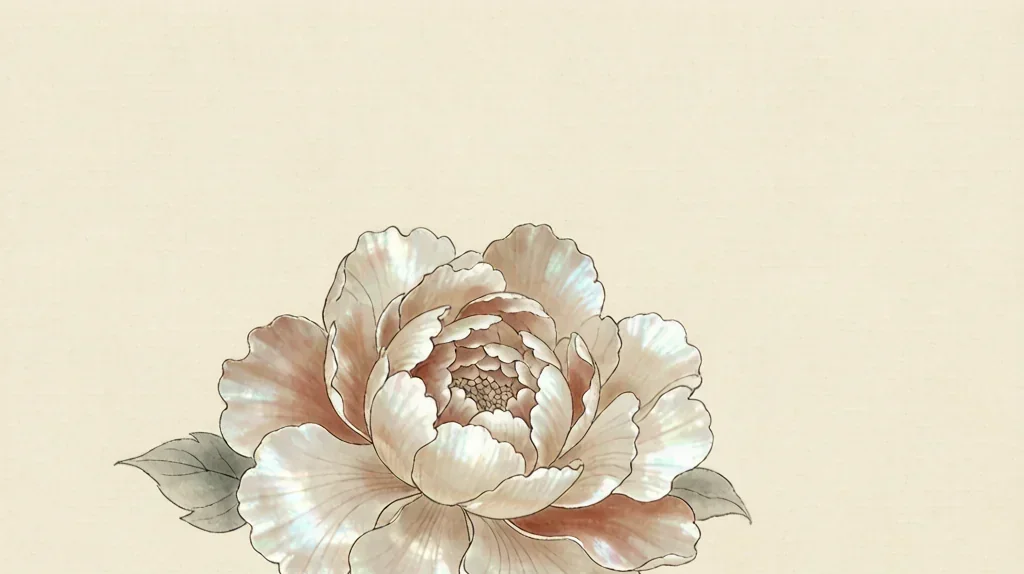
Shell carving is the Chinese decorative art of cutting, shaping, and assembling seashell and mother-of-pearl into pictures, inlay, and small reliefs. Ranging from tiny carved conch figures to grand screens inlaid with iridescent shell, the craft draws on China's long coastline and its taste for luminous, layered surfaces. Often called luodian or mother-of-pearl inlay when set into lacquer or wood, shell work turns a humble beach find into shimmering art. The appeal of the craft lies in a paradox: the raw material is a discarded husk, dull on the outside, yet within it hides a lining that flashes every color of the sea, and the carver's task is to free that hidden light and fix it into a picture. Because the sheen changes with every angle, a shell-carving is never the same object twice, and this restless, living quality is exactly what has kept the art in favor for more than a thousand years.
What Shell Carving Covers
The term spans two related practices: carving individual shells into small sculptural forms, and cutting thin mother-of-pearl pieces to inlay pictures into lacquer, wood, or furniture. Both exploit the shell's color and sheen, but one builds up, the other sets in, and the two meet in many finished objects.
The iridescence — shifting blues, greens, and pinks across the surface — is the material's special gift and the carver's main challenge. The challenge is that the color cannot be chosen or fixed by the maker; it is given by nature and revealed only when the light is right, so the artist works with a partner that refuses to sit still.
This duality means shell carving is as much about placement as about cutting. A piece of nacre that glows in one spot may go dull in another, so the maker must plan the whole composition around the behavior of light, turning what looks like a limitation into the very soul of the design.
Historical Background
Mother-of-pearl inlay has a long Chinese history, used on lacquerware and furniture for centuries and reaching refined heights in imperial workshops. Coastal regions with shell access naturally developed local versions, and the craft spread inland along the trade in luxury goods.
By the Qing, shell-inlaid screens and boxes were prized exports, admired abroad for their glow. European and Middle Eastern collectors prized Chinese luodian as a near-magical material, and the inlay travelled the same routes as porcelain, carrying Chinese taste into foreign homes.
The technique also fed architecture. Shell inlay appeared on lattice, on small architectural panels, and on the fittings of fine rooms, so the art was not confined to the object but entered the space, scattering points of light across a dark interior like stars across a night ceiling.
Materials: Shell and Mother-of-Pearl
Artisans use many shells — conch, trochus, and especially the inner layer of pearl oysters, whose nacre gives the familiar rainbow sheen. The choice of shell sets the palette of the finished piece, since each species flashes a slightly different range of color.
Different shells read warm or cool, so a skilled maker mixes them like a painter mixing pigments, though the "pigments" are fixed by nature. A conch may give cream and gold, a trochus green and blue, and the carver composes by selecting rather than by blending, choosing the right sliver for the right petal.
The nacre layer is thin, which is why inlay cuts it into flakes rather than carving it in the round. This thinness is both the opportunity and the difficulty: the flake is light and luminous, but it is also fragile and must be set with care so it does not lift or crack in the ground.
Techniques of Inlay
For inlay, thin shell is sawn or ground to shape, then set into a prepared ground of lacquer or wood so its surface sits flush. Fine work cuts the shell to follow a drawn design line by line, and the fit must be exact or the picture breaks at the seams.
Some pieces add carving on the shell itself to suggest texture, while others rely on the sheen alone against a dark lacquer field. The carved shell catches light differently from the flat, adding a second layer of relief to the color, so the best inlay is both picture and low sculpture.
Adhesives and abrasives matter more than they sound. Holding a fragile flake flush while the ground cures, then polishing the whole surface so shell and lacquer read as one, is a test of patience, and a poor polish leaves a step that the eye reads as a flaw even when the design is perfect.
Carved Shell Sculpture
Beyond inlay, whole or joined shells are carved into figures, miniature landscapes, and vessels. A large conch might become a peach or a mythical beast with a little cutting and polishing, and the shell's own spiral becomes part of the form rather than something to hide.
These small sculptures suit the scholar's shelf and the tourist's keepsake alike, bridging folk and fine craft. A carved shell fruit is at once a toy and a token of the sea, and the same object can please a child and a connoisseur for different reasons.
The folk side is strong. Coastal carvers have long made small shell novelties for pilgrims and visitors, and this popular trade kept the hand skills alive even when imperial patronage waned, so the art's survival owes something to the beach stall as well as the palace.
Subjects and Imagery
Typical images are flowers, birds, figures, and pavilions, rendered in shell against black lacquer so the inlay glows. Scenes often echo literati painting, condensed into glinting fragments, and the dark ground is what lets the shell speak.
The dark ground is essential: it makes the shell's light read as light, the way night makes a lantern bright. Without the black field the iridescence scatters and weakens, so the maker's first decision is the ground, and only then the picture that will ride upon it.
Figures and flowers dominate because they suit the medium's small scale. A single peony in shell, a pair of birds, a tiny pavilion by a lake — these read clearly even when the pieces are millimeters across, and the restraint matches the intimate scale of the objects that carry them.
Relation to Lacquer and Furniture
Shell carving is closely tied to lacquerware, since mother-of-pearl is most often set in lacquer. It also decorates screens, chests, and boxes, linking it to woodcarving and furniture arts, and a single piece may belong to several categories at once.
This overlap means a single object may be "lacquerware" to one catalog and "shell carving" to another — the crafts are entangled. The classification matters less than the making, because the same workshop might build the lacquer, cut the wood, and set the shell, treating the arts as one continuous skill.
The furniture connection is practical. Chests and screens needed decoration that could survive handling and cleaning, and shell inlay, once polished flush, met that need better than surface painting, so the craft found a steady home in the domestic interior rather than only on the shelf.
Regional Centers
Coastal provinces with shell resources and lacquer traditions became known for the art, and certain cities developed reputations for fine inlay. Local shell types shaped each center's look, so that a southern coastal town might favor warm gold shells while a warmer-water center favored green.
Today demonstration workshops keep the methods visible, and coastal museums show historic shell-inlaid pieces. The regional identities persist in teaching lineages, and a trained eye can often place a screen by its palette and its cuttings, much as with celadon or lacquer.
Tourism has reshaped the map. Where imperial workshops once set the standard, today coastal towns market shell carving to visitors, and the pressure to produce quickly can threaten the slow, careful inlay that made the art famous, a tension familiar across Chinese heritage crafts.
Modern Practice and Heritage
Shell carving continues as a regional craft and heritage art, with artisans making screens, jewelry, and souvenirs. Modern abrasives and adhesives help, but cutting thin shell cleanly still tests skill, and the fundamental difficulty has not changed with the tools.
Contemporary makers also experiment with freestanding shell sculpture, extending the old beach-material tradition in new directions. Some treat shell as a fine-art medium, building large panels that use the sheen as a painter uses color, proving the craft can grow beyond the souvenir stall.
Conservation of old pieces is a growing field. Shell inlay on antique lacquer can lift or darken, and restorers must clean without destroying the glue or the flake, so the preservation of historic luodian is itself a specialist skill passed among conservators and inheritors alike.
Appreciating Shell Work
View shell carving in shifting light: the picture changes as you move, because the sheen depends on angle. A good piece is never the same twice, and the patient viewer who walks around it is rewarded with a slow cycle of color that no photograph can capture.
Notice how the maker used the shell's natural edges and tints, turning a fixed material into a living, changeable image. The art's humility is its strength: it takes what the sea throws away and returns it as light, and in doing so it teaches that beauty often hides in what we overlook.
In the end shell carving is an art of patience with light. It cannot command the color, only court it, and the finest pieces are those where the maker has arranged the shell so that, from the right angle at the right moment, the whole picture seems to breathe in the colors of the ocean that gave it birth.
❓ Frequently Asked Questions
What is Chinese shell carving?
It is the art of carving seashells and inlaying mother-of-pearl into lacquer, wood, or furniture to make glowing pictures.
What is luodian?
Luodian is mother-of-pearl inlay, the practice of setting thin shell pieces into a ground to form a picture that shimmers with angle.
Why does it shimmer?
The inner nacre layer of certain shells reflects light in shifting colors that change with viewing angle and cannot be fixed by the maker.
What is it used for?
Screens, boxes, furniture, jewelry, and small sculptures, often with flower and figure scenes on a dark ground.
How is it related to lacquerware?
Shell is most often inlaid into lacquer, so the two crafts are closely linked and often made in the same workshop.
Is shell carving still made?
Yes; it continues as a regional heritage craft, with workshops making screens, souvenirs, and new freestanding sculpture.