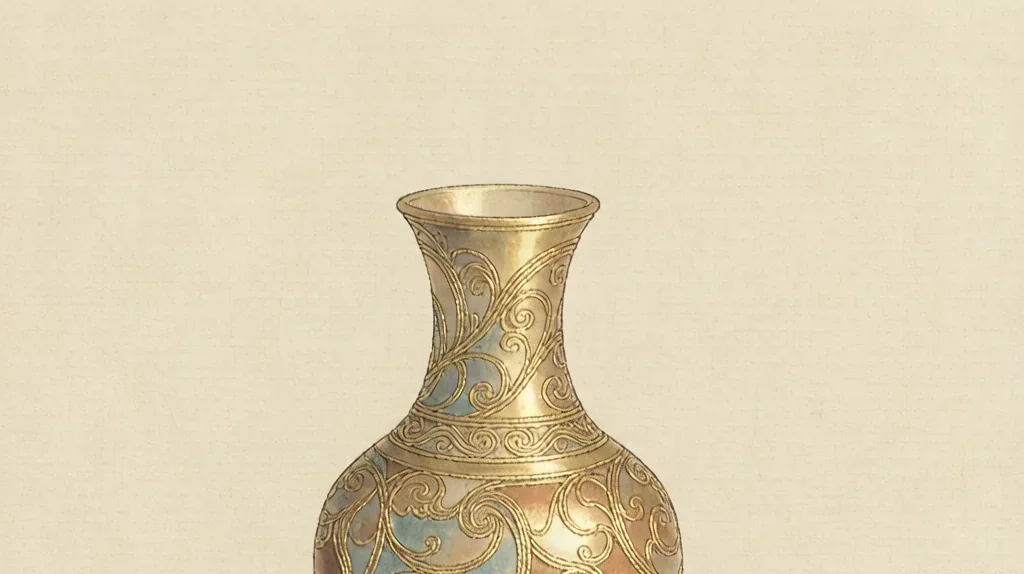
Gold filigree, known in China as huasi or huasi qianqian, is the craft of shaping fine gold (and sometimes silver) wire into scrolls, meshes, and frames that are then built into jewelry, ornaments, and imperial regalia. Often combined with granulation and set with kingfisher feathers, coral, or gems, the art reached its height in the workshops of the Ming and Qing courts. It is prized for an airy lightness that belies the metal's density, turning gold into lace that can be worn, displayed, or bestowed as a mark of favor. The craft sits at the meeting point of goldsmithing, jewelry, and miniature architecture, since the same techniques that make a hairpin can also make a tiny pagoda, and the same patient wire-work that pleases the eye also demonstrates the maker's control over the most obedient and the most stubborn of precious metals.
What Filigree Means
Filigree is built from thin drawn wires, not from a solid sheet. The craftsman pulls gold through successively finer holes to make hair-like strands, then bends, twists, and solders them into patterns. The result is openwork that catches light from every angle, so the metal seems to dissolve into pattern and the pattern seems to float.
Because the form is mostly empty space held together by wire, filigree looks delicate yet can be structurally sound when well made. The open structure also keeps the piece light on the head or the wrist, which is why filigree suited hair ornaments and earrings better than solid cast gold ever could.
The word itself points to the method: "filigree" descends from Latin threads, and the Chinese huasi, "flower wire," captures the same idea of wire bent into floral and scrolling shapes. In both languages the name describes not the metal but what is done to it.
Historical Development
Chinese goldsmiths worked wire and granulation in antiquity, but filigree as a refined court art flourished under the Ming and Qing. Imperial workshops employed specialists to produce headdresses, belt ornaments, and ritual items for the palace, and the craft's finest period coincides with the great age of imperial patronage of the decorative arts.
The craft also traveled along trade routes, absorbing influences while feeding a taste for intricate metalwork across Eurasia. Techniques of wire drawing and granulation were shared, with local differences, from the Mediterranean to China, and objects moved as gifts and goods along the same roads that carried silk and porcelain.
Within China the art was never only courtly. Regional workshops in Beijing, Sichuan, and elsewhere developed their own schools, and the same basic methods served both a palace headdress and a bride's hairpin, so the craft had a popular as well as an imperial life.
The Drawing and Twisting of Wire
The first step is drawing: gold is pulled through a drawplate to make uniform fine wire. The wire may then be twisted with another strand to create a "rope," or flattened and curled into a spiral, and the variety of these preparations is the hidden source of the art's richness.
Consistency matters; uneven wire spoils the symmetry of a pattern, so drawplates and steady hands are central to the workshop. A single ornament may use several gauges of wire, thin for detail and thicker for the main frame, and the maker must keep each true along its whole length.
Twisting deserves attention. A two-strand twist catches light differently from a single strand, and by combining twisted and plain wires the maker builds a kind of shading, so that even a monochrome gold object reads as if it had highlights and shadows worked into the metal itself.
Techniques: Soldering and Granulation
Individual wires are joined with tiny dots of solder so the joints nearly vanish. Granulation adds minute spheres of gold to the surface, a technique shared with ancient Mediterranean and South Asian jewelry, and the spheres can be arranged in rows, clusters, or gradients to suggest texture and weight.
The best work hides its joins so completely that the pattern seems grown rather than assembled. This invisibility is the maker's highest skill, because a visible seam breaks the illusion of a single flowing line and reminds the viewer of the labor behind the grace.
Soldering at this scale demands a controlled flame and a sure eye. Too much heat melts the wire; too little leaves a cold joint that will fail. The filigree worker therefore commands fire as precisely as the wire, and the two skills together define the craft.
Filigree and Kingfisher Feather Inlay
A distinctly Chinese pairing joins gold filigree with diancui, the inlay of kingfisher feathers whose shifting blue-green rivaled enamel. The metal frame held the fragile feathers like a garden bed holds flowers, and the contrast of warm gold with cool feather made a color harmony found in few other crafts.
This combination decorated women's headdresses and court objects, though modern versions often substitute dyed materials for the protected bird's feathers. The substitution reflects both conservation law and changing taste, but the look — gold lace set with luminous blue — remains the signature of the tradition.
Diancui also shows how Chinese workshop practice mixed media without hesitation. The filigree worker was expected to understand feathers as well as wire, and the finished ornament belonged as much to the world of color as to the world of metal, blurring the line between jewelry and painting.
Subjects and Forms
Filigree ornaments take many shapes: flowers, dragons, phoenixes, butterflies, and cloud scrolls. Hairpins, earrings, and belt plaques were common, as were small boxes and miniature architectural models, and the range shows how a single technique could serve fashion, ritual, and play.
Motifs usually carried auspicious meaning — a butterfly for joy, a dragon for imperial authority, a pair of birds for conjugal harmony — so the piece was both pretty and symbolic. A bride's headdress was a small encyclopedia of good wishes rendered in gold.
The cloud scroll deserves special note. As a repeating, flowing line it is almost a self-portrait of the filigree method, since the wire naturally wants to curve, and many of the finest pieces are built almost entirely from scrolling lines that seem to have no beginning and no end.
Court Patronage and Status
Under the Qing, sumptuary rules tied certain ornaments to rank, making fine filigree a marker of status. Palace workshops set the standard, and regional centers such as Beijing and Sichuan developed their own schools, each with characteristic densities of wire and preferences of motif.
The art thus served both adornment and social display, encoding position in precious metal. The number of dragons, the use of certain colors, and the scale of a piece could all signal who wore it, so filigree was also a kind of worn law, readable by those trained to see it.
Patronage also preserved technique. Because the court paid for the most demanding work, masters could spend the years needed to train apprentices, and the knowledge passed in lines from master to student that outlasted any single dynasty's favor.
Modern Revival and Heritage
Today gold filigree is recognized as intangible cultural heritage, with master artisans teaching the slow techniques to apprentices. Contemporary jewelers adapt the style for modern wear while keeping traditional methods, and the contrast of old pattern with new form keeps the craft alive in the market.
Museums display historic pieces, and revived workshops produce both faithful replicas and new designs inspired by the old vocabulary. Some makers collaborate with fashion houses, carrying filigree onto runways while others keep to small, quiet studios where the work changes little from a century ago.
The craft's survival depends on patience as much as skill. A single ornament can take weeks, and few buyers understand the labor involved, so teaching the public to value the time is now part of the inheritor's job as much as the making itself.
Appreciating the Craft
To read a filigree piece, trace the wire: notice how a single strand becomes a flower, how open space does as much work as metal. Good filigree feels weightless and exact at once, and the closer one looks the more the apparent simplicity dissolves into calculation.
The craft rewards patience in the viewer as much as in the maker, since its finest details reveal themselves only up close. Held to the light, a well-made piece shows no seam and no hesitation, and the gold reads as a drawing made permanent rather than a metal worked into shape.
In the end filigree is a lesson in restraint. The maker had gold in abundance yet chose to use almost none of it as mass, spreading the metal into line and leaving the rest as air, so that the luxury lies not in weight but in the discipline that made the weight disappear.
❓ Frequently Asked Questions
What is Chinese gold filigree?
It is the craft of drawing fine gold wire and shaping it into openwork ornaments, often inlaid with feathers or gems, reaching its height in the Ming and Qing courts.
How is the wire made?
Gold is pulled through a drawplate with ever smaller holes to produce uniform, hair-like strands that are then twisted or curved.
What is diancui?
Diancui is kingfisher feather inlay, a blue-green decoration often set into filigree frames to contrast with the gold.
When did the art peak?
Filigree flourished as a court art under the Ming and Qing dynasties, supplied by imperial workshops and regional schools.
Is gold filigree still made?
Yes; it is protected as cultural heritage, with masters teaching the techniques and jewelers adapting them for modern wear.
Why does it look so light?
Because the form is mostly open space held by thin wire, the dense metal reads as airy lace rather than solid mass.