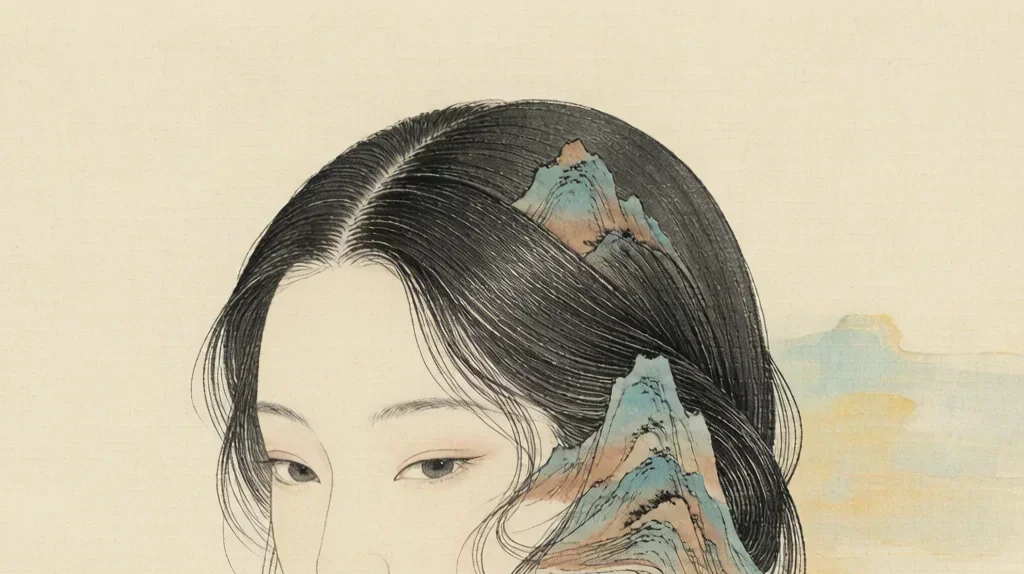
Hair embroidery, or faxiu, is a rare Chinese needlework that uses human hair as the working thread, most often on a fine silk ground. Because hair is strong, evenly tapered, and naturally glossy, it can render faces, hands, and lettering with a delicacy that silk thread cannot match. Rooted in the sericulture and embroidery culture of the Jiangnan region, the art was practiced by women who turned a personal material into portraits and devotional images of striking calm. The choice of hair was never merely practical; in a culture that taught children never to harm the hair given by their parents, offering one's own hair to an image was an act of devotion and self, so that the medium itself carried feeling before a single stitch was set. This double nature — technical and intimate — is what makes faxiu one of the most quietly moving of Chinese textile arts.
What Hair Embroidery Is
In faxiu, strands of human hair replace or supplement silk floss. The hair is cleaned, sometimes split, and worked with a fine needle to build lines and shading. Portraits and calligraphic passages gain a lifelike precision from the dark, smooth strand, which holds a contour that floss, with its slight fuzz, can only approximate.
The effect is subtle: hair does not shimmer like silk, but it holds a contour with quiet authority that suits faces and fine detail. Where silk embroidery delights in color and sheen, hair embroidery delights in line and likeness, and the two arts answer different desires in the viewer.
Because the strand is dark and uniform, the maker works largely in tone rather than hue. Shading comes from the density of stitches and the direction of the hair, so a face is built the way a draftsman builds a face, with cumulative lines rather than with paint, and the result reads as drawing more than as textile.
Historical Roots
The use of hair in needlework has old roots in China, tied to a cultural reverence for hair as a gift from parents not to be casually cut. Embroidering with one's own hair could therefore carry personal or filial meaning, and the act of cutting and offering hair transformed a private substance into a public, lasting image.
The art is most associated with the embroidery centers of the south, where silk skills were highly developed and women's studios produced refined pictorial work. Regions around Suzhou and the lower Yangtze had both the silk ground and the trained hands that faxiu required, and the craft grew where those conditions met.
Historical records and surviving pieces suggest the art was practiced from at least the Ming and Qing, often within the household rather than the shop. A daughter might embroider a parent's portrait in her own hair, or a devout woman might honor a deity with a likeness worked from her own person, and such objects were kept as family treasures.
Why Human Hair
Hair offers practical and symbolic advantages. It is finer and more uniform than many threads, resists fading, and keeps its shape. Spiritually, hair carried a sense of the person, so a portrait in the subject's own hair was deeply intimate and, in the case of a self-offering, almost a relic.
For devotional images, hair from a pious woman might be used to honor a deity or ancestor with something literally of herself. The gift was total: not gold, not silk bought in the market, but the body itself, given in patient hours of stitching that mirrored a vow.
Hair also outlasts silk. Where colored floss can fade and rot, a well-kept hair thread remains dark and whole for centuries, which is one reason the few surviving faxiu pieces still show crisp lines while contemporary silk embroideries have dulled. The material's stubbornness became part of its meaning.
Technique and Preparation
Before stitching, hair is washed and sorted, then often combined in the needle with a little silk for body. The embroiderer works on a taut silk ground, using minute stitches to follow a drawn design, and the tension of both ground and strand must be judged by feel rather than by rule.
Because hair has no give like floss, tension must be controlled so the ground does not pucker, and the strand must be handled so it does not kink. A kink shows as a sudden wrong turn in a contour, and since hair cannot be unstitched cleanly, the maker must plan each passage before the needle enters the cloth.
The needle itself is finer than usual, and the embroiderer often works under good light with the piece close. Many described the process as slower even than fine silk embroidery, because the hair demands constant attention and because a single error can spoil hours, so the craft trained both the hand and the temper.
Subjects: Portraits and Devotion
The most famous hair embroideries are portraits — of ancestors, scholars, and Buddhist or Daoist figures — where the medium captures skin, eyes, and expression with restraint. Calligraphic colophons were also worked in hair, letting a poem or a dedication appear in the same intimate material as the image it accompanied.
Such pieces were private and precious, made to be kept rather than displayed broadly, which is one reason few survive. A portrait of a grandmother in the granddaughter's hair belonged to the family alone, and when families dispersed or houses burned, these small, personal objects were among the first lost.
The restraint of the likeness is striking. Faxiu portraits avoid the bright color of ordinary embroidery and instead rely on the gravity of monochrome line, so the faces have a still, contemplative quality that suited both ancestral reverence and Buddhist calm, and the absence of color becomes a kind of respect.
Relation to Su and Other Embroidery
Hair embroidery belongs to the wider world of Chinese silk embroidery, especially the Su school of Suzhou with its stress on fine, painterly stitching. Artisans skilled in Su often mastered hair work as a specialty, and the two share the same ground, the same framing, and much of the same vocabulary of stitch.
The difference is material: where Su uses colored silk to paint with the needle, faxiu uses hair for line and likeness. A Su embroidery might show a peacock in full color; a faxiu shows a face in pure contour, and the two answer different questions about what needlework can do.
Other regional schools, from Guangdong to Hunan, also produced pictorial embroidery, and faxiu occasionally appears within them as a distinguished sub-skill. The craft thus sits inside a broad, highly developed textile culture, drawing on it and yet remaining its quiet specialist at the edge.
Notable Surviving Works
Museums hold a small number of hair-embroidered portraits, often from the Qing period, showing the refined taste of women's studios. These works are studied for both technique and for what they reveal about female craft culture, since they were made largely outside the recorded, male-authored art world.
Because the medium is fragile and personal, each surviving piece is treated as a document as much as an artwork. A single portrait can tell a historian about stitch method, about idealization of the sitter, and about the emotional economy of the household that commissioned and kept it, so the object carries more than its image.
Some of the most valued survivals pair hair embroidery with ink or with silk accents, showing the maker moving between media with ease. These hybrid pieces remind us that faxiu was never isolated; it was one technique among many that a skilled woman might command, chosen when likeness and intimacy were what the moment required.
Modern Status and Heritage
Today faxiu is rare, practiced by a handful of inheritors who learned from older masters. It is valued as intangible heritage and demonstrated at museums, though few new works enter collections, and the slow, exacting method fits poorly with a market that wants speed and volume.
Contemporary interest focuses on preservation: recording methods and training apprentices so the skill is not lost. Some institutions have commissioned new pieces to document the technique, and a few artists explore hair embroidery as a contemporary medium for portrait and text.
The question of material remains delicate. Using human hair today raises practical and ethical issues that the old studios did not face, and modern practitioners sometimes work with donated or prepared hair under careful conditions, balancing respect for tradition with the realities of the present.
How to Read a Hair Embroidery
Look first at the face and hands, where hair's fine line does its quiet work, then at any inscribed passage. The piece rewards close, gentle viewing rather than distance, because the power lies in details a step back would blur into mere shadow.
Appreciating faxiu means recognizing the patience and personal investment behind a medium drawn from the body itself. When one knows that the contour of a cheek may be the maker's own hair, set stitch by stitch, the image changes from a picture into a presence, and that shift is the heart of the art.
In the end, hair embroidery asks the viewer to slow down. It offers no bright color to catch the eye, no grand scale to impress, only line, likeness, and the quiet fact of human hair made to carry a human face across the centuries, which is perhaps the most personal thing any craft can do.
❓ Frequently Asked Questions
What is hair embroidery?
Faxiu is Chinese needlework that uses human hair as thread, usually on silk, for fine portraits and inscriptions of striking calm.
Why use human hair?
Hair is finer and more uniform than floss, holds shape, resists fading, and carried personal or filial meaning in Chinese culture.
What is it used to depict?
Mostly portraits of ancestors, scholars, and religious figures, plus calligraphic passages worked in hair.
How is it related to Su embroidery?
It belongs to the same southern silk-embroidery world, especially Suzhou's fine, painterly Su school of needlework.
Is hair embroidery common today?
No; it is rare and practiced by a few inheritors, valued as intangible cultural heritage and demonstrated at museums.
Why do so few pieces survive?
They were private, fragile keepsakes made to be kept, not widely displayed, so time and dispersal took most of them.