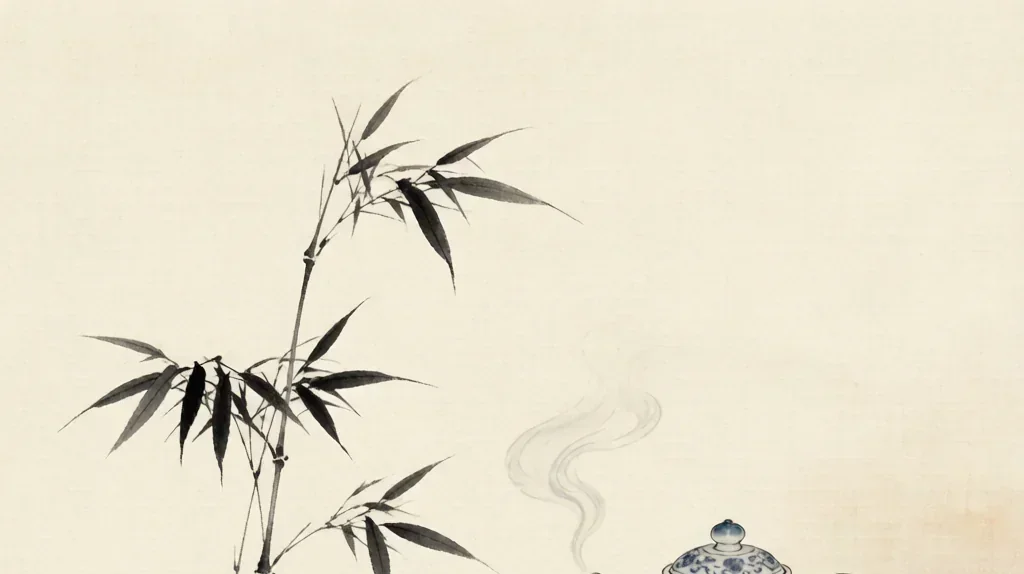
There is a Chinese saying: 开门七件事,柴米油盐酱醋茶—"The seven necessities to open one's door are firewood, rice, oil, salt, soy sauce, vinegar, and tea." Notice that tea is the only one of the seven that is not essential for physical survival. You can live without tea. And yet, for thousands of years, the Chinese have placed it on the same list as fuel and food, alongside the most basic requirements of human existence. This tells you everything you need to know about tea's place in Chinese life. It is not a luxury. It is not a hobby. It is a necessity—not of the body, but of the spirit.
Much has been written about the Chinese tea ceremony (茶道, chá dào)—the formal rituals of preparation, the specialized utensils, the meditative precision of gongfu brewing. These are beautiful traditions, and they deserve their reverence. But they represent only one dimension of tea culture. The deeper, more pervasive dimension is tea as a way of life: the cup that starts the morning, the pot that fuels the conversation, the brew that heals the body, the ritual that binds the community. This is tea not as performance but as presence—the constant, quiet companion of daily Chinese existence.
Morning Tea: The Day Begins with a Cup
In millions of Chinese households, the day does not begin with coffee. It begins with tea. The ritual varies by region and by person, but the essence is the same: before the demands of the day descend, there is a quiet moment with a cup. For some, it is a quick steep of jasmine green tea in a glass jar, the leaves swirling as hot water is poured directly from the thermos. For others, it is a more deliberate affair—a small clay pot, a first rinse to awaken the leaves, a brief steep, the aroma inhaled before the first sip.
This morning tea is not about caffeine, though tea certainly provides it. It is about transition—from sleep to wakefulness, from private to public, from the stillness of night to the motion of day. The warmth of the cup in the hands, the fragrance rising with the steam, the slight bitterness that clears the palate and sharpens the mind—these sensations are as much a part of waking up as opening one's eyes.
In many Chinese offices, the morning tea ritual continues at the desk. Nearly every worker has a personal cup or jar with a built-in strainer, and tea leaves—green, jasmine, oolong, pu'er—are as essential a desk accessory as a computer mouse. The cup is refilled with hot water throughout the day from the office water dispenser. The same leaves may be steeped five, six, seven times, each infusion revealing a different character. This is tea as fuel—not the jolt of coffee, but a steady, sustained presence that accompanies the workday from beginning to end.
Tea and Socializing: The Cup That Connects
In China, tea is the default medium of hospitality. When a guest arrives—whether a close friend or a stranger—the first thing a host does is offer tea. To fail to do so is considered rude. To accept the tea is to accept the relationship, however brief. The exchange is so ingrained that it happens almost unconsciously. You sit down, tea appears. You do not think about it. But the tea is doing important work: it is creating a space for conversation, softening the edges of social interaction, providing something to do with your hands during awkward silences.
The social function of tea is perhaps most visible in business settings. In China, important negotiations do not begin with a handshake and an agenda. They begin with tea. The host pours, the guest accepts, and in those first few sips, the tone of the interaction is established. The quality of the tea communicates respect (or its absence). The pace of pouring and drinking allows for observation and assessment. The shared experience of tasting creates a subtle bond before any words about business are exchanged. Tea is the lubricant of Chinese social and commercial life, and its importance in this role cannot be overstated.
Among friends, tea serves a different purpose. It is an excuse to gather, a reason to sit still. "Let's have tea" is the Chinese equivalent of "let's get coffee"—a low-stakes invitation that can lead to an hour of conversation or an entire afternoon. Unlike a meal, which requires planning and commitment, tea is casual and flexible. You can have tea for ten minutes or three hours. You can have tea with one person or ten. The tea itself is almost incidental; what matters is the space it creates.
Tea Houses: The Third Place
The Chinese tea house (茶馆, chá guǎn) is an institution with a history stretching back over a thousand years. During the Song Dynasty (960–1279), tea houses were centers of urban life—places where people gathered to drink tea, eat snacks, play chess, listen to storytelling, watch performances, and conduct business. They were the social media of their day, the place where information was exchanged, opinions were formed, and community was built.
Modern Chinese tea houses come in many forms. There are the traditional tea houses of Chengdu, with their bamboo chairs and covered-bowl tea (盖碗茶, gài wǎn chá), where old men spend entire afternoons reading newspapers and playing mahjong. There are the elegant tea houses of Hangzhou and Suzhou, overlooking gardens and lakes, where tea is served with exquisite pastries in an atmosphere of cultivated tranquility. There are the bustling tea houses of Guangzhou, where yum cha—the combination of tea and dim sum—is a weekend ritual for entire families. And there are the contemporary tea houses of Shanghai and Beijing, sleek and minimalist, catering to a young, design-conscious clientele that has rediscovered tea as a marker of sophistication.
Despite their diversity, all Chinese tea houses share a common function: they are "third places"—spaces that are neither home nor work, where people can gather, relax, and connect. In an increasingly digital and isolated world, the tea house offers something increasingly rare: a physical space dedicated to conversation, contemplation, and community. The tea is the excuse; the connection is the point.
Regional Tea Customs: A Nation of Tea Drinkers
China's vast geography has produced a remarkable diversity of tea-drinking customs. Each region has its own teas, its own brewing methods, its own rituals, and its own relationship to the beverage.
Sichuan: Covered-Bowl Tea and Leisure — In Chengdu, the capital of Sichuan, tea culture is inseparable from the local philosophy of 慢生活 (màn shēng huó)—"slow life." Tea is drunk from a gaiwan (盖碗), a lidded bowl that serves as both brewing vessel and drinking cup. The lid is used to push aside floating leaves, and the tea is sipped directly from the bowl. Chengdu tea houses are famous for their relaxed atmosphere, their bamboo furniture, and their tradition of ear-cleaning and shoulder-massage services offered to patrons as they drink. To spend an afternoon in a Chengdu tea house is to understand that tea is not a beverage; it is a lifestyle.
Fujian: Gongfu Cha and Precision — The gongfu tea ceremony (功夫茶, gōng fū chá) originated in the Chaozhou region of Guangdong and Fujian Province. "Gongfu" means "skill" or "effort," and the name is apt. The ceremony uses a tiny clay teapot and even tinier cups, and the tea—usually a heavily oxidized oolong like Tieguanyin or Dahongpao—is brewed in multiple short infusions, each lasting only seconds. The process is precise, almost ritualistic: warming the pot, rinsing the leaves, pouring in a continuous circular motion to ensure even extraction, smelling the empty cup after drinking. Gongfu cha is a meditation on tea, an exploration of how a single batch of leaves evolves through a dozen infusions.
Tibet: Butter Tea and Survival — In the high-altitude regions of Tibet and western Sichuan, tea serves a very different purpose. Tibetan butter tea (酥油茶, sū yóu chá) is made by churning brick tea with yak butter and salt into a thick, soup-like beverage that provides calories, warmth, and hydration in an environment where all three are scarce. The flavor is savory and rich, almost like a thin soup, and it is an acquired taste for outsiders. But for Tibetans, butter tea is essential—a source of energy at altitudes where the body burns calories at an accelerated rate, and a source of comfort in one of the harshest inhabited environments on earth.
Guangdong: Morning Tea and Dim Sum — In Guangdong and Hong Kong, the phrase "let's have tea" means something specific: yum cha, the morning or midday ritual of drinking tea and eating dim sum. The tea is usually jasmine, oolong, or pu'er, and it is consumed alongside a parade of small dishes—har gow, siu mai, char siu bao, cheung fun. The meal lasts for hours, the teapot is refilled repeatedly, and the conversation flows as freely as the tea. Yum cha is a social institution, a weekend ritual that brings families together and keeps communities connected.
Beijing: Big-Bowl Tea and Storytelling — In old Beijing, "big-bowl tea" (大碗茶, dà wǎn chá) was the drink of the common people—strong, cheap tea served in large bowls from street stalls. It was not refined, but it was refreshing and affordable. Some Beijing tea houses combined tea with traditional storytelling (评书, píng shū), where a storyteller would hold forth for hours while the audience sipped their bowls and listened. This tradition has largely faded, but it represents an important dimension of tea culture: tea as the companion to narrative, the drink that accompanies stories.
Tea as Medicine: The Healing Cup
Long before tea was a beverage of pleasure, it was a medicine. According to legend, the divine farmer Shennong (神农) discovered tea around 2737 BCE when leaves from a wild tea tree drifted into his pot of boiling water. Shennong, the father of Chinese herbal medicine, was said to have tested hundreds of herbs on himself, and he recognized tea's medicinal properties immediately—it detoxified the body, cleared the mind, and promoted alertness.
Traditional Chinese Medicine (TCM) classifies teas by their thermal nature and their effects on the body. Green tea is considered cooling (凉, liáng) and is recommended for summer consumption and for people with "hot" constitutions. Black tea and pu'er are warming (温, wēn) and are preferred in winter and for those with "cold" constitutions. Oolong occupies a middle ground. Jasmine tea is believed to calm the spirit. Chrysanthemum tea is used to reduce fever and soothe sore eyes. Ginger tea warms the stomach. These classifications are not folk superstition; they represent a coherent system of dietary medicine that has been refined over thousands of years.
Modern science has confirmed many of the health benefits that TCM has long attributed to tea. Tea is rich in polyphenols, particularly catechins, which have antioxidant, anti-inflammatory, and possibly anti-carcinogenic properties. The L-theanine in tea promotes relaxation without drowsiness, creating the state of "calm alertness" that tea drinkers have valued for millennia. The modest caffeine content provides stimulation without the jitters of coffee. Tea hydrates, aids digestion, supports cardiovascular health, and may even protect against cognitive decline. It is, by any measure, one of the healthiest beverages humans have ever consumed.
The Philosophy of Tea
At its deepest level, tea in Chinese culture is not about the beverage at all. It is about a way of being in the world. The tea ceremony—whether the formal gongfu ritual or the casual morning cup—is a practice of mindfulness, of presence, of appreciation for the moment. The tea leaf, plucked from a bush, dried, packaged, shipped, and finally steeped in hot water, contains within it the rain that fell on the mountain, the hands that picked it, the fire that processed it. To drink tea with awareness is to connect with a chain of causation that stretches across time and space.
The Chinese tea master Lu Yu (陆羽), who wrote the Classic of Tea (茶经, Chá Jīng) in the 8th century, understood this. His book is not just a manual of tea preparation; it is a philosophical treatise on how to live. Lu Yu wrote about the proper water for tea, the proper fire, the proper vessels, but beneath all of this was a deeper message: tea is a path to harmony—harmony with nature, harmony with others, and harmony within oneself. The Japanese tea master Sen no Rikyu would later distill this philosophy into four characters: 和敬清寂 (wa kei sei jaku)—harmony, respect, purity, and tranquility. These principles apply equally to the Chinese tradition from which they were derived.
In a world that moves ever faster, tea offers something increasingly precious: slowness. You cannot rush tea. The water must come to the right temperature, the leaves must steep for the right time, the cup must be drunk before it cools. The process imposes its own rhythm, and in submitting to that rhythm, the tea drinker finds a moment of peace. This is tea's greatest gift: not the flavor, not the caffeine, not the health benefits, but the pause. The breath. The quiet space between one thing and the next. To drink tea is to stop, even for a moment, and to be exactly where you are.
The next time you lift a cup of tea, consider what you are holding. It is a leaf that traveled from a mountainside in Fujian or Yunnan or Anhui. It is two thousand years of Chinese civilization in liquid form. It is a medicine, a social lubricant, a meditation aid, and a daily ritual that connects you to hundreds of millions of people doing the same thing at the same moment. It is, in the end, just hot water with leaves in it. And it is everything.
📝 Chinese Vocabulary
- 茶道 (chá dào) — The way of tea, encompassing both formal ceremony and philosophy of life
- 茶馆 (chá guǎn) — Tea house, a social institution for drinking tea and gathering
- 功夫茶 (gōng fū chá) — Gongfu tea ceremony, a precise method of brewing oolong tea
- 盖碗 (gài wǎn) — Gaiwan, a lidded bowl used for brewing and drinking tea
- 开门七件事 (kāi mén qī jiàn shì) — "The seven necessities to open one's door": firewood, rice, oil, salt, soy sauce, vinegar, and tea
Tea in Ceremony and Rites of Passage
Beyond daily drinking, tea in China marks the great turning points of life. At weddings the bride and groom serve tea to parents and grandparents, who accept the cup and offer blessings and gifts, making the beverage a public bond between two families. Tea is also poured before ancestral tablets and at tomb-sweeping rites, offered as a sign of continuing respect to those who came before. In some regions a newborn is introduced to the household with a dab of tea, and the elderly are honored with a daily cup as a gesture of filial care. These rites share a single logic: because tea is ordinary and constant, it is the perfect medium for the recurring obligations of family. The same leaf that wakes a worker at dawn also carries a vow at the altar, linking the smallest courtesy to the largest commitments.
Tea as a Muse: Poetry, Painting, and the Studio
For centuries Chinese scholars treated tea as a companion to the brush. After Lu Yu's Classic of Tea, poets from the Tang onward wrote verses on the pleasures of a single cup, and the Song literati turned the tea contest into a refined sport of judging froth and flavor. Painters kept a brazier and pot beside the desk so that a fresh infusion could clear the mind between strokes, and the quiet of a tea session was thought to steady the hand and open the eye. Tea appears in countless scrolls as the still life of choice: a cracked cup, a wisp of steam, a friend across the low table. The drink therefore did more than refresh; it set a mood of leisure concentration in which calligraphy and poetry were made. To read Chinese art is often to overhear a conversation conducted over many small cups of tea.
❓ Frequently Asked Questions
🎉 Fun Facts
- China produces more tea than any other country in the world—over 3 million tons annually—and has been doing so for over 2,000 years.
- The world's oldest cultivated tea tree, located in Yunnan Province, is estimated to be over 3,200 years old and is still harvested today.
- In Chengdu, some traditional tea houses offer ear-cleaning services to patrons—a tradition that dates back to the Qing Dynasty, when tea houses were full-service leisure destinations.
- At a traditional Chinese wedding, the bride and groom serve tea to their elders in order of seniority, a ritual called jing cha that publicly seals the marriage and welcomes the couple into each family.
- The words for tea split into two global families: the northern land route spread 'cha' across Central Asia and Europe, while the southern coastal ports of Fujian exported the word 'te' to the maritime world.
- In Chinese etiquette the junior guest refills others' cups throughout the meal and never lets a visitor's cup sit empty, a quiet habit of attentiveness built around the tea pot.