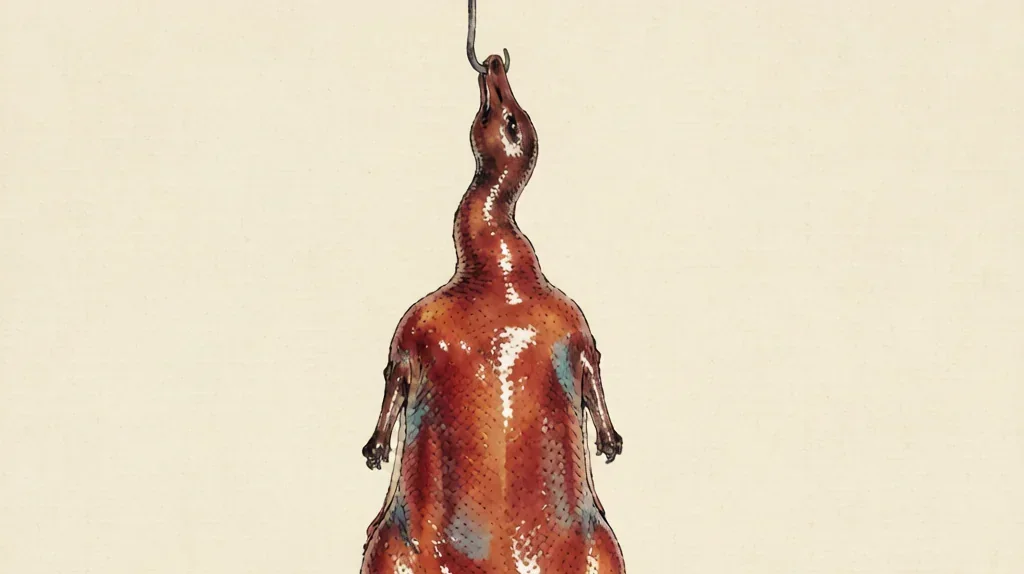
Beijing Roast Duck (北京烤鸭, Běijīng Kǎoyā) stands as the undisputed crown jewel of Chinese imperial cuisine—a dish so iconic that no visit to China's capital is complete without experiencing it. With a documented history spanning over 600 years, this magnificent dish evolved from the imperial kitchens of the Yuan Dynasty through the refinements of Ming and Qing court chefs to become one of the most celebrated culinary achievements in the world. What sets Beijing Duck apart is not merely its flavor but the extraordinary craftsmanship embedded in every stage of its preparation: the careful selection of specially bred ducks, the meticulous process of inflating the skin to separate it from the fat, the art of glazing with maltose syrup, the hours of air-drying, and finally, the roasting over fragrant fruitwood until the skin achieves its legendary lacquered-crimson sheen and crackling crispness. The carving of the duck at tableside—transforming the glistening bird into exactly 108 thin slices, each with the perfect ratio of crispy skin to succulent meat—is itself a performance art that takes years to master. Wrapped in paper-thin pancakes with slivers of scallion, cucumber, and a brush of sweet fermented flour sauce, each bite of Beijing Duck delivers a symphony of textures and flavors that has delighted emperors, diplomats, and food lovers for centuries.
A Tale of Two Roasters: Quanjude and Bianyifang
The story of Beijing Roast Duck in its modern form is inseparable from the rivalry and complementary traditions of two legendary restaurants: Quanjude (全聚德) and Bianyifang (便宜坊). Bianyifang, founded in 1416 during the Ming Dynasty's Yongle reign, is the older of the two and the originator of the 'closed-oven' (焖炉, mènlú) roasting technique. In this method, the duck is placed inside a sealed brick oven where it cooks entirely through radiant heat reflected from the pre-heated walls, with no direct exposure to flames. The closed-oven technique produces a duck with exceptionally tender meat and a more subtle, refined flavor profile—the skin is crisp but not crackling, and the natural sweetness of the duck fat is preserved. Bianyifang's name, which literally means 'convenient and suitable for all,' reflects its original mission to serve delicious food at accessible prices, and its ducks have been praised by connoisseurs for their delicate, nuanced character.
Quanjude, established in 1864 by Yang Quanren, a former poultry seller who saw an opportunity to elevate duck roasting to an art form, pioneered the now-famous 'open-oven' or 'hung-oven' (挂炉, guàlú) technique. In this method, the ducks are hung from hooks above an open fire fueled by fruitwood—typically jujube, pear, or peach wood—which imparts a subtle fruity fragrance to the meat. The open flame renders the fat more aggressively, creating skin that shatters like glass when bitten while leaving the meat beneath impossibly juicy. The visual drama of rows of glistening ducks suspended above dancing flames has become the iconic image of Beijing Duck worldwide, and Quanjude's technique produces the bold, assertive flavor profile that most international visitors associate with the dish. The restaurant's name—'complete virtue gathered together'—reflects Yang Quanren's aspiration to create a dining experience of unsurpassed quality, and Quanjude has since grown into a global brand with hundreds of locations, including outposts in New York, London, and Tokyo.
The Sacred 108 Slices
The carving of a Beijing Duck is far more than mere portioning—it is a ritual performance governed by strict traditions that elevate it to an art form. A master carver trains for years, often apprenticing under a senior chef for a decade before being entrusted to carve for VIP guests. The duck is presented whole to the table for the diners' admiration, its skin gleaming like polished mahogany, before the carving begins. The chef uses a specialized rectangular cleaver and works with surgical precision, executing each cut in a specific sequence designed to maximize the yield of perfect slices.
Tradition holds that a properly carved Beijing Duck should yield exactly 108 slices. This number is not arbitrary—in Chinese culture, 108 carries deep symbolic significance derived from Buddhism, where it represents the 108 afflictions or defilements that humans must overcome to achieve enlightenment. The ringing of temple bells 108 times on New Year's Eve, the 108 beads of a Buddhist prayer mala, and the 108 heroes of the classic novel Water Margin all draw from this same numerological tradition. For the roast duck, the 108 slices are categorized into three types: the first cuts are pure skin (皮, pí), the crispiest and most prized, served with a dish of white sugar for dipping; the next cuts combine skin and meat in perfect proportion; and the final cuts are primarily lean meat. Each type of slice is best enjoyed differently, and a skilled carver knows exactly when to adjust the angle of the blade to produce each category.
From Imperial Courts to the World Stage
Beijing Duck's association with power and prestige has made it a dish of diplomatic significance. During the Nixon visit to China in 1972, Premier Zhou Enlai hosted a banquet featuring Beijing Duck, and the image of American and Chinese leaders sharing this quintessential Chinese dish became a symbol of the thawing of relations between the two nations. Henry Kissinger, who helped orchestrate the historic visit, later wrote that the Beijing Duck banquet was one of the most memorable meals of his diplomatic career. The dish has continued to serve as a culinary ambassador, with Quanjude alone serving over 2 million ducks annually to visitors from around the world.
The preparation of the duck itself is a testament to Chinese agricultural ingenuity. The birds used for authentic Beijing Duck are a specific breed—the Peking Duck (北京鸭, Běijīng Yā)—a white-feathered variety developed over centuries through selective breeding. These ducks are raised under carefully controlled conditions for precisely 65 days, during which the final two weeks involve force-feeding to achieve the ideal fat-to-meat ratio. The processed duck undergoes a multi-day preparation ritual: after slaughter and cleaning, air is pumped between the skin and flesh to separate them, a crucial step that ensures the skin will crisp independently of the meat. The duck is then scalded with boiling water to tighten the skin, coated with a maltose syrup glaze, and hung to air-dry for 12 to 24 hours. Only when the skin is perfectly dry and taut is the duck ready for the oven—a process that transforms a humble waterfowl into what the Chinese poetically call 'the dish that defines a civilization.'
Selecting and Raising the Peking Duck
Authentic Beijing duck begins with a special breed, the white-feathered Peking duck, developed over centuries near the capital. Farmers raise the birds under careful control, usually for about sixty-five days, and in the final two weeks they often force-feed a rich mash to build a thick layer of fat beneath the skin the fat that later renders into crispness. The result is a bird with the ideal balance of lean meat and subcutaneous fat. Only ducks raised and fattened this way produce the lacquered, shattering skin that defines the dish. The breed was so valued that in the 1870s a small group was exported to North America, where it became the ancestor of most duck eaten in the United States today.
Air-Drying and the Maltose Glaze
The transformation from raw bird to crisp delicacy hinges on preparation. After cleaning, the cook pumps air between skin and flesh so the two separate, then scalds the duck in boiling water to tighten the skin. Next comes a glaze of maltose syrup, sometimes with a little vinegar, brushed over the surface. The duck is then hung in a cool, airy place for twelve to twenty-four hours until the skin is taut and dry. This patient drying is what lets the skin blister into glassy crispness rather than steaming soft in the oven. Every step is timed by hand and eye; rush the drying and the signature texture is lost. It is slow craft applied to a humble bird.
Fruitwood Fire and the Hung Oven
At Quanjude the ducks hang from hooks above an open flame fed by fruitwood typically jujube, pear, or peach which lends a faint, fruity smoke to the meat. The open oven renders fat aggressively, so the skin crisps to a shatter while the meat stays juicy. Bianyifang's older closed oven works differently, cooking by radiant heat in a sealed brick chamber for a more subtle, tender result. Either way, the bird is turned and watched throughout so it colors evenly to deep mahogany. The sight of rows of glistening ducks suspended over dancing flames has become the global image of the dish, and the choice of wood and oven is a point of fierce local pride.
The Pancake-Wrapping Ritual
Eating Beijing duck is a hands-on ritual. The carver presents slices of skin and meat, and each diner lays a piece on a thin wheat pancake with a brush of sweet bean sauce, a sliver of scallion, and a strip of cucumber. The pancake is folded and rolled, enclosing hot, crisp duck with cool, crunchy vegetables and a sweet-savory note. The first slices pure crackling skin are often dipped in white sugar alone, a contrast of crisp and sweet. When the duck is finished, the remaining meat and bones are usually simmered into a light soup served at the end. The wrapping turns a luxurious roast into an interactive, shared pleasure.
Peking Duck Beyond Beijing
From its courtly origins the dish traveled far. Overseas Chinatowns adopted it early, and Quanjude itself expanded into a global brand with branches in cities such as New York, London, and Tokyo. Local kitchens abroad sometimes adjust the accompaniments or the roasting to suit available ovens, but the core idea crisp skin, tender meat, pancake wrap travels intact. In China the duck is now a standard at banquets and a must-try for visitors to the capital, while cheaper versions fill casual restaurants. Few dishes carry so much symbolic weight yet remain so approachable, making Beijing duck a rare bridge between imperial heritage and everyday appetite.