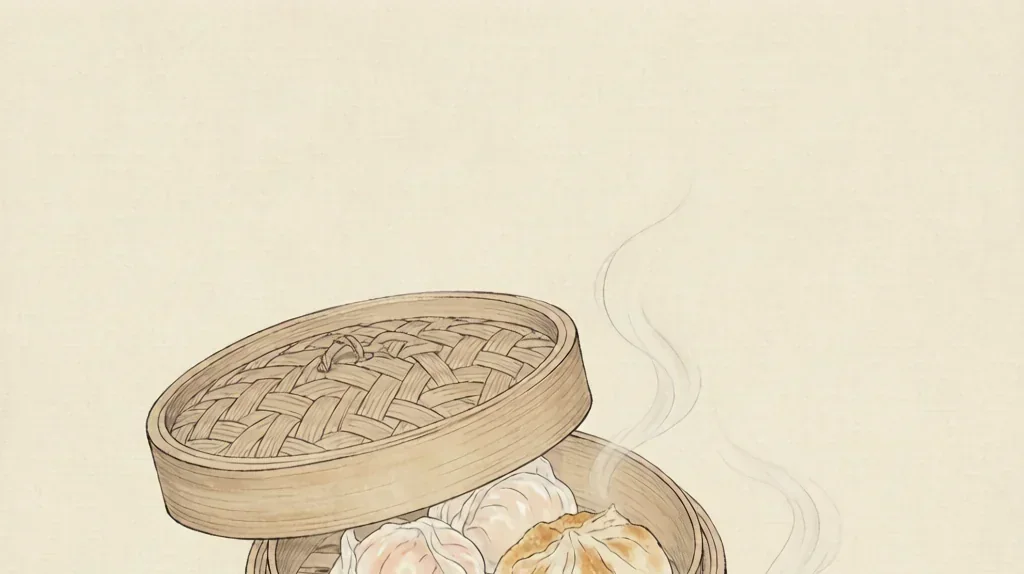
On a Sunday morning in Guangzhou, the great tea houses come alive. By 8 a.m., the vast dining rooms are already humming—not with the quiet murmur of a Western brunch, but with the full-throated roar of a Cantonese yum cha session. Steam carts weave between tables, their contents hidden beneath bamboo lids. Families occupy round tables, the grandparents presiding, the children darting between chairs. Teacups are constantly refilled. The clatter of chopsticks, the clink of porcelain, the shouts of "Har gow here!" from the cart ladies—it is chaos, beautiful and orchestrated, and at the center of it all is dim sum (点心, diǎn xīn).
The words "dim sum" translate literally to "touch the heart"—a poetic name for dishes that are meant to be small, delicate, and emotionally satisfying rather than physically filling. But dim sum is more than food. It is inseparable from the practice of yum cha (饮茶), which means "drink tea." Together, dim sum and yum cha form a complete cultural experience: the leisurely consumption of tea and small dishes, ideally in the company of family and friends, ideally on a weekend morning when there is nowhere else to be and nothing else to do. It is brunch as the Cantonese invented it, and it may be the most civilized meal on earth.
The Origins: Tea Houses of the Silk Road
The yum cha tradition has its roots in the tea houses that sprang up along the ancient trade routes of southern China. Travelers—merchants, porters, scholars—needed places to rest, drink tea, and eat something small. Tea house owners began offering simple snacks alongside their tea, and over time, these snacks became more elaborate. By the Song Dynasty (960–1279), the tea houses of Guangzhou and the Pearl River Delta had evolved into social institutions where people gathered not just to eat and drink but to conduct business, exchange news, and pass the time.
The connection between tea and dim sum is not incidental. In traditional Chinese medicine, tea is believed to aid digestion, and the tannins in tea do indeed help break down fatty foods. Dim sum dishes, many of which are fried or rich, are designed to be eaten in small quantities with plenty of tea. The tea cleanses the palate between dishes, refreshes the mouth, and allows the diner to continue eating for hours without feeling overwhelmed. It is a symbiotic relationship that has endured for a thousand years.
The Dim Sum Hall: A Theater of Food
Entering a traditional dim sum hall is a sensory experience unlike any other. The room is enormous—hundreds of tables, thousands of diners—and the noise level is formidable. Dim sum is not a quiet meal; the Cantonese believe that a quiet restaurant is a dead restaurant, and a lively din is a sign of good food and good company. Waitstaff push trolleys stacked with bamboo steamers, each one containing a different dish. They call out their offerings as they pass: "Har gow! Siu mai! Char siu bao!" Diners flag down the carts that interest them, the dishes are placed on the table, and a stamp is marked on a card that tracks the meal's running total.
The cart system is part of dim sum's charm. It introduces an element of chance and discovery—you might be planning to order steamed spare ribs, but then a cart of freshly fried spring rolls passes by, and plans change. The system also rewards assertiveness. Hesitate, and the cart with the last order of your favorite dish will roll on to another table. Veteran dim sum diners develop a sixth sense for where the best carts are and when to pounce. It is not aggressive; it is enthusiastic. There is a difference.
In modern dim sum restaurants, the cart system is sometimes replaced by a checklist menu, where diners mark their choices on a paper form and hand it to a server. This approach is more efficient and allows the kitchen to prepare dishes to order, but it lacks the theatrical quality of the trolley system. Purists prefer the carts. The uncertainty is part of the fun.
The Essential Dim Sum Dishes
The dim sum repertoire is vast—hundreds of dishes, varying by region and by restaurant—but certain items are considered the benchmarks by which a dim sum kitchen is judged.
Har Gow (虾饺, xiā jiǎo) — The king of dim sum. A har gow is a steamed shrimp dumpling wrapped in a translucent wheat starch skin. The wrapper must be thin enough to see the pink shrimp through it but strong enough to hold together when picked up with chopsticks. The pleats—ideally between seven and ten—must be even and elegant. The shrimp filling must be whole or nearly whole, not minced into a paste, and it must be sweet and springy, with a clean taste of the sea. A har gow that falls apart when lifted, or whose wrapper is thick and gummy, or whose shrimp is mealy, is a failure. A perfect har gow is a small miracle.
Siu Mai (烧卖, shāo mài) — The open-faced pork and shrimp dumpling, recognizable by its cylindrical shape and the orange dot of crab roe or carrot on top. Unlike har gow, siu mai wrappers are made from wheat flour and egg, giving them a yellow color. The filling is a mixture of ground pork and whole shrimp, sometimes with chopped mushrooms, seasoned with sesame oil, soy sauce, and white pepper. The texture should be bouncy and juicy, not dense or dry.
Char Siu Bao (叉烧包, chā shāo bāo) — Steamed buns filled with sweet barbecued pork. The bun itself is a marvel of texture—soft, fluffy, slightly sweet, with a top that splits open during steaming to reveal the filling within. The pork is chopped and mixed with a glossy, sweet-savory sauce that should be generous but not so abundant that it soaks through the bun. Char siu bao are the comfort food of dim sum, the dish that children reach for first and that adults never outgrow.
Cheung Fun (肠粉, cháng fěn) — Rice noodle rolls, wide sheets of steamed rice batter wrapped around a filling—usually shrimp, beef, or char siu—and drizzled with sweet soy sauce. The noodle should be silky and slippery, barely holding together, sliding down the throat with minimal chewing. The best cheung fun are made to order, the rice batter poured onto a cloth stretched over a steamer, spread thin, and scraped off moments later into a loose roll. Pre-made cheung fun that have been sitting on a cart are never as good.
Phoenix Claws (凤爪, fèng zhǎo) — Braised chicken feet, a dish that divides newcomers but rewards the brave. The feet are deep-fried, then braised in a sauce of black beans, garlic, chili, and soy sauce until the skin is soft and gelatinous, nearly falling off the bone. Eating them is a textural experience—the skin yields easily, the cartilage provides a pleasant chew, and the bones are discarded on the side of the plate. The name "phoenix claws" is aspirational, elevating a humble ingredient to something mythical.
Lo Bak Go (萝卜糕, luó bo gāo) — Pan-fried turnip cake, a savory cake made from shredded daikon radish and rice flour, studded with bits of Chinese sausage, dried shrimp, and mushrooms. The cakes are sliced and pan-fried until the exterior is crisp and golden, while the interior remains soft and creamy. They are served with hoisin sauce or chili sauce and are one of the most satisfying dishes on the dim sum menu.
Egg Tarts (蛋挞, dàn tà) — The sweet finale of a dim sum meal. Egg tarts have a flaky, buttery pastry shell—influenced by Portuguese pastéis de nata via the former Portuguese colony of Macau—filled with a smooth, wobbly egg custard that is just barely set. They are best eaten warm, when the custard is at its most fragile and the pastry at its most crisp. A good egg tart is so simple it seems impossible to get wrong, yet so many do. The custard must not be rubbery, the pastry must not be greasy, and the sweetness must be restrained—just enough to satisfy, not enough to cloy.
The Tea Ceremony at the Table
Tea is not an afterthought at dim sum; it is the foundation. When you sit down at a dim sum table, the first question the server asks is not "What would you like to eat?" but "What tea would you like?" The choice matters. Common options include jasmine tea (茉莉花茶, mò lì huā chá), oolong (乌龙茶, wū lóng chá), pu'er (普洱茶, pǔ'ěr chá), and chrysanthemum (菊花茶, jú huā chá). Each has its own character and its own relationship to the food. Pu'er, with its earthy, fermented depth, cuts through the richness of fried dishes. Jasmine refreshes the palate between bites. Oolong bridges the gap, complex enough to be interesting but light enough not to overwhelm.
There is etiquette to the tea service. When someone pours tea for you, you tap the table with two fingers to thank them—a gesture that originated, according to legend, with a Qing Dynasty emperor traveling incognito. When he poured tea for his servants, they could not kowtow without revealing his identity, so they tapped the table instead. The custom persists to this day. When your teapot is empty, you do not call for a server; you simply leave the lid off or tilted, and someone will come to refill it with hot water. The same tea leaves are used for multiple infusions, each round revealing new dimensions of flavor.
Dim Sum Culture: More Than a Meal
Dim sum is not fast food. A proper yum cha session lasts two to three hours, sometimes longer. It is a meal for weekends and holidays, for family gatherings and catch-ups with old friends. The pace is leisurely, the conversation meandering, the food arriving in waves. There is no pressure to finish and leave; tables are not turned over with the efficiency of a Western restaurant. The tea house is a third place—not home, not work, but a social space where relationships are maintained and community is built.
For the Cantonese diaspora, dim sum carries particular emotional weight. In Chinatowns from San Francisco to Sydney, the dim sum hall is a cultural anchor, a place where the language, the food, and the rituals of home are preserved and transmitted to the next generation. Grandparents who may not speak English hold court at round tables, ordering dishes in Cantonese, teaching grandchildren how to use chopsticks, how to tap the table in thanks, how to appreciate the translucent skin of a perfect har gow. Dim sum is edible heritage.
In recent years, dim sum has evolved. High-end restaurants in Hong Kong and beyond have elevated the form, using premium ingredients like truffle, lobster, and wagyu beef. Fusion dim sum—har gow with curry, siu mai with foie gras—pushes boundaries that traditionalists find unsettling. But the heart of dim sum remains unchanged: small dishes, shared with loved ones, over endless cups of tea, on a morning when nothing else matters. That is the art of touching the heart, one bamboo steamer at a time.
📝 Chinese Vocabulary
- 点心 (diǎn xīn) — Dim sum, literally "to touch the heart"
- 饮茶 (yǐn chá) — Yum cha, the practice of drinking tea with dim sum
- 虾饺 (xiā jiǎo) — Har gow, translucent steamed shrimp dumplings
- 肠粉 (cháng fěn) — Cheung fun, silky rice noodle rolls
- 凤爪 (fèng zhǎo) — "Phoenix claws," braised chicken feet
The Dim Sum Kitchen: Discipline Behind the Doors
The calm of the dining room hides a tightly choreographed kitchen. Dim sum is made in batches through the night and morning by teams who divide labor by item: one station folds har gow, another steams siu mai, another fries turnip cakes, another rolls cheung fun to order. Because each piece is small and hand-finished, speed and consistency are everything, and a slowed station backs up the whole cart line. Steamers are timed to the second so shrimp stays bouncy and buns stay fluffy, while fryers are watched for the exact golden edge. The best kitchens treat dim sum as a craft of repetition, where mastery means making the same delicate thing hundreds of times without variation. What arrives at your table as a casual bite is the product of a brigade that has rehearsed it for years. The theater of yum cha rests on this unseen discipline.
Seasonal and Regional Dim Sum
Although har gow and siu mai are constants, dim sum shifts with the seasons and the region. Cantonese kitchens lead with fresh shrimp and greens in spring, crab roe dumplings in autumn, and warming rice rolls in winter; the north adds wheat-based buns and savory pastries, while Fujian and Teochew styles bring teochew dumplings and glutinous sweets. Festivals reshape the menu too, with glutinous rice balls for the Lantern Festival and zongzi appearing near the Dragon Boat Festival. This seasonality keeps the form alive rather than frozen, and it rewards regulars who notice the changing trays. A dim sum hall visited in March and again in October can feel like two related but distinct meals. The constant is the format — small, shared, tea-borne — while the contents honor the time of year.
Dim Sum Etiquette: How to Yum Cha Well
Yum cha has its own quiet manners. The host usually orders the tea and pours first, and any guest tapped on the table with two fingers returns a silent thanks — a habit traced to a traveling emperor who wished to stay incognito. When the pot runs low, leaving the lid ajar signals a server to refill with hot water rather than calling out. Dishes are shared from the center, and the eldest or most honored guest is offered the first choice of a fresh basket. Payment follows the stacked plates or a stamped card, so no one interrupts the meal to settle up. These small courtesies keep the table relaxed and communal, which is the point of the tradition. To yum cha well is less about knowing every dish than about pouring for others and lingering. Good manners at dim sum are simply attention to the people around the table.
❓ Frequently Asked Questions
🎉 Fun Facts
- The largest dim sum restaurant in the world is the Jumbo Floating Restaurant in Hong Kong's Aberdeen Harbour—though it sadly closed in 2020, it could seat over 2,300 diners at its peak.
- The tradition of tapping the table when someone pours your tea is said to date back to the Qianlong Emperor, who traveled in disguise and was served tea by his attendants.
- A skilled dim sum chef can pleat a har gow wrapper in under three seconds, creating between seven and thirteen perfectly even folds—a skill that takes years of apprenticeship to master.
- The classic yum cha bill is still settled by counting the small steamer lids and plates left on the table, a system so efficient that the food needs no written order.
- A true dim sum kitchen runs on specialization — a single chef may spend years making only har gow or only siu mai, perfecting one shape to the exclusion of all others.
- Seasonal dim sum appears through the year: lotus-leaf wraps in summer, crab-roe dumplings in autumn, and sweet glutinous balls for the Lantern Festival, tying the meal to the calendar.