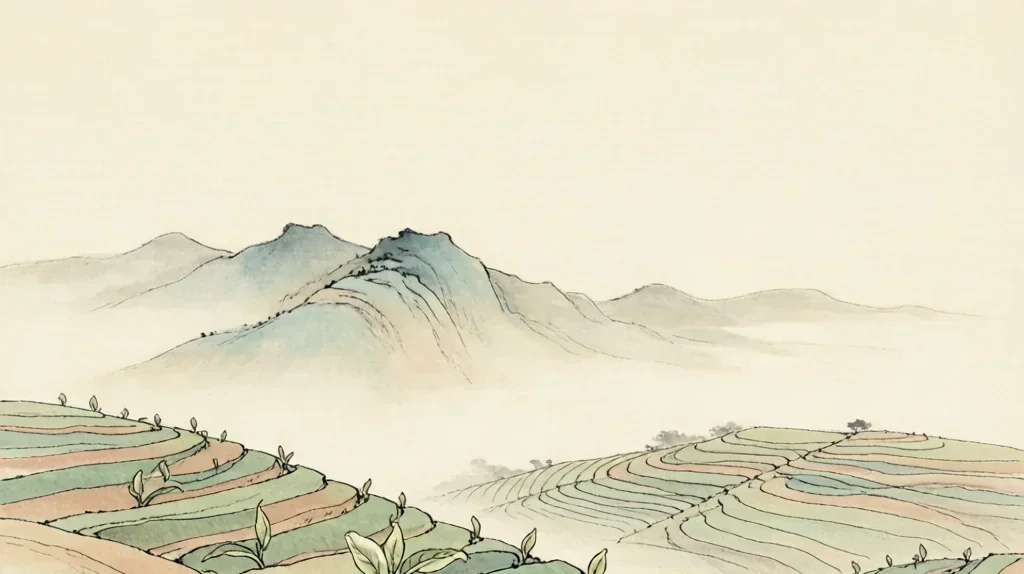
Biluochun (碧螺春, Bìluóchūn), whose name translates poetically to 'Green Snail Spring,' is one of China's most cherished green teas, produced on the misty slopes of Dongting Mountain (洞庭山) on the shores of Lake Tai (太湖) near Suzhou in Jiangsu Province. What distinguishes Biluochun from all other Chinese green teas is its extraordinary appearance — the leaves are tightly curled into delicate spirals, covered with a dense layer of silvery-white downy hairs, resembling tiny snails emerging after spring rain. But its beauty is only the beginning: the tea yields a pale jade-green liquor with an intoxicating fragrance that mingles notes of fruit blossoms, chestnut, and fresh meadow, and a flavor so sweet and refreshing that it has been celebrated in poetry and imperial decrees for centuries. As one of China's Ten Famous Teas and a tea that has been produced since the Tang Dynasty, Biluochun embodies the refined aesthetic sensibility of the Jiangnan region — a place where nature, art, and daily life have always been exquisitely intertwined.
The Emperor Who Named a Tea: Kangxi's Gift of a Name
The story of how Biluochun received its name is one of the most charming episodes in Chinese tea history, involving the Kangxi Emperor (康熙帝), one of the Qing Dynasty's greatest rulers. Before Kangxi's intervention, the tea was known by a much more rustic name: 'Xia Sha Ren Xiang' (吓煞人香), which in the local Suzhou dialect means something like 'Frighteningly Fragrant' or 'Startling Aroma.' The name captured the tea's most striking quality — its astonishing, room-filling fragrance — but it lacked the elegance befitting a tea of such refinement. In 1699, during one of his famous southern inspection tours, Kangxi visited the Lake Tai region and was offered this local tea. The emperor, a man of cultivated taste who appreciated fine teas, was deeply impressed by its appearance and flavor but found the name 'Startling Aroma' to be crude and unworthy of such a treasure.
After contemplating the tea's characteristics — its spiral shape resembling a snail shell, its vivid green color, and its early spring harvest — Kangxi bestowed upon it the name 'Biluochun,' meaning 'Green Snail Spring.' The name was perfectly chosen: 碧 (bì) captures the vibrant jade-green of the leaves and liquor; 螺 (luó) describes the distinctive snail-like spiral curl of the processed leaves; and 春 (chūn) indicates that the tea is made from the first tender buds of spring, the season of renewal and the most prized harvest for green teas. With imperial endorsement, Biluochun's reputation soared, and it became a tribute tea (贡茶, gòng chá) sent annually to the Qing court in Beijing. The story of Kangxi's naming illustrates the profound relationship between Chinese tea culture and the imperial court, where an emperor's poetic sensibility could elevate a local specialty to national renown. It also reflects the Confucian ideal that names should be fitting — that the designation of a thing should capture its essential nature with elegance and precision.
A Tea Grown Among Fruit Trees: The Secret of Biluochun's Aroma
The extraordinary fragrance of Biluochun is not solely a product of processing technique — it begins in the unique agricultural ecosystem of Dongting Mountain, where tea bushes are interplanted with fruit trees. This practice, known as 'tea-fruit intercropping' (茶果间作, chá guǒ jiànzuò), has been maintained for centuries on both the eastern and western peaks of Dongting Mountain. The tea bushes grow in the dappled shade of loquat, peach, plum, apricot, bayberry, and citrus trees, which provide partial shade that slows leaf growth, encouraging the development of higher concentrations of amino acids and aromatic compounds. More importantly, the tea bushes absorb the volatile aromatic compounds released by the surrounding fruit trees and their blossoms, a phenomenon that tea scientists have confirmed through chemical analysis — the leaves of Biluochun contain unique aromatic profiles not found in tea grown in monoculture.
In spring, when the fruit trees burst into bloom and the tender tea buds emerge, the entire mountain is enveloped in a heady mixture of fragrances — peach blossoms, plum flowers, loquat blooms, and the fresh, vegetal scent of new tea leaves. This sensory environment infuses the tea with its characteristic fruity-floral bouquet, often described as having notes of apricot, peach, and chestnut, with a subtle undertone of fresh greenery. The specific combination of fruit trees varies by location on the mountain, and connoisseurs claim they can distinguish Biluochun grown among peach trees from that grown among loquats. The harvest is an exercise in extreme selectivity: only the bud and the single adjacent young leaf (一芽一叶, yī yá yī yè) are picked, and it takes approximately 60,000 to 70,000 of these delicate shoots to produce a single kilogram of finished tea. The picking season is heartbreakingly brief — only about two weeks in late March to early April — and the best tea, known as 'Before the Rain' (雨前, yǔ qián), must be harvested before the Qingming Festival (清明节) when the buds are at their most tender and fragrant.
The Art of the Snail: Crafting Biluochun's Distinctive Shape
The tightly curled, spiral shape that gives Biluochun its name is not a natural form — it is the result of a demanding hand-processing technique that has been refined over centuries. After the leaves are picked, they undergo a brief withering period before the critical kill-green (杀青, shāqīng) step, where they are tossed in a hot wok at temperatures between 180 and 200 degrees Celsius. The tea maker uses bare hands, protected only by years of calloused experience, to continuously toss, press, and stir the leaves — a technique that requires extraordinary sensitivity to prevent scorching while ensuring the enzymes are fully deactivated. The entire kill-green process takes only three to five minutes, and timing is critical: stop too early and the tea will oxidize and lose its fresh character; go too long and the delicate fragrance will be destroyed.
Immediately after kill-green, while the leaves are still hot and pliable, the shaping begins. This is the most distinctive and demanding stage of Biluochun production, known as 'twisting and shaping' (揉捻成形, róu niǎn chéng xíng). The tea maker uses a specific hand motion — pressing the leaves against the hot wok surface and simultaneously twisting them between the palms — to roll each leaf into a tight spiral. This motion must be repeated hundreds of times, with gradually decreasing wok temperature, until every leaf has been coaxed into its characteristic snail-shell curl. The process also presses the natural juices to the surface of the leaves, where they dry and crystallize, contributing to the tea's intense flavor. Finally, the shaped leaves are dried at a low temperature to lock in their form and preserve the silvery-white down (白毫, bái háo) that covers each leaf — a sign of supreme tenderness, as only the youngest buds produce this fine hair. The entire process, from picking to finished tea, takes an experienced master about 40 minutes per small batch, and the resulting leaves, when dropped into a glass cup, unfurl gracefully as they steep — a visual performance that adds to the pleasure of drinking Biluochun.
One Tender, Three Fresh: The Aesthetic of Biluochun
Connoisseurs describe the essence of Biluochun with the phrase 'One Tender, Three Fresh' (一嫩三鲜, yī nèn sān xiān). The 'one tender' refers to the tenderness of the buds — the finest Biluochun consists exclusively of the unopened bud and the first tiny leaf, so delicate that they seem to melt on the tongue. The 'three fresh' encompass three dimensions of freshness that define the tea's character: freshness of color (色鲜, sè xiān), freshness of aroma (香鲜, xiāng xiān), and freshness of flavor (味鲜, wèi xiān). The color is a luminous, almost translucent jade-green, bright and clear, like spring water filtered through new leaves. The aroma is intensely fresh — not the cooked, vegetal scent of lesser green teas, but a vibrant, living fragrance that evokes the first days of spring, with distinct notes of young fruit blossoms, fresh chestnuts, and a hint of sweet grass. The flavor is remarkably sweet for a green tea, with a gentle umami richness that comes from the high concentration of amino acids in the tender spring buds, and virtually no bitterness or astringency when brewed correctly.
Brewing Biluochun requires a gentle touch to preserve its delicate character. Unlike oolong or pu'er teas that thrive with near-boiling water, Biluochun demands water at approximately 80 degrees Celsius (175 degrees Fahrenheit). The traditional brewing method uses a tall glass cup (玻璃杯, bōlí bēi), which allows the drinker to appreciate the visual drama of the leaves unfurling — a spectacle known as 'snow flying and dancing' (雪花飞舞, xuěhuā fēiwǔ), as the white downy hairs detach from the leaves and swirl in the water like miniature snowflakes. The first infusion should be brief, no more than one to two minutes, with subsequent infusions progressively longer. A truly fine Biluochun can yield three to four satisfying infusions, though the first brew is always considered the finest, capturing the fullest expression of the tea's freshness. The experience of drinking Biluochun is one of spring itself — a sensory reminder of renewal, delicacy, and the fleeting beauty of the season's first growth.
The Hand Harvest and Its Brief Window
Biluochun's quality is decided in a few weeks each spring. Pickers work the slopes of Dongting Mountain from dawn, selecting only the bud and the single leaf beside it. The season is short roughly two weeks in late March and early April and the finest leaves must be taken before the Qingming Festival, while they are still tiny and downy. A single kilogram of finished tea can require sixty to seventy thousand such shoots, meaning many hours of careful handwork per batch. Rain, wind, or a late cold snap can shrink the harvest overnight, so connoisseurs follow the calendar closely. This brevity is part of the tea's romance: you taste not just a leaf but a fleeting moment of the Jiangnan spring.
The Glass-Cup Brewing Ritual
To drink Biluochun well, use a tall glass cup and water at about eighty degrees Celsius never boiling, which would scald the tender leaves and turn the cup bitter. Place a spoonful of the spirals in the cup and add hot water; the curled leaves sink, then slowly unfurl, while their silvery down detaches and drifts through the liquor like falling snow, an effect poets named snow flying. The first steep is the shortest, a minute or two, and the leaves can be infused three or four times, each brew a little longer and a little softer. Watching the leaves open is part of the pleasure, a small performance of spring unfolding in the glass.
Biluochun Within Jiangnan Culture
Biluochun is inseparable from the refined taste of Jiangnan, the lower Yangtze region of gardens, canals, and scholar-poets. Suzhou, the nearest great city, is famous for its classical gardens where a host might serve this tea to a guest among rockeries and moon-gate windows. The tea's restraint quiet color, subtle fruit-floral scent, no harshness mirrors the local ideal of understated elegance. To drink it is to take part in a long civic tradition of treating tea as art and hospitality as etiquette. The Kangxi Emperor's rebranding of a rustic local leaf into an imperial tribute only confirmed what Suzhou already knew: that this small spiral is one of the region's finest cultural exports.
Choosing and Keeping Fine Biluochun
Good Biluochun shows a uniform jade-green color, a tight snail curl, and a visible coat of white down; the aroma should be fresh and fruity, never stale or musty. Because the tea is so prized, the market holds many imitations machine-rolled leaves, blends from other provinces, or last year's stock passed off as new. Buy from a trusted source and look for the tender, downy bud rather than large, coarse leaves. At home, seal the tea in an airtight container and keep it in the refrigerator, away from strong odors, using it within about a year. Treated this way, the spring fragrance survives until the next harvest reminds you why it is worth the care.