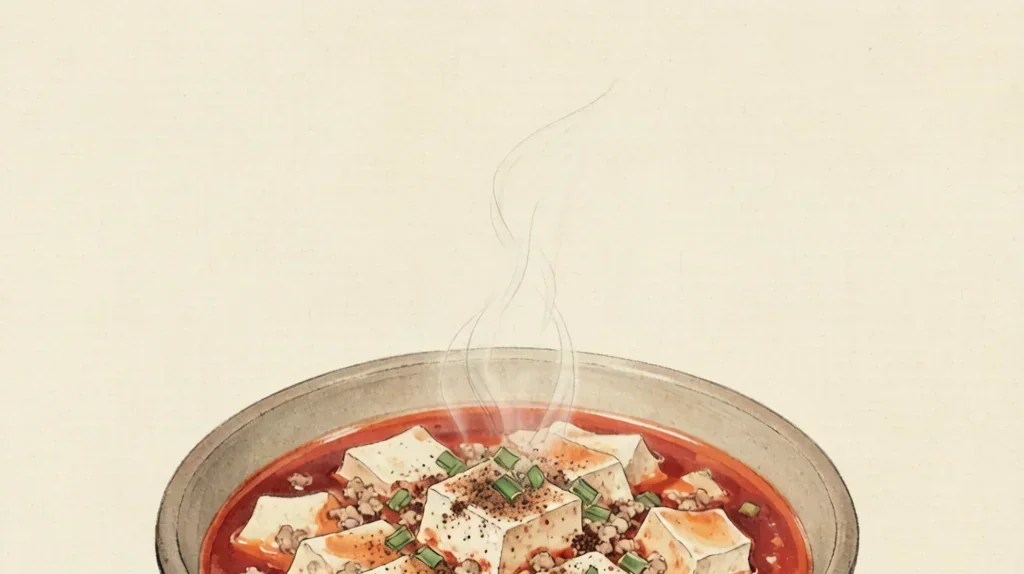
Mapo tofu is one of the most recognizable dishes to travel out of China's southwestern Sichuan Province, and for good reason: few foods deliver as much drama in a single bowl. In Chinese it is called má pó dòu fu, written 麻婆豆腐. The name literally pairs má (numbing) with pó (old woman or grandmother), and the dish is exactly what that strange pairing promises — soft cubes of soybean curd bathed in a sauce that is at once numbing, spicy, aromatic, and deeply savory. For an English-speaking cook or diner encountering it for the first time, mapo tofu can feel like a challenge to the senses. Yet behind its fiery reputation lies a dish with a clear history, a precise flavor logic, and a cherished place in the everyday cooking of Chengdu and beyond. This article explores where mapo tofu came from, what goes into it, how it is made, and why it has become a global ambassador for Sichuan flavor.
Origins of a Humble Dish
The most widely told origin story places mapo tofu in late nineteenth-century Chengdu, the relaxed, food-obsessed capital of Sichuan. According to tradition, a small restaurant near the Wanfu Bridge on the outskirts of the city was run by a couple. The wife had a pockmarked face — in Mandarin, má can suggest the speckled marks of smallpox, and pó is an honorific for an older woman — so locals affectionately called her Mapo, the "Pockmarked Granny." Travelers and porters stopping at her husband's oil-and-tofu shop would ask for a quick, filling meal, and the resourceful woman began cooking tofu in a chili-and-bean-paste sauce thickened with a little ground beef. The dish was cheap, warming, and unforgettable, and the name stuck.
Whether or not every detail of that legend is historically exact, the story captures something true about Sichuan street food: it was born from ordinary people feeding other ordinary people, not from palace kitchens. Mapo tofu's genius is that it turns the humblest of ingredients — tofu, a few spoonfuls of fermented paste, a handful of meat — into something luxurious through technique and spice. By the early twentieth century the dish was firmly established in Chengdu's restaurant culture, and cookbooks of the Republican era list it among the city's defining preparations.
The Regional Heart: Sichuan and the Málà Spirit
To understand mapo tofu you must understand málà, the "numbing-spicy" pairing that defines so much of Sichuan cooking. Má is the tingling, almost electric numbness produced by Sichuan peppercorn (huājiāo), a small reddish-brown berry with a citrusy, woodsy fragrance that is unrelated to the black or white peppercorns familiar in the West. Là is the heat of dried chili. Together they do not simply make food hot; they create a layered sensation in which the tongue is first cooled and tingled, then set alight, leaving the eater alert and a little exhilarated.
Sichuan's famously humid climate is often cited as the reason its people reached for chili and pungent spices — the idea being that sweating helps the body cope with dampness. Whatever the medical truth, the result is a regional palate that prizes complexity over raw fire. Mapo tofu is a perfect teaching example of this: a well-made version is not merely "spicy," but balanced across several registered tastes — numbing, hot, salty, fragrant, and faintly sweet — with the softness of tofu providing constant relief. Sichuan cuisine as a whole is counted among China's Eight Great Cuisines, and mapo tofu is one of its most eloquent spokesdishes.
Ingredients That Do the Work
The ingredient list for mapo tofu is short, but each element earns its place. The star is dòu fu — fresh soybean curd — ideally the soft, silken variety that quivers on the spoon yet holds its shape through gentle simmering. Against it sits a small amount of ground meat, traditionally beef in Chengdu though pork is common elsewhere; the meat is there for savory depth rather than as the centerpiece. The soul of the sauce is dòubànjiàng, a fermented paste of broad beans and chili that Sichuan calls the "soul of the cuisine," and dàdòuchǐ, fermented black beans that add a funky, salty bass note.
Around these anchors gather the aromatics: garlic, ginger, and scallion; the all-important Sichuan peppercorn, toasted and ground; and dried chili or chili oil for heat and color. The dish is finished with a slurry of cornstarch that gives the sauce its glossy, clinging texture, and often a final shower of scallion greens. Some modern versions enrich the sauce with a spoonful of stock. The point is restraint: mapo tofu is not a pantry raid but a careful composition in which one or two dominant flavors are supported, never smothered, by the rest.
How Mapo Tofu Is Made
Making mapo tofu at home is approachable, and the sequence rewards attention. The tofu is first cut into neat cubes and blanched briefly in lightly salted water; this firms the curd and removes any faint beaniness, and it makes the cubes far less likely to crumble later. While the tofu rests, the cook heats oil and blooms the Sichuan peppercorns and chili, then adds the fermented bean paste and black beans, stirring until the raw edge cooks off and the kitchen fills with fragrance. Ground meat goes in next, broken up and browned so it distributes in tiny savory specks throughout the sauce.
Stock or water is added to loosen the mixture into a simmering broth, and the drained tofu cubes are slid in and gently folded rather than stirred — vigorous stirring is the enemy of intact tofu. The mixture is left to bubble a few minutes so the curd absorbs flavor, then thickened with cornstarch slurry until the sauce turns silky and coats each piece. A final scatter of toasted Sichuan pepper and scallions goes on top. The classic Chengdu touch is to serve it rippling and hot, with plain steamed rice standing by to absorb the sauce. The whole process takes well under half an hour, which is part of why it became a working-person's staple.
Cultural Meaning and the Seven Characteristics
Chinese food writers sometimes describe an ideal mapo tofu through a set of poetic descriptors: má (numbing), là (spicy), tāng (hot temperature), xiān (fresh-savory), rén (tender), nián (soft-clinging), and huá (smooth). Together they read almost like a checklist of pleasures, and they show how seriously Sichuaners take the balance of a dish that outsiders might dismiss as "just spicy." Mapo tofu also embodies a broader Chinese culinary value: the elevation of the cheap and plain through skill. Tofu was long a food of monks, farmers, and the poor; transforming it into a restaurant headliner is a quiet democratic triumph.
Beyond technique, the dish carries the warmth of its legend — the image of a pockmarked grandmother feeding travelers at a bridge. That human story is part of why mapo tofu feels hospitable rather than intimidating. In Chengdu today, ordering mapo tofu is as natural as ordering fries in the West, and the dish travels well: it appears in homes from Sydney to San Francisco, often adapted with local tofu and a gentler hand on the chili, yet always reaching back to that bridge-side kitchen.
When and How It Is Eaten
Mapo tofu is fundamentally a home-and-everyday dish, not a festival food. It is eaten as one of several shared plates at a Sichuan meal, almost always alongside plain rice, whose mildness is the perfect counterpoint to the sauce. Because it is quick to prepare and uses pantry staples, it is a weeknight favorite across China wherever Sichuan ingredients are available. In Chengdu and Chongqing it also appears in specialist restaurants where chefs compete to balance the numbing and the hot to a razor's edge.
For the visitor, mapo tofu is often an early, thrilling lesson in what Sichuan food really is. A first encounter can be startling — the Sichuan peppercorn's tingle is unlike any other spice — but most people quickly learn to love it. Served sizzling in a ceramic bowl, eaten with rice and perhaps a cooling side dish of cucumber, mapo tofu is less a test of endurance than an invitation: come sit, eat, and let an old woman's recipe look after you.
Pixian Bean Paste: The Soul of Chengdu
If mapo tofu has a single soul, it is Pixian bean paste. Made in Pixian county near Chengdu from broad beans, chili, salt, and flour, the paste is fermented in open earthen vats through hot summers and cold winters, sometimes for years, until it turns a deep reddish brown and develops a funky, savory complexity no quick substitute matches. The climate and the microbial air of the region are considered essential, which is why true Pixian paste carries a geographic reputation like a wine appellation. In mapo tofu it provides the savory backbone against which the peppercorn and chili play, and across Sichuan it seasons everything from fish to green beans. Understanding the paste explains why the dish cannot be faked with generic chili sauce: the depth comes from patient fermentation, a slow craft hidden inside a fast, fiery bowl.
Mapo Tofu in Home Kitchens
Beyond restaurants and legend, mapo tofu is a weeknight workhorse in ordinary Chinese homes. It uses pantry staples, tofu, a spoon of bean paste, a little ground meat, and aromatics, and comes together in under half an hour, which is exactly why busy cooks return to it. Families tune it to taste: more peppercorn for thrill, less chili for children, extra tofu for a lighter plate, sometimes swapped entirely for mushroom to keep it vegetarian. Served steaming over plain rice, it is the kind of dish that stretches a small amount of meat across a meal and still feels generous. Its home appeal is the flip side of its restaurant fame, proof that a dish can be both a Sichuan showpiece and a Tuesday dinner. The pockmarked granny's recipe survives not in museums but in millions of everyday woks.
❓ Frequently Asked Questions
📝 Chinese Vocabulary
麻婆豆腐 — : Mapo tofu, the numbing-spicy Sichuan dish of soft tofu in chili-bean sauce.
豆腐 — : Tofu, fresh soybean curd, the soft base of the dish.
花椒 — : Sichuan peppercorn, the berry that creates the numbing má sensation.
豆瓣酱 — : Fermented broad-bean and chili paste, the savory soul of the sauce.
麻辣 — : "Numbing-spicy," the defining flavor pairing of Sichuan cuisine.
豆豉 — : Fermented black beans, the salty, funky bass note that deepens the sauce of mapo tofu.
郫县豆瓣 — : Pixian bean paste, the prized fermented broad-bean and chili paste from Pixian county that is the soul of Chengdu cooking.
万福桥 — : Wanfu Bridge, the Chengdu bridge where the Pockmarked Granny is said to have run the original mapo tofu stall.
🎉 Fun Facts
- The legend says Mapo ran her tofu stall by the Wanfu Bridge on the southern edge of old Chengdu, feeding laborers and porters passing through.
- Sichuan peppercorn is not related to black pepper; it belongs to the same family as citrus and was once banned in the United States as a potential crop pest.
- A "mapo" flavor is now bottled as a ready-made sauce mix across Asia, letting home cooks replicate the dish in minutes.
- The dish's fame is such that Chengdu officially lists it among the city's intangible cultural heritage foods.
- Authentic Pixian bean paste is fermented for months to years in large earthen vats, developing the deep, funky character that defines Chengdu cooking.
- Mapo tofu appears on nearly every Sichuan restaurant menu worldwide, often serving as a visitor's very first taste of the numbing-spicy mala flavor.