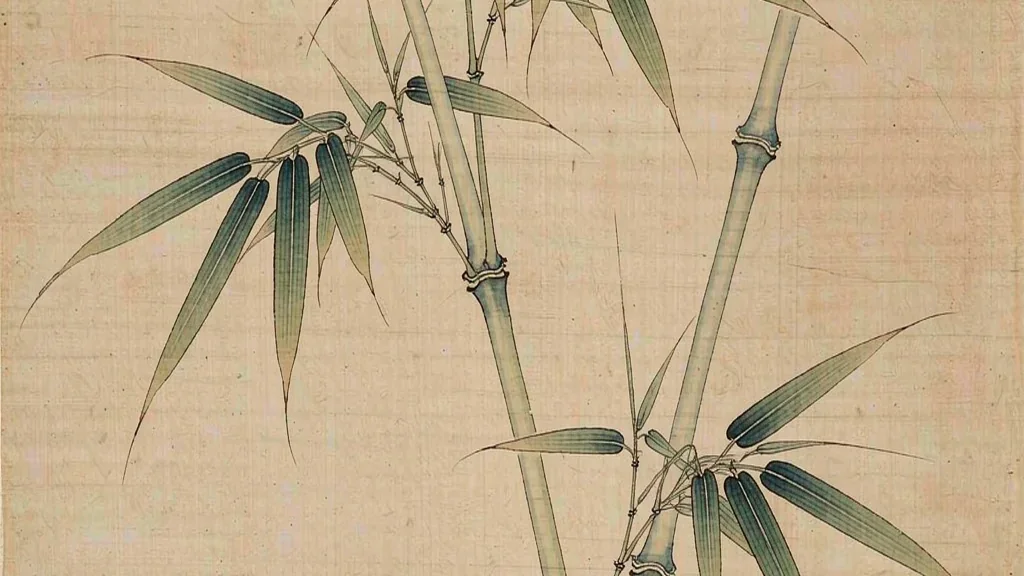
Bamboo (竹, zhú) is perhaps the most painted plant in the entire Chinese tradition and a founding member of both the "Four Gentlemen" (四君子) and the "Three Friends of Winter" (岁寒三友). It earned this honor because its straight jointed stalk, its ability to bend without breaking in the wind, and its evergreen leaves made it a perfect picture of the gentleman: upright in principle, flexible in conduct, and constant through hardship. Painted almost always in ink, with a few disciplined strokes, bamboo became the first subject many students learn and the lifelong test of a master's control.
Why Bamboo Became a Gentleman
The bamboo's meanings are unusually rich. Its hollow center suggested humility (an empty mind ready to learn); its straight segments suggested integrity; its nodes suggested moral steadfastness; and its bend-without-breaking posture suggested resilience.
As one of the Three Friends of Winter, bamboo stays green when other plants wither, marking it as a companion in adversity. With plum and pine, it forms a tight emblem of loyal friendship.
In the Four Gentlemen set, bamboo carries the lesson of integrity joined to flexibility—a balance Chinese thought prized above either quality alone.
Early Literary and Pictorial Roots
Bamboo appears in Chinese literature from the earliest poetry, and the plant was a constant of garden and studio life. By the Tang dynasty it was a recognized painting subject, often paired with rocks and the figures of scholars.
The scholar-official Wang Wei and others of the Tang painted bamboo, and the plant's simple geometry—a column and leaves—made it ideal for the brush from the start.
Its rise tracks the growth of the literati sensibility, for bamboo asked less for color than for characterful line, exactly what the amateur scholar practiced daily in calligraphy.
Wen Tong and the Huzhou Bamboo School
The Northern Song painter Wen Tong (文同, 1018–1079) is the towering name in bamboo painting. He observed bamboo so closely that, the story goes, he always carried a piece of bamboo in his mind before lifting the brush.
From this came the famous idiom "having a complete bamboo in the chest" (胸有成竹, xiōng yǒu chéng zhú): to plan thoroughly before acting. Wen Tong's careful, rounded leaves set a standard.
He was linked to Huzhou (湖州), and his followers are called the "Huzhou bamboo school" (湖州竹派), a lineage that shaped how bamboo was painted for centuries.
Su Shi and the Theory of Bamboo
Wen Tong's cousin-in-law Su Shi (苏轼, 1037–1101)—poet, calligrapher, and theorist—wrote memorably about bamboo, arguing that one must grasp the whole plant's spirit, not just copy leaves. He even claimed that if you seek only segments and leaves, "where will you find bamboo?"
Su Shi's essays helped turn bamboo painting into a philosophical act: the painter must understand the living thing before the image. This idea fed the literati emphasis on insight over imitation.
His friendship circle made bamboo a shared literati language, painted, praised, and exchanged among the scholarly elite.
Technique: Stalk, Node, and Leaf
A bamboo painting is built from three parts. The stalk is a series of upright or leaning segments painted in one continuous, even stroke, with a small break at each node to mark the joint.
The leaves are grouped in clusters of varying count—often in "characters" of three, four, or five strokes—and must show direction and weight, since a floating or repetitive leaf betrays the hand.
Because bamboo is monochrome, everything depends on rhythmic brush pressure; the best leaves look as if blown by a single wind. Ink tone separates near and far stalks.
Bamboo with Rocks and Other Subjects
Bamboo is frequently paired with rocks (石, shí), whose hard stillness contrasts the plant's supple movement. The combination is a miniature essay on firmness and pliancy.
It also appears with plum and pine (the Three Friends), with orchids, and with the figure of a scholar in a garden. Such groupings let one scroll carry several moral lessons at once.
In handscrolls and albums, bamboo passages show the painter's breath and speed more nakedly than almost any other subject, which is why masters return to it.
Cultural Role in the Scholar's Life
In the scholar's studio, a bamboo scroll was both decoration and self-portrait. Its upright-yet-yielding form mirrored the conduct expected of an official amid factional courts.
Bamboo was exchanged among friends as a wish for steady character, and planted in gardens so the living plant reinforced the painted one. The art constantly referred to daily life.
To paint bamboo well was thus a kind of moral exercise; the steady hand and composed mind required were themselves virtues.
Legacy and Living Tradition
Bamboo remains the conventional first subject for ink students because it teaches the controlled line that everything else builds on. Amateur clubs across China and abroad still practice it.
The idiom "having a complete bamboo in the chest" long ago left painting to become everyday speech for good preparation, a sign of how deeply the image entered the language.
Contemporary ink artists continue to reinvent bamboo—sometimes with new materials or abstraction—yet its identity as the plant of upright, flexible virtue endures undimmed.
❓ Frequently Asked Questions
Why is bamboo such an important painting subject?
Its straight jointed stalk, wind-bent flexibility, and evergreen leaves made it an image of the gentleman—upright yet yielding, constant through hardship. It is both a Gentleman and a Friend of Winter.
Who was the famous bamboo painter?
Wen Tong (1018–1079), a Northern Song master whose careful rounded leaves set the standard. His followers form the Huzhou bamboo school, and his cousin-in-law Su Shi wrote influential theory about the plant.
What does "a bamboo in the chest" mean?
It is the idiom xiōng yǒu chéng zhú, from Wen Tong's practice of knowing the whole plant before painting. It now means to plan thoroughly before acting, and has left painting for everyday speech.
How is bamboo painted?
The stalk is segments painted in even strokes with a break at each node; leaves are clustered strokes showing direction and weight. Monochrome ink tone separates near and far stalks.
What does bamboo symbolize?
Hollow center for humility, straight segments for integrity, nodes for steadfastness, and bending without breaking for resilience. With pine and plum it marks friendship in adversity.
Is bamboo still taught today?
Yes. It is typically the first subject for ink beginners because it trains the controlled line, and it remains practiced by amateur painters in China and abroad.