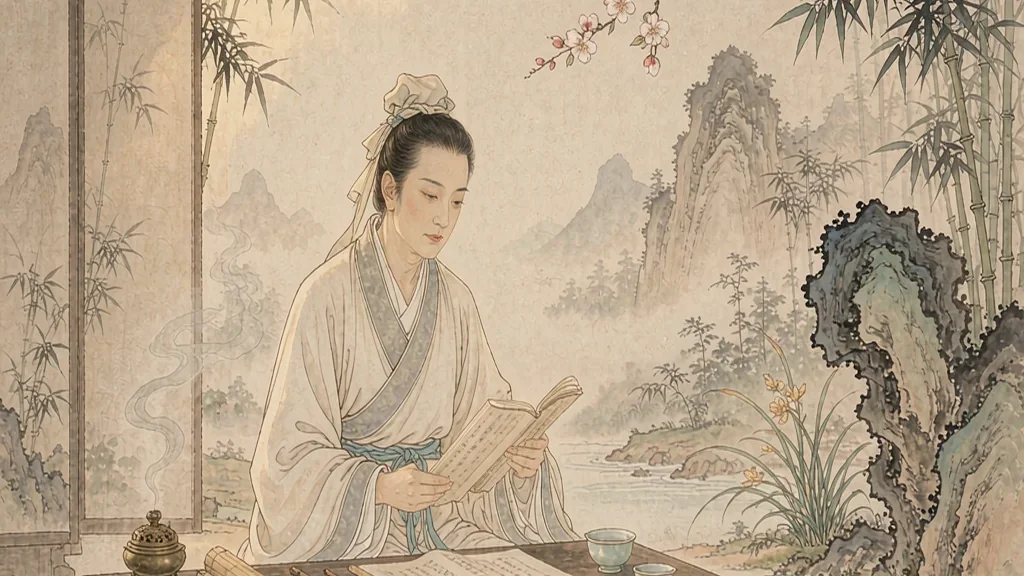
Literati painting (文人画, wénrénhuà) is the tradition of China's scholar-officials—men trained in the classics who painted as amateurs, for themselves and their friends, rather than for court or market. From the Song onward it became the most influential stream in Chinese art, built on the idea that a painting's value lies less in likeness than in the painter's character, learning, and spontaneous brush. The ideal work joined poetry, calligraphy, painting, and seal into one surface, so that to read it was to meet the mind of a cultivated person. Its leading theorists, above all Dong Qichang, made "literati" almost synonymous with "serious Chinese painting."
Who Were the Literati?
The wénrén were members of the educated elite who entered service through the imperial examination system, steeped in Confucian classics, history, and poetry. Many were also calligraphers by daily habit.
They painted not to earn a living but to express feeling, sharpen the mind, and bond with peers. Amateur status was itself a mark of freedom from commerce and a claim to moral independence.
Because they controlled the writing of criticism and history, the literati shaped the very terms in which Chinese painting came to be judged—often to the disadvantage of professionals.
Early Voices: Su Shi and the Song Turn
The Song poet and official Su Shi (苏轼, 1037–1101) is a founding voice. He argued that a painting should capture the "idea" (意, yì) of a thing rather than its surface, and praised painters who were first of all men of letters.
With friends such as Mi Fu (米芾), Su Shi promoted an art of relaxed, calligraphic brushwork and personal tone, treating painting as a branch of writing. This set the literati apart from the careful academy.
The phrase that a gentleman may "paint as he writes" captured the new self-image: the brush was one instrument across all arts.
The Yuan Masters and the Mature Ideal
After the Ming fall, the Yuan period (1271–1368) saw scholar-painters turn inward. The "Four Yuan Masters"—Huang Gongwang, Ni Zan, Wang Meng, and Wu Zhen—simplified forms, dried their brush, and opened up emptiness.
Ni Zan's sparse riverside trees and Huang Gongwang's long "Dwelling in the Fuchun Mountains" show the literati ideal at full maturity: personal, literary, and quietly expressive rather than grand or decorative.
This generation made the album leaf and handscroll the natural homes of literati art, intimate formats for a private audience of friends.
The Union of Four Arts on One Surface
The signature literati work carries painting, poetry, calligraphy, and seal together. A line of verse in the painter's own handwriting sits beside the image, and a red seal confirms authorship and mood.
This unity meant a picture was also a piece of writing and a trace of the body. To appreciate it you needed literary competence—exactly the competence the elite already had.
The practice raised painting to the level of calligraphy and poetry, the two arts the literati already honored most, and helped justify their claim to cultural leadership.
Freehand (Xieyi) and the Value of Suggestion
Literati painters favored xiěyì (写意, "writing the idea"): broad, suggestive strokes over fine description. The goal was to catch spirit (qìyùn) with economy, leaving the rest to the viewer.
This is why a literati landscape may use few strokes and much empty paper, or a bamboo may be a handful of leaves. Restraint was a sign of confidence, not poverty.
The approach also suited amateurs, who could not match a court professional's finish but could outclass one in learned ease and individual voice.
Dong Qichang and the Southern School Theory
The late-Ming theorist Dong Qichang (董其昌, 1555–1636) gave literati painting its grand historical frame. He divided landscape into a "Southern School" of amateur ink masters—Wang Wei through the Yuan masters—and a "Northern School" of professionals.
Dong ranked the Southern (literati) line higher, casting the history of painting as a moral-aesthetic ascent toward scholarly spontaneity. His scheme, though partly artificial, became the standard map of the field.
Through Dong, "literati" came to mean not just who painted but how painting ought to be judged—personal, ink-based, and learned.
Literati Painting Versus the Professional
The contrast with court and workshop painters was sharp in theory. Professionals sought finish, color, and patronage; literati sought expression, ink, and peers. Each defined itself against the other.
In practice the line blurred: some literati were fine technicians, some professionals painted with spirit, and emperors collected both. But the status hierarchy favored the amateur scholar.
This tension produced much of Chinese painting's richness, as each side pushed the other toward new effects.
Legacy and the Modern Inheritance
The literati ideal dominated Qing painting through the Orthodox masters and inspired the Individualists, and it framed how Chinese art met the modern West in the twentieth century.
Reformers like Chen Hengke and painters like Qi Baishi and Fu Baoshi reworked literati values for new times, keeping the union of poetry, calligraphy, and painting even as subjects changed.
Today "literati painting" names both a historical tradition and an ongoing sensibility—the belief that a picture is most valuable when it reveals a cultivated, free, and sincere mind.
❓ Frequently Asked Questions
What is literati painting?
It is the tradition of China's scholar-officials who painted as amateurs for self-expression and friendship. Its value lies in the painter's character and spontaneous brush rather than fine likeness or market appeal.
Who were the key literati figures?
Su Shi and Mi Fu shaped its Song theory; the Four Yuan Masters matured its style; Dong Qichang gave it a grand historical frame; and modern masters like Qi Baishi carried it forward.
What does "poetry, calligraphy, painting, seal" mean?
It is the literati ideal of uniting a verse in the painter's handwriting, the image, and a red seal on one surface, so a picture also reveals the painter's literary and calligraphic cultivation.
What is xieyi?
Xieyi means "writing the idea": broad, suggestive brushwork that catches a subject's spirit with economy, favoring emptiness and personal voice over detailed finish.
How did Dong Qichang shape the idea?
He divided landscape into a "Southern" literati school and a "Northern" professional one, ranking the Southern higher. His scheme became the standard map of Chinese painting history.
Is literati painting still alive?
Yes. It remains both a historical tradition and an ongoing sensibility, reworked by modern artists who keep the union of poetry, calligraphy, and painting while changing subjects and media.