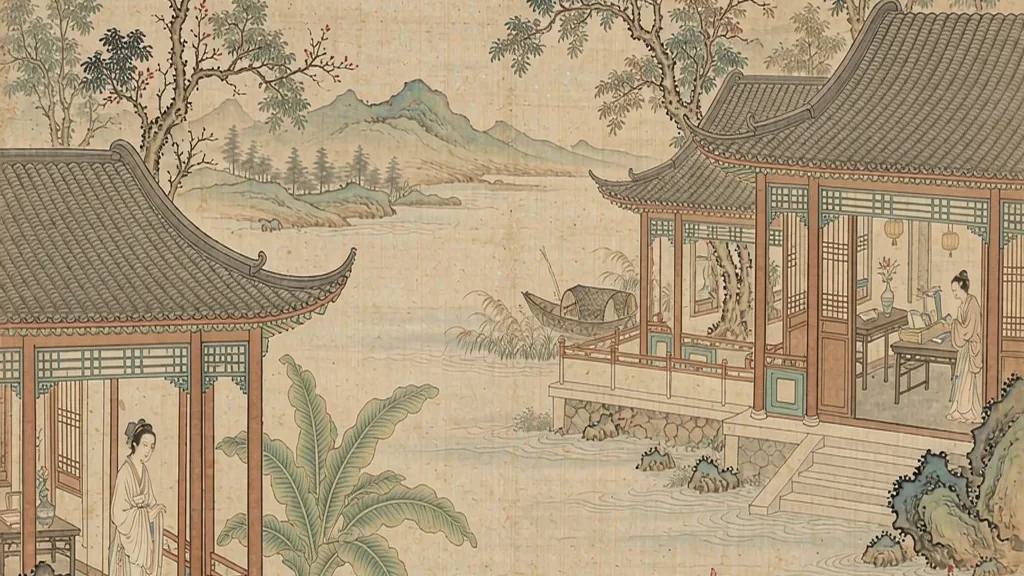
Xia Gui (夏圭, also written Xia Gu, active roughly 1190–1230) was a leading landscape painter of China's Southern Song dynasty, celebrated alongside Ma Yuan as one of the two great masters of the imperial painting academy at Hangzhou. He is best known for perfecting the "one-corner" composition, in which the main subject is pushed to a single edge of the silk and the rest is left as open, misty space, an approach that turned emptiness into a powerful expressive device. Xia Gui's loose, wet brushwork and atmospheric distance helped redefine Chinese landscape painting, shifting it from the monumental, fully filled views of the Northern Song toward a more lyrical, suggestion-driven mode that profoundly influenced later painters in China, Japan, and beyond.
Life and Historical Setting
Xia Gui lived during the Southern Song dynasty (1127–1279), the period after the Jurchen Jin conquered northern China and the Song court retreated south to establish a new capital at Lin'an, modern Hangzhou. This move placed the academy of painters in a prosperous, lake-and-mountain environment that shaped a distinctly southern sensibility in art. Like many court artists, Xia Gui is a somewhat shadowy historical figure; we know him mainly through his surviving works and through later records such as the collectible notes of the Yuan and Ming periods.
He is conventionally listed among the "academy painters" (yuanhua) who served the Southern Song emperors, and he is often paired with Ma Yuan (active c. 1190–1225) so closely that later critics coined the phrase "Ma–Xia" (马夏) to describe their shared style. Within the academy he is said to have held the rank of "Painter-in-Attendance" (daizhao), one of the titled positions open to skilled professionals at court.
The Southern Song Academy
The Southern Song imperial academy was smaller and more informal than its Northern Song predecessor, but it remained the most important institution for professional painting of its age. Emperors such as Gaozong and Ningzong were themselves serious patrons of the arts, and the court valued painters who could combine technical brilliance with emotional resonance. Within this setting, a style emerged that historians later called the "Ma–Xia" school.
This academy style favored intimate, cropped views over panoramic ones, thin and fluent outline brushwork, and a refined palette of ink tones enlivened by touches of color. It was art made for connoisseurs and rulers, meant to be contemplated at close range rather than displayed on a grand public wall, and Xia Gui became its most innovative landscape exponent.
The "One-Corner" Composition
Xia Gui's signature contribution is the "one-corner" or "partial-view" composition (一角 / 边角构图). Instead of centering a mountain or filling the whole surface, he placed a cliff, a few trees, or a riverside pavilion at one side or a corner, leaving vast expanses of silk blank or only faintly washed with mist. The empty areas were not "nothing"; they were mist, water, sky, and distance.
This asymmetry was a deliberate aesthetic choice. By withholding most of the scene, Xia Gui invited the viewer to complete the painting mentally, a mode of participation that later became central to literati theories of painting. The device also created a sense of boundless space on a small, handheld album leaf or fan.
Brushwork and Ink Tone
Technically, Xia Gui worked in ink on silk with a wet, broken, and "axe-cut" texture stroke (the so-called "axe-cut cun" associated with his school) to model rocks and cliffs. His trees were often rendered with swift, confident strokes, and his figures, boats, and pavilions were tiny but precisely placed, giving scale to the vastness around them.
He was a master of graded ink wash, building atmosphere through layers of dilute tone rather than through hard contour. Later Japanese collectors and painters particularly admired this fluid, calligraphic quality, which they associated with the spirit of Zen spontaneity, even though Xia Gui himself was a professional court painter rather than a monk.
Major Surviving Works
Xia Gui's most famous extant handscroll is "Pure and Remote Views of Streams and Mountains" (Xi shan qing yuan tu, 溪山清远图), a long ink landscape that drifts through cliffs, riverbanks, temples, and fishing boats with extraordinary rhythmic variety. Although its early history is complex and some sections may reflect later hands, it remains the key reference for his manner.
Another important work is the album or fan tradition grouped as "Twelve Views of Landscape" (shan shui shi er jing, 山水十二景), of which only a fragment survives; it shows exactly the one-corner cropping and misty recession that define his fame. A poem attributed to the emperor Ningzong appears on some versions, underscoring his court status.
Relation to Ma Yuan
Ma Yuan and Xia Gui are so entwined in later literature that it is easy to confuse them, yet they had distinguishable tendencies. Ma Yuan's compositions often anchor a diagonal from a corner with a foreground tree or rock and a distant peak, while Xia Gui's recession is usually softer and more water-bound, with broader expanses of mist. Both, however, share the cropped format and the lyrical mood.
The pairing was canonized by Ming-dynasty critics, who sometimes judged the "Ma–Xia" manner as too "merely skilled" when measured against the moral seriousness expected of literati painting. That criticism tells us more about later taste than about the painters' actual achievement, which was immense.
Influence in China
Within China, Xia Gui's manner was carried forward by Yuan and Ming professional landscapists and by the "Zhe School" (Zhe pai) of the early Ming, whose leaders such as Dai Jin absorbed the wet brushwork and cropped compositions of the Southern Song academy. Even painters who formally rejected "professional" styles borrowed his sense of spatial economy.
During the Qing dynasty, as literati ideals dominated, Xia Gui was less frequently imitated directly, but his works remained in imperial collections and were copied by court painters. The one-corner idea never disappeared; it simply migrated into the vocabulary of suggestion that all later Chinese landscape relied upon.
Influence in Japan
Xia Gui's impact was especially strong in Japan, where Southern Song academy painting arrived through trade and Zen temple exchanges. Japanese connoisseurs called such works "Xiá-Guí" and collected them fervently; the Karoku (Kamakura) and Muromachi periods saw Japanese ink painters such as those of the Ashikaga shogunate's studios emulate the Ma–Xia manner.
The Japanese term "haboku" (broken ink) and the whole tradition of Zen ink painting (suiboku-ga) owe a clear debt to the wet, abbreviated Southern Song style that Xia Gui helped define. In this sense, his "one-corner" emptiness became a shared East Asian visual language.
Legacy and Modern Reception
Today Xia Gui is studied as a pivotal figure in the transformation of Chinese landscape from monument to mood. Art historians read his blank spaces as a philosophical stance as much as a compositional trick, aligned with Daoist and Chan ideas about the sufficiency of the incomplete. His works are housed in major collections including the National Palace Museum in Taipei and collections in Japan and the United States.
For contemporary viewers, Xia Gui offers a lesson in restraint: that a painting can say more by showing less, and that the edge of a cliff and a band of mist can carry the weight of a whole world. His one-corner vision remains one of the most quietly radical inventions in the history of landscape art.
❓ Frequently Asked Questions
Who was Xia Gui?
Xia Gui was a leading landscape painter of China's Southern Song dynasty, active around 1190–1230, famous for the "one-corner" composition and paired with Ma Yuan as "Ma–Xia."
What is the "one-corner" composition?
It is a layout in which the main subject is placed at one edge or corner of the silk and the rest is left as open mist and space, inviting the viewer to imagine the whole scene.
Was Xia Gui a court painter?
Yes. He served in the Southern Song imperial academy at Hangzhou and is traditionally listed among the academy painters, reportedly holding the rank of Painter-in-Attendance.
What are Xia Gui's most famous works?
His best-known surviving work is the handscroll "Pure and Remote Views of Streams and Mountains," along with the fragmentary "Twelve Views of Landscape."
How did Xia Gui influence Japan?
Southern Song academy ink painting reached Japan through trade and Zen temples; Japanese ink painters emulated his wet, cropped style, which fed into the suiboku-ga tradition.
How is Xia Gui different from Ma Yuan?
Both used cropped formats, but Ma Yuan often anchors a diagonal with a foreground tree, while Xia Gui's recession is usually softer and more water-bound with broader mist.