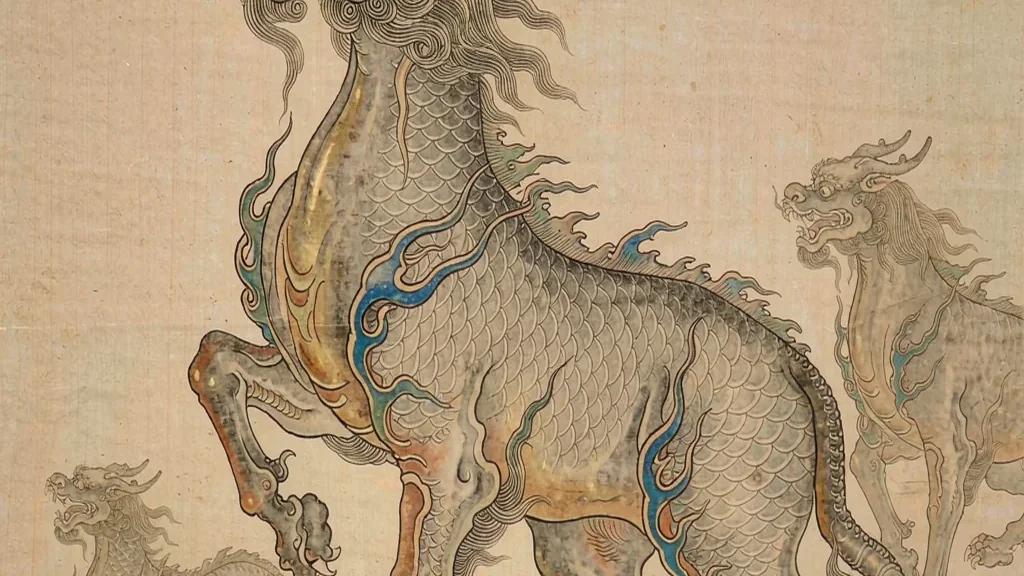
Bixie are winged, hybrid guardian creatures of Chinese art, best known from stone sculptures placed before the tombs of Han and later dynasties. Part lion, part dragon, and part winged beast, they belong to a family of apotropaic animals believed to ward off evil and protect the dead. Found predominantly along the "spirit roads" leading to elite burials, bixie rank among the most striking examples of Chinese monumental stone sculpture.
What Is a Bixie?
The term bixie means roughly "to avoid evil" or "ward off inauspicious influences," signalling the creature's protective function. It is a chimera: a powerful body like a crouching feline or canine, wings folded along the flanks, a wide scrolling mane, and often a horned or fanged head with an open, roaring mouth.
Bixie are closely related to other tomb guardians such as the tianlu (heavenly deer or unicorn-like beast) and the qilin. In many excavated contexts the two appear as a pair, one sometimes identified as a male and the other as a female guardian.
Unlike the more familiar dragon or phoenix, the bixie is essentially a funerary and apotropaic being rather than an auspicious imperial symbol, though the broader family of winged beasts overlaps with celestial imagery.
Origins and Early Forms
Winged protective beasts have deep roots in Eurasian art, and Chinese examples appear from the Warring States period onward, influenced by steppe and Near Eastern motifs of winged lions and griffins carried along the Silk Routes.
The classic stone bixie flourished under the Eastern Han dynasty (first to third century CE), when carved beasts lined the approach roads to the tombs of emperors, princes, and high officials. The famous pair before the tomb of the Han prince Liu Sheng's kin at Mancheng and the Xiao dynasty tombs near Nanjing show the type at its monumental best.
These early works balance naturalism in muscle and posture with stylization in the scrolling ornaments of mane and wing, an aesthetic that would characterize Chinese animal sculpture for centuries.
The Spirit Road
Elite tombs were approached by a "spirit road" (shendao), a processional path lined with stone statues. The bixie stood among the first figures encountered, facing outward to repel malign forces before the soul reached its resting place.
The spirit road could extend for hundreds of metres and include steles, pillars, civil and military officials, horses, and other beasts. The bixie's position near the entrance gave it a commanding apotropaic role.
Such arrangements reveal how sculpture served cosmology: the arrangement of figures was less documentary than liturgical, choreographing the journey between the world of the living and the realm of the ancestors.
Defining Physical Features
A typical bixie crouches with forelegs extended and haunches coiled, ready to spring. The head is large, with bulging eyes, a broad nose, and curled horns; the mouth is open in a silent roar. Wings are rendered as feathered or scrolled shapes along the shoulders.
The body surface carries flowing lines suggesting fur and flame-like scrolls, while the base is often a simple plinth. Size varied from modest table pieces to colossal outdoor guardians several metres long.
Carvers used the hardness of the stone — usually a fine limestone or sandstone — to hold crisp detail, while the overall mass conveyed permanence and authority.
Regional Schools
The most celebrated bixie come from two heartlands: the Han and later tombs around present-day Hebei and Henan in the north, and the Southern Dynasties tombs near Nanjing and Danyang in the lower Yangtze.
Southern examples of the fifth and sixth centuries are especially elongated and graceful, with soaring necks and sweeping wings, reflecting a distinct regional taste. Northern works tend to be stockier and more massive.
These regional differences help art historians date and attribute unprovenanced pieces, since style is closely tied to place and period.
Symbolism and Belief
The bixie embodied the belief that the boundary of a tomb was also a boundary between order and chaos. By stationing a fearsome, otherworldly beast there, the living sought to keep demons and misfortune from disturbing the deceased or leaching back into the world.
Wings signified the creature's ability to move between earthly and heavenly spheres, escorting the spirit upward. The open mouth was both a roar of defiance and a channel for breath or qi.
In this way the bixie fused protection, transit, and potency into a single sculptural idea.
Later Transformations
After the Tang, freestanding stone bixie declined as tomb sculpture shifted toward bureaucratic and military figures. The motif survived, however, in smaller jade, bronze, and ceramic versions kept as personal amulets against evil.
In popular later usage the name "bixie" broadened to any evil-warding charm, and the winged beast became a decorative motif on furniture, seals, and scholar's objects.
The creature thus migrated from the tomb entrance into the household, retaining its old function of protection in a new, intimate scale.
Legacy and Collecting
Today the great outdoor bixie are protected monuments, several listed among China's most important carved stone treasures. Rubbings of their surfaces were once made for study, though this practice is now restricted to preserve the stone.
Museums in China and abroad display bixie to illustrate the achievement of early Chinese sculpture, which is sometimes overshadowed by ceramics and bronzes in popular accounts.
The bixie remains a potent emblem of how Chinese art gave form to the unseen guardians of the afterlife.
Bixie in Popular Charm
Later Chinese kept the bixie idea alive in small jade, bronze, and ceramic charms carried to ward off evil, even when the great stone guardians had long left the tomb.
The name broadened to mean any apotropaic object, and the winged beast appeared on seals, furniture, and scholar's desk items as a quiet protector.
Thus a funerary colossus shrank into a pocket guardian without losing its old job.
Bixie and the Dragon
The bixie shares traits with the dragon—scales, horns, and power—yet remains a distinct, earthbound guardian rather than a celestial ruler. The two sometimes appear together in art.
Where the dragon brings rain and imperial authority, the bixie brings protection at the threshold. Their contrast shows the range of Chinese composite beasts.
Understanding the bixie clarifies how the Chinese populated the world with specialized spirits.
❓ Frequently Asked Questions
What does bixie mean?
It means roughly "ward off evil," naming the creature's role as a protective guardian.
Where were bixie placed?
Along the spirit road at the entrance to elite tombs, facing outward to repel malign forces.
Are bixie real animals?
No; they are mythical chimeras combining feline, dragon, and winged-beast traits.
When did they appear?
Winged guardian beasts developed from the Han period and peaked in the Southern Dynasties.
How do bixie differ from qilin?
The qilin is a gentle auspicious omen, while the bixie is a fierce funerary protector.
Do bixie still exist today?
Yes, as protected stone monuments and as smaller jade or bronze charms.