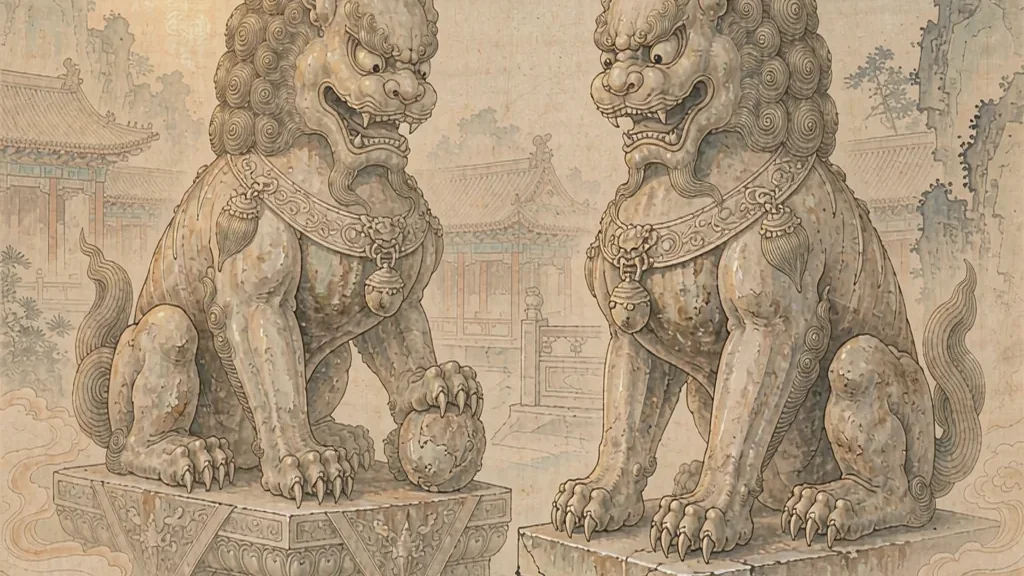
They guard the gates of temples, government buildings, and wealthy homes throughout China — pairs of stone lions (石狮, shíshī) that have stood watch for centuries. With their bulging eyes, snarling mouths, and massive paws resting on embroidered balls or cubs, these stone guardians are among the most recognizable symbols of Chinese culture. They are also among the least understood: the 'lion' in Chinese tradition is not the African or Asian lion of nature but a mythical creature created by sculptors who had never seen a live lion.
The Buddhist Origins of the Stone Lion
The stone lion was introduced to China through Buddhism, which arrived in the first century CE. In Buddhist tradition, the lion was the symbol of the Buddha's teaching — the 'lion's roar' that awakens sentient beings. Early Buddhist art in China included sculpted lions as guardians of temple gates, following the Indian tradition of placing lion figures at the entrances to sacred spaces.
Chinese sculptors, who had no experience of real lions, developed a stylized, composite creature that combined elements of dogs, dragons, and other Chinese animals. The result was a uniquely Chinese 'lion' that bears little resemblance to its African or Indian counterparts but is immediately recognizable as a guardian figure.
The Shape of the Guardian Lion
The classic Chinese guardian lion has a large head, bulging eyes, a broad nose, and a wide mouth that can be open or closed. The open mouth expels evil spirits; the closed mouth protects the good spirits within. The male lion places his paw on an embroidered ball (绣球, xiùqiú), symbolizing power and unity. The female rests her paw on a cub, symbolizing protection and the nurturing of offspring.
The lion's mane is carved in swirling curls that suggest the stylized clouds of Chinese art. The body is stocky and powerful. The pose is seated, with the front legs straight and the haunches lowered, ready to spring.
Materials and Techniques
Stone lions are carved from a variety of materials depending on the patron's resources. The finest are carved from white marble or granite, using hammer and chisel techniques that have changed little over centuries. Less expensive lions are made from sandstone, limestone, or even concrete.
The carving process begins with selecting a block of stone large enough for the lion. The sculptor sketches the outline on the stone surface, then cuts away the excess stone with a point chisel. The details are refined with progressively smaller tools, and the surface is smoothed with abrasives. A large stone lion can take months to complete.
The Placement and Meaning of Stone Lions
Stone lions are always placed in pairs, with the male (on the left, as you face the building) and the female (on the right). They guard the entrance against evil spirits and malicious influences. The ball under the male's paw represents the unity of the empire; the cub under the female's represents the continuity of the family.
The lions also serve as status symbols. The size and quality of the lions reflect the wealth and importance of the building they guard. A pair of massive white marble lions at the gate of a government building announces the authority of the institution within.
The Stone Lion in Chinese Culture
The stone lion has become deeply embedded in Chinese culture. The 'lion dance' (舞狮, wǔshī) performed during the Spring Festival and other celebrations is based on the stylized movements of stone lions. Lion imagery appears on New Year pictures, embroidery, and household decorations.
In Chinese folklore, the lion is a protective spirit that drives away evil. Even today, pairs of small stone lions can be seen guarding the entrances of Chinese homes, restaurants, and businesses around the world.
The Spread of Stone Lions Across China
From their beginnings as Buddhist temple guardians, stone lions spread to every corner of Chinese society. By the Ming and Qing dynasties, stone lions guarded government offices, military camps, examination halls, wealthy homes, bridges, and even the entrances to villages. The presence of stone lions marked a place as important and protected.
The style of stone lions varied by region. The lions of northern China, particularly those in Beijing, are more massive and formal, with a strong, solid presence. The lions of southern China, particularly in Fujian and Guangdong, are more lively and expressive, with open mouths that seem to bark and bodies poised as if about to spring.
The Lion Dance Connection
The stone lion's pose and expression directly influenced the Chinese lion dance (舞狮, wǔshī), a performance art that dates back to the Tang dynasty. The lion dance uses two performers — one controlling the head, one the body — to imitate the movements of the guardian lion: the proud stance, the watchful gaze, the playful pawing of the ground.
The lion dance is performed during the Spring Festival, at business openings, and at other celebratory events. The dance is believed to bring good luck and drive away evil spirits — the same function as the stone lions themselves. The connection between the stone lion and the dance lion is a direct link between monumental sculpture and living performance.
Stone Lions in the Modern Era
Stone lions continue to be carved and installed in modern China. New buildings, including government offices, banks, and hotels, often have stone lions at their entrances. The style has become standardized, with most modern stone lions following the Qing dynasty conventions.
Outside China, stone lions can be found in Chinatowns around the world, guarding the entrances to Chinese restaurants, temples, and community centers. The Chinese stone lion has become a global symbol of Chinese culture, recognized everywhere as a sign of protection and authority.
❓ Frequently Asked Questions
📝 Chinese Vocabulary
石狮 — : stone lion; guardian figure
绣球 — : embroidered ball; the male lion's symbol of power
门神 — : door god; related protective figures
舞狮 — : lion dance; a traditional Chinese performance
辟邪 — : to ward off evil; the function of guardian lions
绣球 — : embroidered ball; the male lion's symbol
舞狮 — : lion dance; traditional performance based on guardian lions
卢沟桥 — : A historic bridge near Beijing, renowned for the hundreds of small carved stone lions that adorn its balustrades, long a favorite subject for counting contests.
🎉 Fun Facts
- The marble stone lions guarding the Imperial Gate in Beijing weigh over 2,000 kilograms each.
- In Chinese, the word for 'lion' (狮, shī) is a homophone with 'master' (师, shī) — adding to the lion's associations with authority.
- Stone lions are sometimes called 'Chinese guardian lions' or 'foo dogs' — the latter is a Western misnomer that confuses them with dogs.
- The stone lions at the entrance of the HSBC Building in Shanghai each weigh over 10 tons and had to be transported on specially reinforced roads.
- Stone lions are sometimes called 'shi gan' (石敢当) in folk tradition — 'the stone that dares to block' evil spirits.
- The pair of large guardian lions outside the Forbidden City's main gates are so beloved that visitors have polished their cubs and balls bright by touch, a modern habit of seeking luck from the stone guardians.