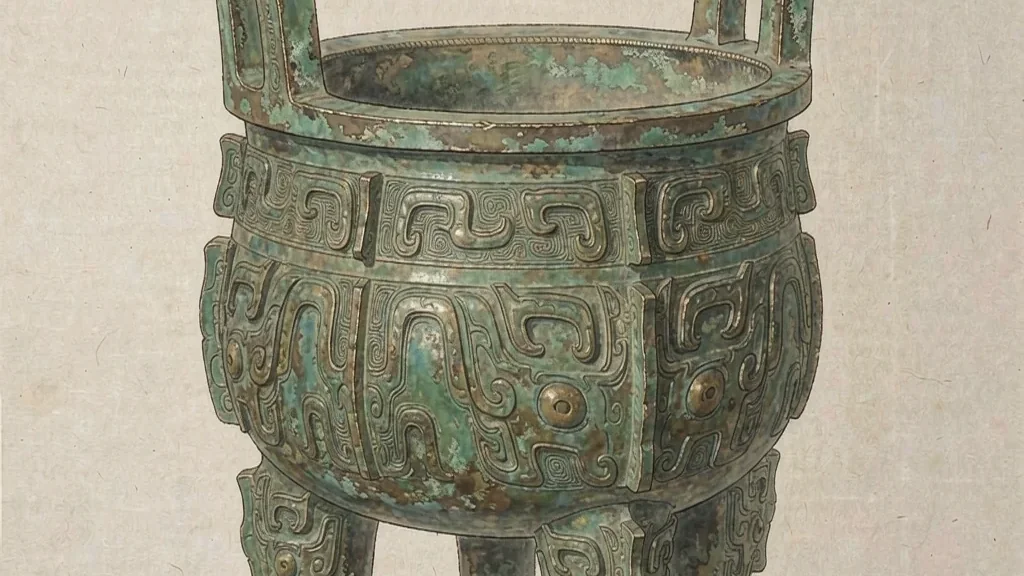
The ding is the most iconic ritual vessel of ancient China — a deep, often round-bodied cauldron supported on three legs, or a rectangular version on four. Emerging in the Neolithic and reaching its artistic height in the Shang and Zhou dynasties, the bronze ding served both to cook and to offer food to ancestors in ceremonies that bound the living and the dead. Over time it became the supreme symbol of political authority, the "tripods of state" representing legitimate rule itself.
Form and Function
A ding is defined by its legs and its two upright handles (er) across the rim. The round tripod form echoes the round heaven, while the rarer square fangding on four legs evokes square earth, a cosmological pairing central to Chinese thought.
In ritual, ding held offerings of meat and, paired with gui vessels for grain, anchored the banquet for ancestors. The number and size of ding a person could use were strictly graded by rank, making the vessel a visible index of status.
Beyond ceremony, early ding were practical cooking pots; the bronze form elevated a humble cauldron into an object of state.
Early Origins
The ding first appears in pottery among Neolithic cultures such as the Longshan, where ceramic tripods were everyday cookware. With the advent of bronze casting in the Erlitou period (often linked to early Shang), the form was translated into metal and reserved for elites.
By the Shang dynasty the bronze ding had become a vehicle for ancestor worship on a grand scale. Foundries at Anyang produced massive vessels whose weight and decoration proclaimed the power of the king and his lineage.
The transition from clay to bronze marks the moment the ding left the kitchen and entered the temple and the treasury.
The Shang Bronze Age
Shang ding are celebrated for their monumental size and their decoration in the taotie motif — a symmetrical, mask-like beast face with bulging eyes. This motif, possibly apotropaic or clan-related, wraps around the vessel in bands.
Casting used the piece-mould technique: a clay model was coated, sectioned into moulds, and reassembled around a clay core, with molten bronze poured into the gap. The method allowed complex relief without the weakness of fusion seams.
Shang bronzes achieved a high-tin alloy with a silvery gleam when freshly cast, quite different from the green patina we associate with ancient bronze today.
Zhou Developments
Under the Zhou, inscriptions (jinwen) inside ding grew longer and more historical, recording grants of land, awards, and covenants. These cast texts are among our primary sources for early Chinese history and law.
Zhou ritual codified the use of ding: the king was entitled to nine, dukes to seven, ministers to five, and lesser officials to three, a hierarchy enforced through sumptuary law. To "ask about the ding" became a metaphor for scheming after the throne.
Decoration grew finer and more literate, shifting from the fearsome taotie toward interlace, bird scripts, and elegant linear patterns.
The Tripods of State
Legend holds that the Xia founder Yu cast nine ding from metal tribute of the Nine Provinces, which then passed to the Shang and Zhou as tokens of the mandate to rule. Whoever held the nine tripods held the realm.
When the Zhou royal house declined, rulers of contending states "asked the weight of the ding," a phrase signalling ambition to usurp the king. The vessels thus functioned as portable legitimacy.
Although the original nine tripods are lost, the idiom dingzhi for the seat of government survived for millennia in Chinese political language.
Famous Examples
The Houmuwu ding (formerly Simuwu ding) from late Shang Anyang is among the largest ancient bronzes known, weighing over 800 kilograms and standing more than a metre tall, inscribed for a queen mother.
Numerous Zhou ding with long inscriptions reside in major museums, prized as much for their texts as their form. Each reveals the patron's name, the occasion, and the prayer that the vessel be used by descendants forever.
Such pieces show the ding functioning simultaneously as art, archive, and altar.
Technique of Decoration
Relief decoration was cast, not chased, by varying the thickness of the mould cavity. Secondary details could be engraved after casting, but the major ornament rose from the foundry itself.
The lost-wax method existed in China but was less central to ding production than piece-mould casting, which suited the crisp, repeated symmetry of ritual bronze style.
Handles, legs, and body were sometimes cast separately and joined, though many ding are single, seamless casts of extraordinary control.
Legacy and Meaning
Long after bronze ritual faded, the ding remained a cultural emblem: imperial courts cast commemorative ding, and the word entered idioms for stability and centrality, such as dingding (to settle or stabilize).
In modern China the ding appears in national symbols and public monuments as a sign of civilizational continuity. Reproductions teach new generations the grammar of ancient form.
From cookpot to cosmic symbol, the ding charts the long Chinese road from utility to ceremony to statecraft.
Ding in Daily Life
Before becoming purely ritual, the ding was a cooking pot used by nobles for meat, and its three legs let it sit over a fire. The bronze form elevated this everyday act into ceremony.
Even as a ritual vessel, the ding kept its culinary identity; offerings of meat linked the living feast to the ancestral one. The kitchen and the altar were not far apart.
This domestic root explains why the ding feels both grand and familiar.
Ding and the Literati
From the Song dynasty, scholars collected ancient ding as antiquities, rubbing their inscriptions and copying their forms in painting and bronze. The ding became a link to a golden classical age.
Neo-Confucian thought valued the ding as a relic of proper ritual order, and reproductions furnished temples and academies. The vessel served both archaeology and morals.
In literati hands the ding was history made tangible.
Ding in Popular Memory
The ding passed into language as a metaphor for stability and centrality. The phrase dingding still means to settle or make firm, while wen ding can mean to win the throne.
In modern public life, commemorative ding are cast for national occasions, deliberately echoing antiquity to claim continuity with the bronze age. The form thus speaks across three thousand years.
❓ Frequently Asked Questions
What is a ding?
A ding is a deep bronze cauldron on three or four legs used for ritual food offerings to ancestors.
Why were ding important?
They anchored ancestor worship and, by Zhou law, marked rank; later they symbolized political legitimacy.
What is the taotie?
A symmetrical, mask-like beast face that decorates Shang bronzes, possibly protective or clan-related.
How were ding cast?
By the piece-mould method, in which sectioned clay moulds cast crisp relief decoration.
What were the nine tripods?
Legendary vessels cast by Yu symbolizing the nine provinces and the right to rule the realm.
Where are famous ding today?
Major examples such as the Houmuwu ding are in the National Museum of China and other institutions.