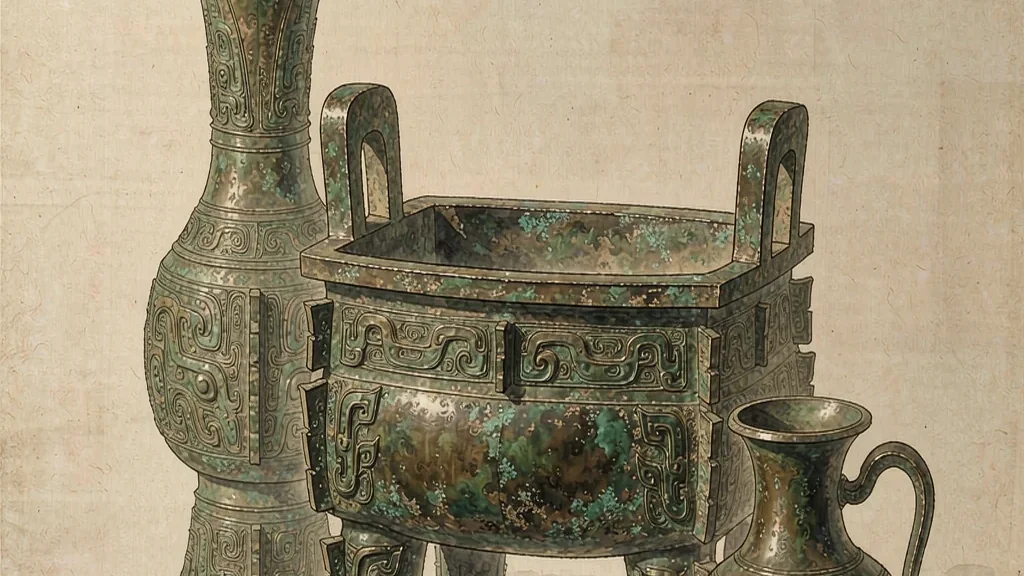
Chinese bronze ritual vessels are the masterpieces of the Shang and Zhou dynasties (roughly 1600–256 BCE), a corpus of cast metal objects used in ceremonies to honour ancestors and, by extension, to display rank and legitimize rule. From food cauldrons and wine jars to water pans and bells, these vessels formed a complete liturgical toolkit. Their precise forms, inscriptions, and decoration make them primary evidence for the religion, politics, and technology of early China.
The Ritual System
Bronze vessels were not tableware but instruments of sacrifice. Sets of ding (meat) and gui (grain) were arranged by strict count according to the user's rank, turning the altar into a diagram of the social order.
Wine vessels — jue, jia, gu, and you — served the frequent Shang and early Zhou libations to ancestors, while water vessels such as pan and yi were used in purification before rites.
The ensemble thus enacted a formal feast for the spirits, with each shape carrying a named function known from inscriptions and later ritual texts.
Shang Achievement
The Shang founded the great tradition of bronze casting at Anyang, where foundries produced vessels of astonishing size and thinness. The bronze alloy (copper with tin and lead) was tuned for hardness and ring.
Decoration centres on the taotie mask, framed by dragons, leiwen (square spiral) grounds, and flanges. The effect is hieratic and powerful, suited to communication with ancestors.
Shang bronzes were buried with the elite and, because bronze resists decay, survive in numbers that outstrip any other Shang art form.
Zhou Inscriptions
The Zhou expanded the use of cast inscriptions, often inside the vessel mouth or on the bottom. These jinwen record grants, treaties, punishments, and pious wishes that descendants use the vessel forever.
Such texts are invaluable: they name real people and events, sometimes corroborating or correcting the later written histories. A single vessel can settle a debated chronology.
The growth of writing on bronze marks the shift from Shang visual terror to Zhou textual authority.
Major Vessel Types
Beyond the ding and gui, important forms include the jue and jia (tripod wine warmers), the gu (slender beaker), the you (covered wine jar), the zun (wine vessel), and the lei (jar).
Each type has a stable silhouette repeated across centuries, so shape alone lets specialists date a piece. Hybrid and eccentric forms appear in the late Zhou as old rules loosened.
This typology is the grammar of Bronze Age material culture, taught through museum collections worldwide.
Casting Method
Chinese bronzes were made by the piece-mould (section-mould) method rather than lost-wax for most ritual ware. A model was coated in clay, cut into sections, reassembled around a core, and poured.
Relief was built into the mould, so the decoration is integral to the cast. The technique allowed large, complex vessels with crisp, repeatable ornament and few weak seams.
Handles and appendages were sometimes cast separately and joined by welding or by pouring bronze into pre-set sockets.
Regional and Later Bronze
Beyond the central plain, regions such as the south (the state of Chu) and the steppe frontier produced distinct bronzes — bell sets, exaggerated forms, and animal styles reflecting local culture.
In the Eastern Zhou, bronze increasingly served aristocrats as fine tableware and personal gear, with inlaid gold and silver and pictorial scenes. The ritual monopoly weakened.
By the Qin and Han, standardized coinage and iron tools eclipsed ritual bronze, though bells and mirrors continued.
Symbolism and Power
Because vessel sets encoded rank, control of bronzes was control of ceremony and thus of legitimacy. The transfer of the "nine tripods" marked the transfer of heaven's mandate.
Ancestor worship through bronze bound the living lineage to its dead, securing continuity of family and state. The vessel was at once altar, archive, and emblem.
This fusion of metal, ritual, and authority is why bronzes sit at the origin of Chinese political symbolism.
Collecting and Study
Bronzes have been collected and catalogued in China since the Song dynasty, when scholars rubbed and studied inscriptions, founding the field of epigraphy (jinshi).
Today major pieces are cornerstones of museum collections, and scientific analysis of alloy and provenance continues to refine our understanding of workshops and trade.
They remain the clearest window onto the minds of the people who first unified China's material and spiritual world.
Sound and Music
Not all bronze vessels were silent; bell sets and resonating pans joined the ritual ensemble. Their tuned tones accompanied the offering and the dance that honored ancestors.
The great vessels may also have been struck or used with sounding implements in ceremony. Bronze's ring linked the visual and auditory in ritual.
Music turned the altar into a total sensory address to the spirits.
Decline of the Bronze Rite
From the late Zhou, iron tools, standardized coin, and written law reduced the ritual bronze's central role. Vessels became finer tableware for aristocrats rather than instruments of state.
The unity of bronze, rank, and cosmos loosened as new philosophies questioned lavish sacrifice. By the Han, jade and tomb figurines often carried the older concerns.
Still, the bronze vocabulary of form outlived its rite, echoing in later art.
Bronze and Identity
Vessels were inscribed with clan emblems and personal names, making each a statement of who the owner was within the ritual order. The bronze was, in effect, a portable identity.
When dynasties fell, surviving vessels passed to new holders who sometimes added their own inscriptions, layering histories on one object.
This accumulation of names makes a single vessel a small archive of changing rule.
The study of bronzes, called jinshi or "metal and stone," began with Song scholars who rubbed inscriptions and compiled the first typologies still used today.
Rubbings transfer the raised characters to paper, letting a vessel be read and shared without moving the heavy object, a technique that shaped Chinese epigraphy.
Scientific methods now add alloy analysis and radiocarbon dating of associated organic matter, refining attributions that once rested on style alone.
Reproductions and forgeries are so abundant that connoisseurship remains a living skill, balancing eye, science, and provenance in equal measure.
International loans and major exhibitions have turned ritual bronzes into ambassadors of early Chinese civilization, introducing global audiences to a world that existed long before paper, porcelain, or the Great Wall were known. Their sheer weight and the ring of the metal still surprise first-time viewers who expected something fragile.
❓ Frequently Asked Questions
What were bronze vessels for?
They were used in ancestor rituals as a formal feast set, also marking the user's rank.
How old are they?
They flourished in the Shang and Zhou dynasties, roughly 1600 to 256 BCE.
How were they made?
Chiefly by piece-mould casting, with relief built into the clay mould.
What is taotie?
A symmetrical beast mask that dominates Shang bronze decoration.
Why are inscriptions important?
Zhou bronze texts record real events and people, anchoring early Chinese history.
Where are they now?
In major museums worldwide, where they are studied for alloy, provenance, and text.