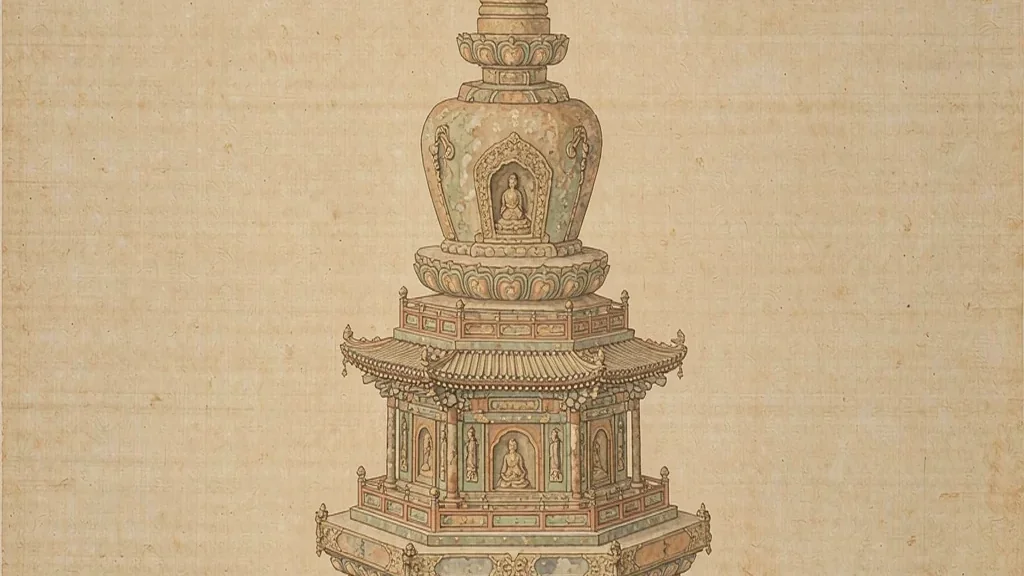
Miniature Buddhist stupas are small-scale replicas of the dome-shaped monument that enshrines relics of the Buddha and marks sacred space. In China they were made in bronze, gilt metal, stone, jade, and ceramic as personal votive objects, foundation deposits, and tomb furnishings from the Northern dynasties onward. Though tiny, each repeats the full symbolic architecture of the stupa — base, dome, spire, and finial — carrying the cosmology of enlightenment into the palm of the hand.
What Is a Stupa?
The stupa originated in India as a burial mound for the Buddha's relics, evolving into a cosmic diagram: a squared base for earth, a dome for water, a spire for fire, and a finial for air and ether.
China received the form with Buddhism and transformed it into the multi-tiered pagoda, but the compact stupa remained a focus of devotion, especially in esoteric and earlier schools.
In miniature, the stupa became a portable relic shrine and a subject of meticulous craft.
Arrival in China
Buddhism entered China from the first century CE, and with it the stupa. Early Chinese stupas blended Indian mounds with Chinese pavilion roofs, a synthesis visible even in small votive pieces.
The Northern Wei and subsequent dynasties produced cast bronze stupas inscribed with donor names and wishes for merit, often placed in temple foundations or caves.
These objects show how quickly the foreign form was naturalized into Chinese metalwork.
Materials and Types
Miniature stupas appear in gilt bronze, copper, stone, jade, and glazed ceramic. The most common are small cast bronzes a few centimetres tall, sometimes hollow to hold a tiny relic or sutra.
Some are "stupa-shaped pagodas" with several diminishing tiers; others keep the rounded Indian dome with a tall spire. A few are incorporated into the tops of votive stele.
Gilt-bronze examples were prized for their lustre, associating the object with light and the Buddha's radiance.
Symbolism in Miniature
Every part of a stupa carries meaning: the base is the earth and the law; the dome (anda) holds relics and signifies the Buddha's enlightened mind; the spire (chattra) is the axis of the world.
The finial often ends in a flame or jewel, pointing to nirvana beyond form. To circumambulate or own a stupa was to participate in this cosmology.
Even a pocket-sized version was believed to radiate protection to its owner and surroundings.
Votive and Funerary Use
Donors commissioned miniature stupas to gain merit for themselves and departed kin, inscribing names and prayers. Many were buried at temple foundations as lasting offerings.
In tombs, small stupas and pagoda models joined other mingqi, providing the dead with sacred architecture. Their presence marks the Buddhist coloring of later Chinese burial.
Such pieces bridge public monastic monuments and private devotion.
Craft and Detail
Bronze stupas were cast by piece-mould and finished by chasing the spire and niches. Tiny Buddha images or niches were often added around the base and dome.
Stone and jade versions were carved with drills, their hard material holding crisp miniature reliefs of attendant figures and lotus thrones.
The best examples achieve architectural clarity at a scale where a millimetre matters.
Regional Variants
Northern dynasties favoured compact, Indian-derived forms; Tang and later pieces lean toward tiered pagoda shapes with Chinese roofs. Tibetan-style stupas (with bulging domes) appear where esoteric Buddhism flourished.
Local workshops from Hebei to Sichuan produced distinct regional accents in proportion and ornament, useful for dating unprovenanced pieces.
This variety reflects the spread of Buddhism across a vast, diverse landscape.
Legacy
The miniature stupa survives in modern votive practice, in collection as art, and in the garden pagodas of East Asia that descend from the same idea.
Museums display them beside monumental pagoda models to show the conversation between scale and meaning in Buddhist art.
In shrinking the stupa, Chinese craft kept its cosmos intact — proof that significance, not size, makes a monument.
Relics and the Reliquary
The stupa exists to hold relics, and miniature stupas often contained a tiny casket with a fragment of bone, a pearl, or a rolled sutra. The object was thus a complete sacred apparatus in miniature.
Depositing relics inside linked the owner to the historical Buddha across centuries, a direct channel of blessing rather than a mere symbol.
Museum x-rays sometimes reveal these hidden contents, turning a small bronze into a sealed time capsule of faith.
Stupas in Cave Temples
At sites such as Yungang and Longmen, small stone stupas were carved into the rock among the Buddha images, marking the cave as a miniature cosmos centered on the relic monument.
Devotees traced the stupa's form with their eyes during worship, absorbing its geometry of liberation. The motif also crowned niche tops and stele finials.
These rock-cut miniatures show how pervasively the stupa shaped sacred space, above ground and below.
From Stupa to Pagoda
China transformed the rounded stupa into the tall, tiered pagoda, but the miniature kept both forms alive. A small gilt stupa and a small pagoda might sit side by side on one altar.
The stupa preserved the Indian memory of the relic mound, while the pagoda expressed the Chinese love of height and tiers. Together they chart Buddhism's translation.
Collectors value the stupa form precisely because it is the older, more concentrated emblem of the religion.
The stupa's compact form made it ideal for the domestic altar, where a small bronze could stand among incense and lamps as the focus of daily devotion.
In esoteric Buddhism the stupa became a meditation diagram, its parts recited as a path from earth to awakening, so owning one was like holding a compressed sutra.
Japanese and Korean miniature stupas show how the Chinese form seeded regional traditions, each adding local proportions while keeping the relic at the centre.
Today the form survives in garden stupas and souvenir replicas, carrying an ancient silhouette into wholly modern settings without losing its calm authority.
Collecting miniature stupas has grown as interest in Buddhist art widens, and careful provenance is now required to keep looted pieces from re-entering the market. A well-documented example can be traced from a specific cave or monastery to the present owner, and such records are themselves becoming part of the object's value. The miniature stupa, then, carries both relic and biography, a small object whose paper trail can be longer than its height.
❓ Frequently Asked Questions
What is a stupa?
An Indian-derived monument enshrining Buddha relics, read as a diagram of the cosmos.
Why make them miniature?
As portable votive objects, foundation deposits, and tomb furnishings granting merit.
What were they made of?
Gilt bronze, copper, stone, jade, and glazed ceramic, often just centimetres tall.
When did they appear in China?
From the Northern dynasties onward, as Buddhism spread after the first century CE.
What does the dome mean?
The dome (anda) holds relics and signifies the Buddha's enlightened mind.
How do they differ from pagodas?
The stupa keeps the rounded Indian dome; China later developed it into tiered pagodas.