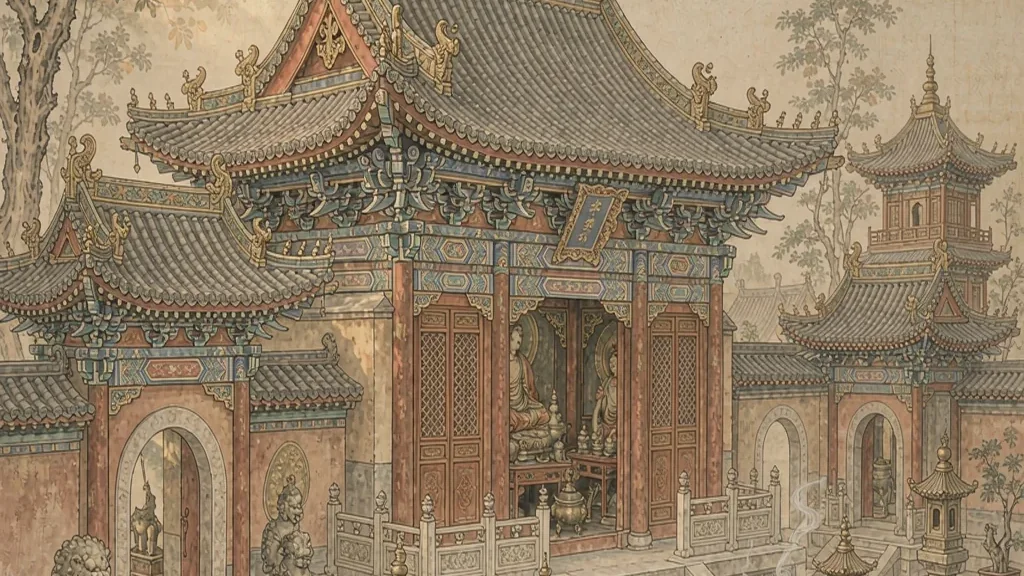
Temple models in Chinese art are miniature replicas of Buddhist and Daoist shrines, pagodas, and ritual halls, made as votive offerings, tomb furnishings, or teaching aids. Ranging from ceramic or wooden models buried with the dead to exquisite gilt-bronze shrines enshrining a Buddha, they compress full architecture into a small, portable form. These objects let devotion and display travel: a believer could "build" a temple in miniature and carry the merit of construction.
Why Make a Model?
A model temple offered a practical substitute for a full building. Donors who could not fund a real monastery could commission a miniature one, gaining the same religious merit in scaled form.
In tombs, models of houses, towers, and shrines furnished the afterlife with the sacred architecture the dead would need, parallel to the mingqi of servants and animals.
Models also served instruction, letting monks and patrons visualize a planned or ideal structure before stones were laid.
Materials and Forms
Temple models appear in pottery, wood, bronze, lacquer, and later ivory and Cloisonné. The simplest are ceramic models of a hall on a platform with a tiled roof and doors.
Bronze and gilt examples often take the form of a miniature shrine (chaitya-like niche) housing a small Buddha, blending architecture and icon in one object.
Some models are puzzle-like, with detachable roofs revealing interior altars, showing the builder's delight in miniature realism.
Buddhist Votive Models
From the Northern Wei onward, devotees cast small bronze "model stupas" and shrine houses bearing inscriptions of merit. These were personal acts of piety, sometimes buried at a temple's foundation.
A classic form is the miniature pagoda with multiple tiers, each roofed and balustraded, topped by a finial — a portable summary of the monumental pagoda.
Such pieces traveled the Silk Road and influenced similar votive architecture in Korea and Japan.
Tombs and the Afterlife
Han and later tombs contained ceramic models of watchtowers, granaries, and shrine halls, evidence that the afterlife was imagined as a complete, sacred household.
These models preserve wooden architecture long rotted away above ground, making them key evidence for the history of Chinese building.
Their proportions and roof curvatures are studied by architects reconstructing lost structures.
Pagoda Miniatures
The pagoda — China's translation of the Indian stupa — became a favourite subject for models. Miniature pagodas in stone, bronze, and jade range from a few centimetres to architectural garden pieces.
Each tier of a model pagoda echoes the real structure's function of housing relics and marking sacred space vertically toward heaven.
Garden and scholar's pagoda models blurred the line between devotion and ornament, gracing courtyards as well as altars.
Daoist and Popular Models
Daoist temples and "tower of the immortals" models also appear, often in the shape of a multistoreyed pavilion. Popular religion produced models of local shrines for home altars.
These reflect the Chinese habit of miniaturizing the cosmos: a small shrine could stand in for the whole sacred geography of a region.
Such models link private devotion to the public ritual landscape of temples and mountains.
Craftsmanship
Miniature architecture demanded the same carpentry and tile-work as full buildings, scaled down. Model roof tiles, brackets (dougong), and doors were rendered with care.
In bronze, the piece-mould method cast crisp architectural detail; in wood, joinery mimicked real frames. The best models are accurate enough to be measured drawings.
This fidelity is why models are treated as documents, not merely curios.
Legacy
The tradition continues in contemporary votive models, festival displays, and the miniature gardens of Suzhou, where architecture is endlessly replayed at small scale.
Museums use temple models to explain Chinese structural principles to visitors who may never see a timber hall being raised.
In shrinking the temple, the model enlarged its reach, carrying sacred space into pockets, tombs, and homes.
Miniature as Architectural Record
Temple models are valued by historians because they preserve building types that have largely vanished. A ceramic hall model shows the curvature of eaves, the placement of doors, and the rhythm of columns with a clarity that literary plans lack.
Timber architecture decays, but a fired-clay model can survive two thousand years underground. Scholars compare such models with excavated foundation trenches to reconstruct the original superstructure of lost shrines.
In this sense the humble votive object becomes a measured drawing in three dimensions, a quiet archive of Chinese construction.
Garden and Scholar Models
Beyond tombs and altars, small architectural models entered the scholar's garden and studio. Miniature pagodas, bridges, and pavilions were arranged among rocks and water to evoke famous landscapes in miniature.
These garden models blurred devotion and aesthetics, letting a retiree stage an imagined pilgrimage among his own plants. The taste for such microcosms fed the later art of the scholar's rock and the tray garden.
The model thus migrated from rite to refinement without losing its cosmic claim to stand for the whole world.
Models Along the Trade Routes
Chinese temple models traveled with Buddhism across Asia. Small bronze shrines from Hebei or Shaanxi have turned up in Central Asian caves and Japanese repositories, showing how portable devotion was.
Recipients copied the forms locally, so a Tang model pagoda might spawn a Japanese or Korean descendant. The miniature thus carried both faith and building knowledge across languages.
Today these dispersed objects let museums trace a single architectural idea around half a continent.
The craft of the model also trained builders, who learned proportion and joinery at small scale before raising full-sized halls. The miniature was a school as well as a shrine.
In folk religion, home altar models of local temples let households keep a patron deity close without a journey, binding the family to its community god.
Festival floats and processional structures continue the model tradition in motion, rebuilding the sacred city temporarily in the street each year.
Collectors prize models that record a lost building type, since the object may be the only evidence that a certain roof or bracket ever existed.
Digital scanning now records model details at microscopic scale, so a fragile ceramic shrine can be studied and even reconstructed virtually without risking the original. The same data feeds accurate replicas that bring the miniature temple within reach of classrooms far from any collection, spreading its quiet lesson. In this way the model keeps teaching long after the building it copied has fallen, linking past craft to future students.
❓ Frequently Asked Questions
What is a temple model?
A miniature replica of a shrine, pagoda, or hall made as a votive, funerary, or teaching object.
Why were they made?
To gain religious merit, furnish tombs, or visualize planned architecture at small scale.
What materials were used?
Pottery, wood, bronze, lacquer, and later ivory and Cloisonné.
How do they help historians?
They preserve lost timber architecture in accurate miniature for study and reconstruction.
Are pagodas common subjects?
Yes; tiered pagoda miniatures are a favourite, summarizing the monumental form.
Do they still exist today?
Yes, in votive objects, festival displays, and the miniature architecture of classical gardens.