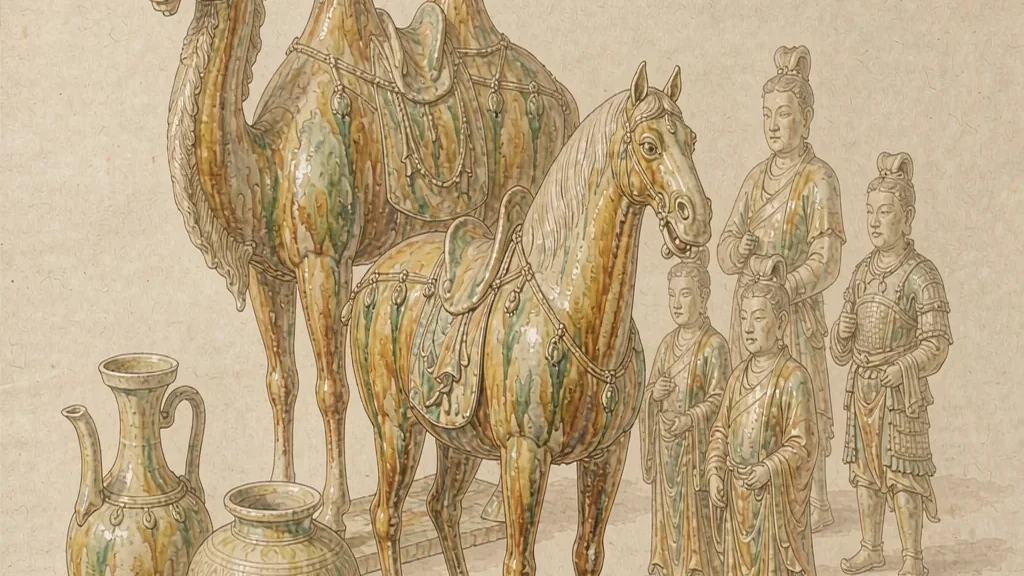
Tang sancai, meaning "three colours," is the lead-glazed earthenware of the Tang dynasty (618–907 CE), famed for its free-flowing ambers, greens, and creams applied over a pale body. Despite the name, the palette often includes browns and blues. Sancai was used chiefly for tomb figurines and a few vessels, and its relaxed, painterly brightness captures the cosmopolitan confidence of the Tang golden age at its most worldly.
Meaning of "Sancai"
San means "three" and cai "colours," but the term is shorthand rather than a strict count. The classic trio is green (copper), amber or brown (iron), and cream (the body showing through), with cobalt blue appearing on finer pieces.
The glazes are lead-based, which lowers their melting point and lets them spread and pool with gravity during the firing. The result is soft, uneven colour fields quite unlike the controlled enamels of later porcelain.
Sancai thus celebrates accident and flow, an aesthetic of ease that suited Tang taste.
Technique and Body
Sancai is made on a buff or white earthenware body, not porcelain. Coloured glazes are brushed in separate areas; where they meet, they run together at the edges, creating natural blends.
Because lead glaze is soft and slightly toxic, sancai was almost entirely funerary — meant for the tomb, not the table. This context explains both its abundance and its freedom of design.
Figures were often moulded in sections and assembled, then glazed, making production efficient enough for large burial sets.
Figurines of the Tomb
The glory of sancai is its figurines: plump court ladies with high hair and narrow sleeves, stern officials, foreigners with deep-set features, camels, and horses. These record the Tang court and the Silk Road within it.
The fat lady figurines reflect a Tang ideal of beauty and abundance, while the foreign grooms and dancers reveal contact with Central Asia, Persia, and beyond.
Horses and Bactrian camels laden with silk stacks stand as emblems of the trade that fed Tang prosperity.
Silk Road Connections
Sancai's subjects and even its cobalt blue (from West Asian sources) show Tang China's integration into a Eurasian world. Foreign musicians, acrobats, and beasts appear with matter-of-fact regularity.
Some sancai shapes echo metal and glass vessels imported from the west, evidence of a two-way exchange of form as well as material.
The ware is therefore a ceramic passport to the multicultural Tang, where the tomb mirrored the bustling capital.
Vessels and Use
Beyond figurines, sancai appears on pillows, jars, ewers, and trays, usually for burial. A few practical sancai wares existed but were uncommon because of the lead glaze.
Forms such as the phoenix-head ewer and the melon-shaped jar show how closely ceramic followed metalwork silhouettes of the period.
The colour flow made each piece unique, valued then as a sign of life and now as a hallmark of Tang craft.
Historical Arc
Sancai rose in the high Tang and was most lavish in the eighth century. After the An Lushan upheaval (755–763) and changing burial customs, elaborate sancai declined.
Later dynasties produced related lead-glazed wares, but the classic Tang sancai remained the reference point for colourful funerary ceramic.
Its brief, brilliant career makes it a concentrated symbol of one dynasty's worldly moment.
Influence and Legacy
Tang sancai strongly influenced Korean and Japanese glazed ceramics and the later "three-colour" traditions of both East Asia and, via trade, the Islamic world's colourful wares.
In China, the look was revived in later periods and endures in folk and tourist ceramics that echo the old palette.
Museums prize sancai for its immediacy: few ancient ceramics feel so close to the people who made and buried them.
Collecting and Care
Because sancai is porous earthenware, excavated pieces often carry soil staining and burial accretions. Conservation avoids harsh cleaning that would strip the original surface.
Forgeries exist, so collectors check the glaze's ageing, the body's fabric, and the burial context. Study collections help train the eye.
Properly cared for, sancai keeps its cheerful, weathered glow as a document of Tang life.
Glaze Chemistry
The flowing look of sancai comes from lead flux, which melts early and carries copper and iron colourants. Because lead is fluid, the glazes run together where they meet, giving soft, unpredictable blends.
This chemistry also made the ware unsuited to food, since lead can leach. The tomb context solved the problem by removing the objects from daily use entirely.
Modern analysis of the glaze layers helps distinguish Tang originals from later imitations and forgeries.
Sancai and Metalwork
Many sancai shapes imitate silver and gold vessels imported from Sasanian Persia and Central Asia. The phoenix-head ewer and the lobed bowl are direct ceramic translations of western metal forms.
By copying prestigious foreign objects in colourful local clay, Tang potters domesticated exotic taste. The result feels both Chinese and cosmopolitan at once.
This dialogue of materials shows how ceramics recorded the empire's open, borrowing culture.
Excavation and Context
Most sancai survives because it was buried; tombs near Xi'an and elsewhere have yielded complete sets with their original arrangement intact. The burial context tells us how figures were grouped around the dead.
Such finds let archaeologists date styles closely and reconstruct Tang funerary ritual. A single chamber can contain dozens of linked pieces.
The tomb, not the museum, was the ware's true first home and meaning.
The three-colour palette was a Tang taste for brightness that set sancai apart from the sober monochromes prized by later connoisseurs. Its appeal is immediate, even cheerful.
Because figures were produced in moulds and finished quickly, individual character survives chiefly in painted detail and pose rather than in fine carving. The medium rewarded speed.
Intact groups are rarer and more valued than single figures, since a lone lady or camel has lost the company that explained its place in the tomb.
Where the lead glaze has weathered, a soft iridescence has appeared that later collectors prize as a beauty the Tang potters never planned.
Recent museum displays group sancai by tomb, letting visitors read the whole assembly at once and recover the arrangement that gave each figure its original meaning within the buried household. Context, not the isolated object, is now the lesson, and the cheerful glaze reads best among its companions. Scholars also use the groups to track how fashion in faces and dress changed across the eighth century. This makes sancai a dated archive of taste as much as a tomb good, useful far beyond its original grave.
❓ Frequently Asked Questions
What is Tang sancai?
A lead-glazed earthenware of the Tang dynasty with flowing green, amber, and cream glazes.
Why only three colours?
The name is shorthand; green, amber, and cream dominate, but brown and blue also appear.
Were they used at table?
Rarely; the lead glaze made them mainly funerary objects for the tomb.
What do the figures show?
Court ladies, officials, foreigners, camels, and horses of Tang cosmopolitan life.
How were they made?
By brushing coloured lead glazes on an earthenware body so they run and pool in firing.
Why did sancai decline?
Changing burial customs after the mid-eighth century reduced elaborate funerary ware.