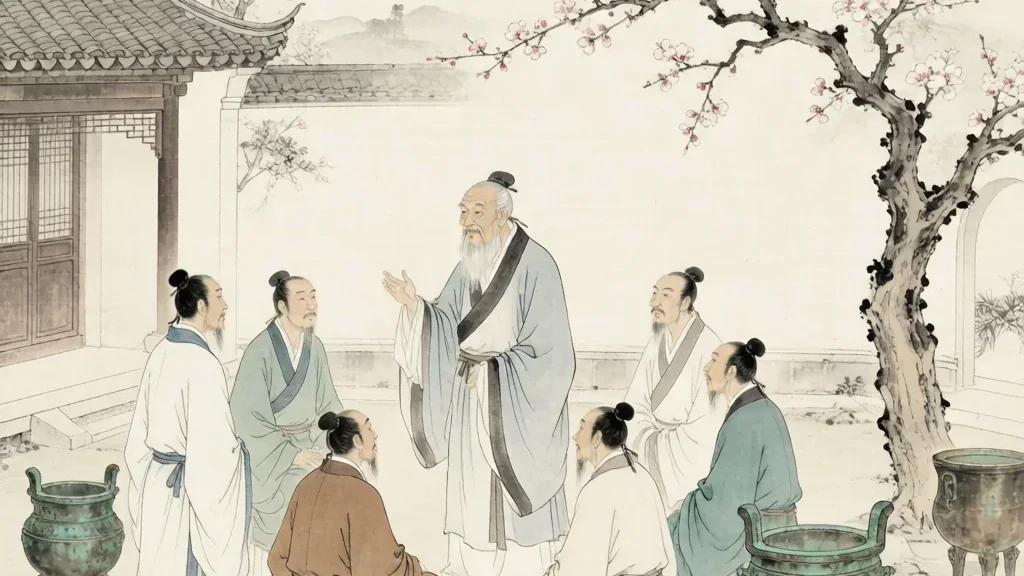
Few philosophical traditions have shaped human civilization as profoundly and enduringly as Confucianism (儒家思想, Rújiā sīxiǎng). Originating in China over 2,500 years ago, this school of thought — centered on moral cultivation, social harmony, and righteous governance — became the ethical backbone of East Asian civilization. Its influence stretches from the corridors of imperial courts to the everyday rituals of family life, from Korea to Japan, Vietnam to Singapore. To understand Chinese culture is to understand Confucianism.
Who Was Confucius?
Confucius (孔子, Kǒngzǐ), born Kong Qiu in 551 BCE in the state of Lu (modern-day Shandong Province), lived during the turbulent Spring and Autumn Period, when the once-glorious Zhou Dynasty had fragmented into warring feudal states. The son of an aging warrior and a young mother, Confucius lost his father at the age of three and was raised in modest circumstances by his mother. Despite poverty, he immersed himself in the study of history, poetry, music, and ritual — the six arts (六艺, liù yì) of a cultivated gentleman.
Confucius spent much of his adult life as a teacher and, briefly, as a government official. He traveled from state to state with a devoted band of disciples, offering his counsel to rulers on how to govern with virtue rather than force. While he never achieved high political office during his lifetime, his true legacy was his teaching. After his death in 479 BCE, his disciples compiled his sayings and dialogues into the Analects (论语, Lúnyǔ), a collection of wisdom that remains one of the most influential books in human history.
The Core Concepts: Ren, Li, Yi, and Xiao
Confucianism is not a religion in the Western sense — it has no deity, no creation myth, and no promise of an afterlife. Rather, it is an ethical framework built on several interlocking concepts that together form a guide for living a virtuous life.
Ren (仁) — Benevolence and Humaneness: The central pillar of Confucian thought, ren is often translated as "benevolence," "humaneness," or "goodness." Confucius defined it simply: "Do not impose on others what you yourself do not desire" (己所不欲,勿施于人). This golden rule embodies the spirit of ren — a deep, empathetic care for fellow human beings. In the Analects, Confucius explains that ren is achieved through self-cultivation: "To conquer oneself and return to propriety is ren" (克己复礼为仁). It is not an abstract ideal but a daily practice of treating others with compassion, respect, and sincerity.
Li (礼) — Ritual Propriety: If ren is the inner quality of goodness, li is its outward expression. Li encompasses rituals, ceremonies, manners, and social conventions — the formalized patterns of behavior that structure human relationships. Confucius believed that performing the right actions in the right way, from ancestor worship ceremonies to the simple act of greeting an elder, cultivated moral character and maintained social order. Far from empty formalism, li was a means of internalizing virtue through practice. "To subdue oneself and return to ritual is to perfect one's humanity," he taught.
Yi (义) — Righteousness: Yi represents moral disposition — the inner compass that guides a person to do what is right, not for profit or recognition, but simply because it is right. Confucius contrasted the "superior person" (君子, jūnzǐ), who acts according to yi, with the "small person" (小人, xiǎorén), who acts for personal gain. "The superior person understands yi; the small person understands profit," he declared in the Analects. Yi is the quality that gives a person moral courage — the willingness to stand by principle even when it is inconvenient.
Xiao (孝) — Filial Piety: At the foundation of Confucian ethics lies xiao, the virtue of honoring and caring for one's parents and ancestors. Confucius saw the family as the basic unit of moral education — if one cannot love and respect one's own parents, how can one extend benevolence to society at large? Filial piety extends beyond a parent's lifetime; ancestor veneration, a practice that predates Confucius by millennia, was given philosophical justification through his teachings. To this day, the concept of xiao profoundly influences family dynamics across East Asia.
The Five Classics and the Confucian Canon
While the Analects is the most accessible introduction to Confucius's thought, the broader Confucian canon is vast. The Five Classics (五经, Wǔ Jīng), traditionally associated with Confucius as compiler or editor, form the core of the classical curriculum: the Book of Changes (易经, Yì Jīng), a divination manual that became a philosophical treatise on change; the Book of Documents (书经, Shū Jīng), a collection of historical records and speeches; the Book of Poetry (诗经, Shī Jīng), an anthology of ancient poems; the Book of Rites (礼记, Lǐ Jì), a compendium of ritual practices; and the Spring and Autumn Annals (春秋, Chūnqiū), a chronicle of Confucius's home state.
Later, the Song Dynasty scholar Zhu Xi (朱熹) canonized the Four Books (四书, Sì Shū) as the core texts for the imperial civil service examinations — a system that shaped Chinese governance for over a thousand years. These texts — the Analects, the Mencius (孟子), the Great Learning (大学), and the Doctrine of the Mean (中庸) — were memorized by every aspiring scholar-official, ensuring that Confucian values permeated the ruling class.
Confucianism's Enduring Legacy
The impact of Confucianism on East Asian civilization cannot be overstated. For over two millennia, it provided the moral and philosophical foundation for Chinese governance, education, and social organization. The imperial examination system, which selected officials based on merit rather than birth, was a direct product of Confucian ideals. The emphasis on education, self-cultivation, and respect for tradition fueled a literate, stable, and remarkably continuous civilization.
In Korea, Confucianism became the state ideology of the Joseon Dynasty (1392–1910), shaping everything from architecture to gender relations. In Japan, Confucian principles were adapted to complement the indigenous Shinto and Buddhist traditions, influencing the samurai code of bushido. In Vietnam, Confucian academies trained generations of scholars. Even today, the values of hard work, respect for education, family loyalty, and social harmony — hallmarks of many East Asian societies — are deeply rooted in Confucian soil.
While the 20th century brought criticism of Confucianism as a feudal relic that stifled individualism, recent decades have seen a resurgence of interest. As modern societies grapple with social fragmentation and ethical uncertainty, many are returning to Confucius's timeless question: how should a person live? His answer — with benevolence, ritual, righteousness, and filial devotion — remains as relevant as ever.
The Ideal of the Junzi
The junzi, the 'gentleman' or mature noble person, is Rujia's picture of the good life made personal. He is steady rather than swayed, courteous yet firm, and does what is right even with no reward in sight. Confucius insisted this was open to anyone willing to learn, not a matter of birth, which was a bold claim in his age. Becoming a junzi means constant self-examination, study of the classics, and practice of ritual until right action becomes natural. The contrast is the petty person, who chases gain and approval; the gentleman chases what is fitting. This ideal gave Chinese culture a shared standard of character for family, school, and office, and it linked private virtue to public trust. To be a gentleman, in this sense, was less a rank than a discipline maintained for a lifetime.
Ritual in Everyday Life
Li, often translated ritual or propriety, is the grease of Rujia social life. It covers not only ceremonies but the small courtesies of meeting, seating, speech, and gift, the thousand gestures that tell people they are recognised and respected. Practised daily, li turns bare coexistence into a humane order, teaching the body to act with consideration before the mind argues about it. Confucius valued ritual precisely because it shapes feeling, not just behaviour; the right bow can build the right heart. Families kept ancestral rites, schools opened with bows, and courts moved by protocol, all meant to harmonise relations. Critics call this rigid, yet the underlying aim was warmth through form, a way to carry respect without words. In a culture that prized harmony, li was how harmony was performed, one small act at a time.
Ruling by Virtue
Rujia politics begins with the person of the ruler. A sovereign should lead by de, moral virtue, so that the people follow as grass bends before wind, needing few laws and fewer punishments. Confucius taught that if those above are upright, those below will be upright of themselves, which made self-cultivation the foundation of good government. This ideal produced the model of the benevolent official and the frank censor who corrected the throne, and it tied ethics to statecraft for two millennia. Detractors note it could soften enforcement or excuse weak rulers, yet the aspiration endured in edicts and exams alike. The phrase 'govern by virtue' still enters leadership talk today, a reminder that Rujia saw public power as an extension of personal character rather than a separate craft.
The Way of Study
For Rujia, learning is not schooling but a lifelong shaping of the self. Confucius described a path from attentive youth to a settled old age, and said that at seventy he could follow his heart without overstepping the line, the fruit of decades of practice. Study meant the classics, history, and poetry, but also reflection and action, since mere book knowledge without conduct was hollow. The goal was not passing an exam alone but becoming humane, able to weigh a situation and respond with propriety. Teachers were honoured as guides in this work, and friendship among learners was itself a method. The famous love of education in later Chinese society, the belief that anyone might rise by study, grew from this conviction. To learn, in Rujia's sense, was to keep remaking oneself toward the gentleman one ought to be.
❓ Frequently Asked Questions
📝 Chinese Vocabulary
儒家 — — The Confucian school of thought; literally "the school of scholars"
仁 — — Benevolence, humaneness; the supreme Confucian virtue
礼 — — Ritual propriety, ceremony, proper conduct
君子 — — The superior person or gentleman; the Confucian moral ideal
论语 — — The Analects; the collected sayings of Confucius
孝 — : Filial piety, the respect, care, and reverence owed to parents and ancestors.
中庸 — : The doctrine of the mean, the pursuit of balanced, timely conduct that avoids excess and deficiency.
天命 — : The mandate or ordinance of heaven, the higher moral order and destiny governing human affairs.
🎉 Fun Facts
- Confucius was said to have 3,000 disciples, of whom 72 were considered outstanding sages in their own right. Their names are still remembered today.
- The imperial civil service examination system, inspired by Confucian ideals of meritocracy, lasted over 1,300 years — from 605 CE to its abolition in 1905.
- Confucius's birthday, September 28, is celebrated as Teachers' Day in Taiwan, and grand ceremonies are held at Confucian temples across East Asia.
- The Five Classics were already ancient when Confucius taught, and he is said to have edited several, shaping what later became the core curriculum.
- Rujia teaching spread across East Asia, shaping Korean, Japanese, and Vietnamese ideals of family, schooling, and government for centuries.
- Confucius declared that at seventy he could follow his heart's desires without overstepping the line, describing a life of earned ease through self-cultivation.