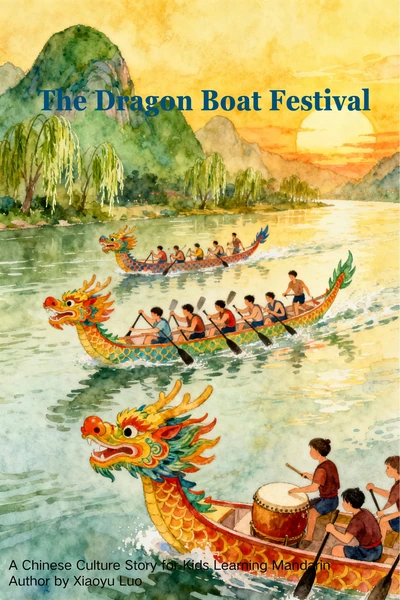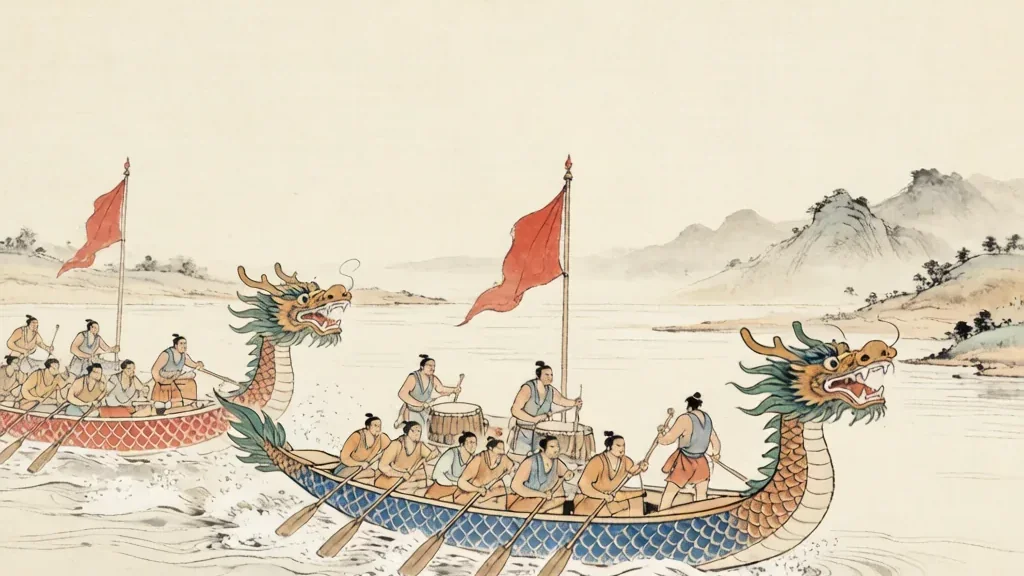
Every year, on the fifth day of the fifth lunar month, the waters of rivers and lakes across China and beyond come alive with the thunder of drums and the flash of painted scales. Long, narrow boats carved like dragons slice through the water, propelled by teams of paddlers moving in perfect unison. On the shore, crowds roar with excitement. The air smells of bamboo leaves and sticky rice. This is the Dragon Boat Festival (端午节, Duānwǔ Jié) — a 2,000-year-old tradition born not from celebration, but from tragedy, loyalty, and one man's unbreakable love for his country.
Behind the thrilling races and the delicious sticky rice dumplings lies the story of Qu Yuan (屈原), a poet, a patriot, and a man whose final act of devotion would echo through the ages and inspire one of the most unique festivals in the world.
The Golden Age of a Scholar-Poet
Qu Yuan was born around 340 BCE in the State of Chu, one of the seven major kingdoms during China's Warring States period. From a young age, Qu Yuan showed extraordinary talent — not just in poetry, but in governance, diplomacy, and statecraft. He rose quickly through the ranks of the Chu court, eventually becoming a trusted minister and advisor to King Huai of Chu.
Qu Yuan was a reformer at heart. He believed in honest governance, in laws that protected the common people, and in building alliances with neighboring states to resist the growing power of the aggressive Qin kingdom to the west. His poetry — including masterpieces like "Li Sao" (离骚, "Encountering Sorrow") — blended personal emotion with political commentary, creating a new genre of Chinese literature that would influence writers for millennia.
But Qu Yuan's brilliance and integrity made him enemies. Corrupt officials at court, jealous of his influence and threatened by his reforms, began to whisper lies into the king's ear. They accused Qu Yuan of arrogance, of disloyalty, of conspiring against the throne. The king, swayed by these false accusations, gradually withdrew his trust from Qu Yuan and eventually banished him from the capital.
Exile and the Fall of Chu
Cast out from the court he had served so faithfully, Qu Yuan wandered the countryside of Chu. He lived among farmers and fishermen, witnessing firsthand the suffering of ordinary people under corrupt rule. During these years of exile, he wrote some of his most powerful poetry — verses filled with sorrow for his country's decline, anger at the corruption that had poisoned the court, and unwavering love for the land and people of Chu.
His most famous lines capture the depth of his devotion:
"Long did I sigh to hold back tears, grieving for the people's hardships... Though my body be dismembered, how could my heart ever change?"
Meanwhile, Qu Yuan's warnings proved tragically prescient. Without his counsel, King Huai made a series of disastrous decisions. He was deceived by the Qin kingdom into a trap and died in captivity. The State of Chu, weakened by internal corruption and poor alliances, began to crumble.
In 278 BCE, the news Qu Yuan had dreaded finally arrived: the Qin army had captured Ying, the capital of Chu. The kingdom he had devoted his life to serving was falling, and he was powerless to stop it.
The Sacrifice at the Miluo River
On the fifth day of the fifth lunar month, overcome with grief and despair, Qu Yuan walked to the banks of the Miluo River (汨罗江). There, according to legend, he composed his final poem — "Huai Sha" (怀沙, "Embracing the Sand") — a lament for his fallen kingdom and a declaration of his unshakable integrity. Then, clutching a heavy stone to his chest, he waded into the river and let the waters take him.
When the local people heard what had happened, they were devastated. Qu Yuan had been a hero to them — a man who had stood up for the common people, who had spoken truth to power, who had refused to compromise his principles even when it cost him everything. They rushed to the river in their fishing boats, desperately searching for his body.
They beat drums and splashed the water with their paddles to scare away fish and evil water spirits that might harm Qu Yuan's body. They threw cooked rice wrapped in leaves into the river — an offering to feed Qu Yuan's spirit and, according to some versions of the legend, to distract the fish from consuming his remains.
This frantic, grief-stricken search became the origin of two enduring traditions: dragon boat racing, which recreates the villagers' desperate dash to find Qu Yuan's body, and the eating of zongzi (粽子), the sticky rice dumplings wrapped in bamboo leaves that were thrown into the water as offerings.
Zongzi: Dumplings Wrapped in History
The zongzi is the iconic food of the Dragon Boat Festival, and its origins are deeply tied to the Qu Yuan legend. According to one version of the story, after Qu Yuan's death, his spirit appeared to the villagers in a dream. He thanked them for their offerings but told them that the fish were eating the rice before it could reach him. "Wrap the rice in bamboo leaves and tie it with colored string," he instructed. "The fish fear the five-colored threads."
The villagers followed his instructions, and thus zongzi was born. Today, zongzi comes in countless regional variations. Northern Chinese zongzi tend to be sweet, filled with red bean paste or jujube dates. Southern Chinese zongzi are often savory, stuffed with salted egg yolk, pork belly, mushrooms, and chestnuts. The sticky glutinous rice is soaked, then wrapped in bamboo or reed leaves into a distinctive tetrahedron shape, tied with string, and boiled or steamed for hours until the rice becomes soft, fragrant, and infused with the flavor of the leaves.
Making zongzi is often a family activity during the Dragon Boat Festival. Grandmothers teach grandchildren how to fold the leaves, pack the rice just right, and tie the strings tightly enough to hold but not so tight that the rice can't expand. The process is a form of cultural transmission — each generation passing on not just a recipe, but a connection to the story of Qu Yuan and the values he represents.
The Thrill of Dragon Boat Racing
Dragon boat racing has evolved from its solemn origins into one of the most exciting and internationally popular water sports in the world. A standard dragon boat is a long, narrow canoe adorned with a carved dragon head at the bow and a dragon tail at the stern. It carries a crew of 20 paddlers, a drummer at the front who sets the rhythm, and a steersperson at the back who guides the boat.
The drummer is the heartbeat of the boat. Seated at the front, facing the paddlers, the drummer pounds a large drum in a steady, accelerating rhythm that the paddlers match stroke for stroke. The sound carries across the water, a primal pulse that drives the crew forward. As the race reaches its climax, the drumbeat quickens, the paddlers dig deeper, and the dragon boat seems to fly across the surface of the water.
Modern dragon boat racing has become a global phenomenon. The International Dragon Boat Federation (IDBF) oversees competitions worldwide, with national teams from over 80 countries. Cities from Vancouver to Venice, Sydney to Singapore host annual dragon boat festivals that draw hundreds of teams and thousands of spectators. The sport's unique combination of teamwork, tradition, and raw athletic power has made it one of the fastest-growing water sports on the planet.
The Deeper Meaning of Duanwu
The Dragon Boat Festival is about more than just racing and eating. It carries layers of cultural meaning that have accumulated over two millennia. At its core is the value of loyalty and integrity (忠, zhōng) — the unwavering commitment to one's principles and one's people that Qu Yuan embodied. In a world of political convenience and moral compromise, Qu Yuan's story reminds us that some things are worth standing for, even when standing alone.
The festival is also associated with health and protection. The fifth lunar month was traditionally considered a dangerous time — the beginning of summer, when insects, snakes, and diseases became more active. Families hang mugwort and calamus (艾草 and 菖蒲) on their doors to ward off evil spirits and illness. Children wear five-colored silk threads (五色丝线) around their wrists for protection. Adults drink realgar wine (雄黄酒), believed to have medicinal properties that guard against poisons and pests.
These protective customs blend seamlessly with the Qu Yuan legend. The villagers' frantic efforts to protect Qu Yuan's body from fish and evil spirits evolved into broader rituals of protection for the living. The Dragon Boat Festival thus becomes a moment of both remembrance and renewal — honoring the past while safeguarding the future.
Guarding Health in the Poison Month
The fifth lunar month was long viewed as a hazardous turn of the year. Summer heat, rising insects, and the spread of disease made it what people called the 'poison month,' and the festival's quieter customs are really a toolkit for getting through it. Households hung bundles of mugwort and calamus by the door, trusting their sharp scent to push pests and bad air away. Children wore five-colored silk threads around the wrist and sometimes a small herb sachet, while adults took a sip of realgar wine or dabbed the powder on the skin, believing it cleared toxins. In some places a parent drew the character for 'king' on a child's forehead with realgar, borrowing the tiger's authority to frighten harm. These rites sit beside the races and the rice dumplings, reminding us that Duanwu was as much about keeping the family safe through summer as about mourning a poet.
Today, as dragon boats slice through waters around the world and families unwrap steaming zongzi, the spirit of Qu Yuan lives on. His poetry is still read in schools across China. His story is told to children who will grow up to tell it to their own children. And every year, on the fifth day of the fifth month, the drums beat again — a heartbeat that has never stopped, connecting us to a poet who loved his country so much that he gave everything for it.