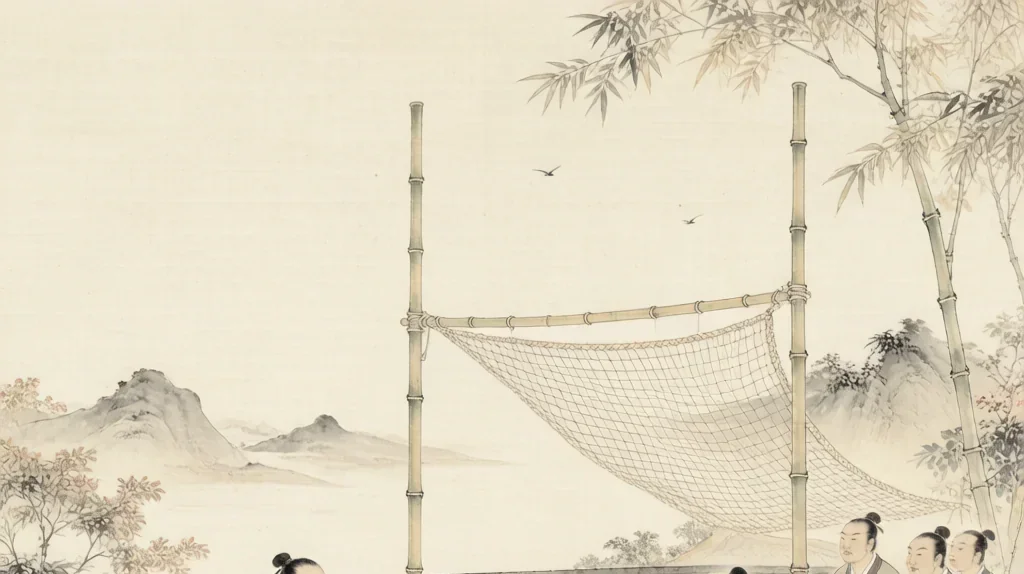
Long before the English codified the rules of association football in 1863, Chinese players were already kicking a leather ball through a net suspended between two poles. This ancient game was called Cuju — literally "kick ball" — and it flourished across China for nearly two millennia. In 2004, FIFA formally recognized Cuju as the earliest known form of football, acknowledging what Chinese historical records had documented for centuries: the beautiful game has roots that stretch back to the Warring States period of ancient China.
Origins in the Warring States
The earliest mention of Cuju appears in the "Zhan Guo Ce" (Strategies of the Warring States), a historical text compiled around the 3rd century BCE. According to these records, the people of Linzi, the capital of the State of Qi, were passionate about Cuju. The game was played not merely for recreation but as a form of military training. Soldiers used Cuju to build stamina, develop teamwork, and maintain physical fitness during peacetime. The ball was originally made by stuffing feathers and hair into a leather casing, sewn together with meticulous care.
During the Qin and early Han dynasties, Cuju evolved from a military exercise into a popular civilian sport. The Han dynasty historian Sima Qian wrote about Cuju in his monumental "Records of the Grand Historian," noting that wealthy families would build dedicated Cuju fields in their compounds. The Han military continued to use Cuju as a training tool, and soldiers who excelled at the game were rewarded with promotions and honors.
The Golden Age: Tang and Song Dynasties
The Tang dynasty marked a significant technological breakthrough in the history of Cuju: the invention of the inflated ball. Instead of stuffing feathers into a leather shell, craftsmen developed a bladder made from animal bladders, inflated with air and covered with a stitched leather casing of eight panels. This new ball was rounder, bouncier, and more predictable — a revolution that transformed the nature of the game. The Tang court embraced Cuju enthusiastically, and women's Cuju became popular, with female players demonstrating remarkable skill.
The Song dynasty brought Cuju to its cultural zenith. Professional Cuju leagues emerged, complete with guilds and star players who earned fame and fortune. The most famous organization was the "Qiyun She" (齐云社), often translated as the "Cloud-Leaping Club," which established standardized rules, organized tournaments, and trained young players. Song dynasty paintings depict Cuju scenes in exquisite detail, showing players in flowing robes executing acrobatic kicks while spectators cheer from elegant pavilions. The game had split into two main formats: "Zhu Qiu," where players aimed to kick the ball through a goal, and "Bai Da," a freestyle juggling competition judged on technique and artistry.
How Cuju Was Played
In its most popular competitive form, Cuju involved two teams attempting to kick a ball through a circular goal. The goal was a net strung between two tall bamboo poles, with a circular opening called the "fengliu yan" (风流眼), or "eye of elegance," suspended high above the ground. Players could use any part of their body except their hands — a rule that directly prefigures modern football. Unlike modern football, however, Cuju emphasized skillful passing and individual technique over physical confrontation. The goal was elevated rather than at ground level, making scoring a matter of precision rather than power.
The number of players varied by format. Some games featured up to 16 players per side, while smaller matches used 2 to 10 players. A referee oversaw the match, and penalties were enforced for fouls such as using hands, excessive physical contact, or unsportsmanlike conduct. The game was played on a rectangular field, with goals at either end. The ball itself was approximately 20 centimeters in diameter, slightly smaller than a modern football.
Decline and Rediscovery
During the Ming and Qing dynasties, Cuju gradually declined in popularity. The Ming founder Zhu Yuanzhang, suspicious of any activity that might foster political gatherings, banned the game among soldiers. The Manchu rulers of the Qing dynasty favored horseback sports and archery over ball games. By the 19th century, Cuju had largely disappeared from Chinese life, surviving only in isolated rural communities and in the pages of historical texts.
The 20th century brought a rediscovery of Cuju. As modern football gained popularity worldwide, Chinese scholars began to research their own football heritage. Archaeological excavations uncovered Cuju balls, murals, and figurines from Han and Tang tombs. In 2004, at the Third International Football Symposium in Zibo, Shandong province — the ancient capital of Qi — FIFA President Sepp Blatter officially declared that "football originated in China, in the city of Linzi." The Linzi Football Museum now stands as a testament to this ancient heritage, housing the world's largest collection of Cuju artifacts and history.
Cuju's Enduring Legacy
Cuju's influence extends far beyond its role as a historical curiosity. The game established fundamental principles that would later define football worldwide: teamwork, skill-based competition, and the universal joy of kicking a ball. When you watch a modern footballer bend a free kick into the top corner or execute a perfect volley, you are witnessing techniques that Cuju players were practicing two thousand years ago. The spirit of Cuju — the idea that a simple ball can bring people together in celebration and competition — is exactly what makes football the world's most popular sport today.
The Evolution of the Cuju Ball
The ball is the quiet hero of Cuju's story. The earliest versions were leather casings stuffed with feathers or hair, sewn tightly so they held shape but did not bounce fine for a game played on the ground. The great Tang breakthrough was the air bladder: craftsmen inserted an inflated animal bladder and closed it in an eight-panel stitched leather cover, producing a rounder, bouncier ball that flew true and rewarded skill. That single invention changed how the game felt and let players attempt the acrobatic, airborne kicks seen in Song paintings. Later dynasties refined the stitching and size, settling near twenty centimeters across. The leap from stuffed to inflated is the same leap European football would make centuries later with the rubber bladder, which is part of why FIFA could trace a continuous idea of kick the round ball back to Linzi.
Cuju beyond the Battlefield: Court and Commoners
Cuju was never only a soldier's drill. By the Han dynasty wealthy families built private courts, and the Tang court turned the game into elegant entertainment, with women's Cuju praised in poetry for its grace. The Song era carried it furthest into civil life: guilds like the Cloud-Leaping Club set rankings and rules, star players earned fame, and painters recorded spectators cheering from pavilions as players in flowing robes leapt for the ball. Ordinary villagers played in open fields, while the imperial household kept professional teams. So the game lived at every level of society drill ground, court garden, market square, and festival ground which is why its habits no hands, teamwork, skill over force feel so familiar to a modern football fan. Cuju was, in effect, a people's sport long before it was a symbol of heritage.
Cuju's Place in World Football History
Cuju's claim on world history is simple but striking: FIFA, in 2004, accepted documented Chinese records placing a ball-kicking game in the Warring States period, more than two millennia before England's 1863 rules. That recognition does not say modern football descended directly from Cuju the routes are separate but it establishes China as the earliest known home of organized kicking-ball play with written rules. The shared principles are what matter: a round ball, teamwork, skill over brute force, and the joy of a goal. Linzi's football museum and the Qi capital's pride keep that memory public, and scholars use Cuju to show that the human impulse to kick a ball toward a target is ancient and near universal. Cuju thus sits at the head of football's long family tree as its earliest documented branch.
❓ Frequently Asked Questions
📝 Chinese Vocabulary
- 蹴鞠 — Cuju, literally "kick ball," the ancient Chinese football game
- 齐云社 — The "Cloud-Leaping Club," the most famous Song dynasty Cuju guild
- 风流眼 — "Eye of elegance," the circular goal opening in Cuju
- 白打 — Freestyle Cuju juggling competition judged on artistry
- 筑球 — Competitive Cuju format with goals and teams
🎉 Fun Facts
- FIFA officially recognized Linzi, Shandong Province, as the birthplace of football in 2004, citing the Warring States period origins of Cuju.
- The earliest Cuju balls were stuffed with feathers and hair inside an eight-panel leather cover, evolving to air-inflated bladders by the Tang dynasty.
- Emperor Taizu of Song (Zhao Kuangyin) was famously depicted playing Cuju in the painting "Taizu Cuju Tu," one of the most famous sports images in Chinese art.
- Women's Cuju was widely popular during the Tang dynasty, with female players celebrated for their grace and technical skill in contemporary poetry and art.
- Linzi, the ancient Qi capital, now houses a dedicated football museum holding the world's largest collection of Cuju artifacts.
- Cuju nearly vanished under the early Ming emperor, who banned it among soldiers for fear the game might breed political gatherings.