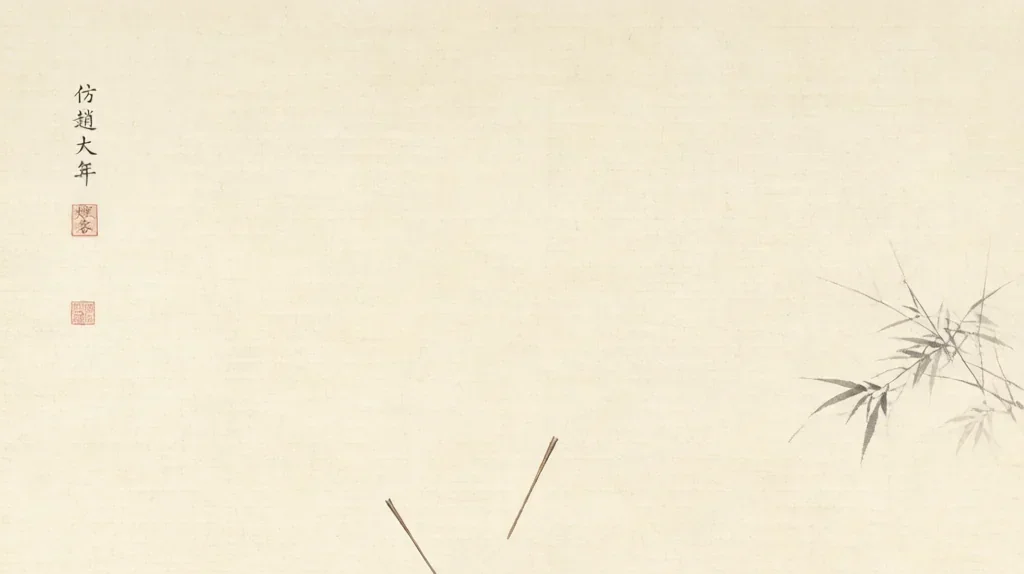
Imagine an ancient Chinese banquet: silk-robed scholars and officials reclining on cushioned seats, cups of warm wine circulating, poetry being composed on the spot. As the evening progresses, a servant brings forth a bronze vessel with a narrow mouth and two looped handles, along with a bundle of slender arrows. The guests rise, take their positions, and begin a game that is equal parts sport, ritual, and social performance. This is Touhu — "pitch-pot" or "arrow throwing" — one of the most elegant and enduring games in Chinese history.
From Archery Ritual to Parlor Game
Touhu originated from the ancient Zhou dynasty ritual of archery, which was one of the Six Arts that every gentleman was expected to master. During formal banquets, hosts would invite guests to demonstrate their archery skills. However, not all guests were skilled archers, and setting up a full archery range indoors was impractical. The solution was ingenious: substitute a narrow-mouthed pot for the distant target, and short arrows for the longbow. The essence of aiming and precision remained, but the scale became intimate and accessible.
The earliest written records of Touhu appear in the "Li Ji" (Book of Rites), one of the Confucian classics compiled during the Warring States period and Han dynasty. The text describes Touhu not merely as a game but as a vehicle for moral education. The manner in which a person threw the arrows — their posture, their composure, their acceptance of success or failure — revealed their character. A gentleman who missed would smile graciously; a boor who scored would gloat. Touhu was, in essence, a test of virtue disguised as entertainment.
The Rules of Refinement
Touhu was governed by an elaborate set of rules that varied across dynasties but always emphasized ceremony. The pot, typically made of bronze or ceramic, stood about 40 centimeters tall with a mouth roughly 7 centimeters in diameter. It had two small looped handles on either side, known as "ears." Players took turns throwing arrows from a distance of approximately 2.5 meters — close enough to make scoring possible, far enough to make it challenging.
The scoring system was intricate. Landing an arrow directly into the mouth of the pot earned the highest points. An arrow that bounced off the rim and then fell in was called a "rebound score" and was considered especially skillful. Striking one of the pot's ear loops and having the arrow ricochet into the mouth earned bonus points and was a mark of exceptional ability. Before each throw, a musician would beat a drum to establish rhythm, and the players would move in time with the music. The game continued until all arrows had been thrown, at which point the loser was required to drink a cup of wine as penalty — a civilized consequence that kept the atmosphere light and convivial.
The Philosophy Behind the Game
What set Touhu apart from mere recreation was its deep philosophical underpinning. Confucian scholars saw the game as a microcosm of proper conduct in society. The player's stance — feet together, body upright, arm extended gracefully — embodied the principle of "li" (ritual propriety). The calm acceptance of outcome reflected "ren" (benevolence) and "yi" (righteousness). Even the penalty drinking was governed by ritual: the loser would bow, accept the cup with both hands, and drink modestly.
The Book of Rites devotes an entire chapter to Touhu, detailing not just the rules but the moral lessons embedded within them. "When the superior man plays Touhu," the text states, "he does so with dignity and grace. His movements are measured, his spirit is calm, and he treats both victory and defeat with equanimity." This philosophical dimension elevated Touhu above other games and secured its place in the curriculum of the scholarly elite for over two thousand years.
Evolution Through the Dynasties
During the Han dynasty, Touhu flourished in the courts and aristocratic households. Archaeological excavations have uncovered beautifully decorated bronze Touhu pots from this period, some inlaid with gold and silver, indicating the game's prestige. The Three Kingdoms period produced famous Touhu anecdotes, including stories of the strategist Zhuge Liang using the game to test the character of potential allies.
The Tang and Song dynasties saw Touhu reach its peak of popularity and sophistication. Song dynasty scholar Sima Guang wrote an influential treatise on Touhu that codified the rules and reinforced the game's moral dimensions. His work, "Touhu Xinge" (New Rules for Touhu), standardized the scoring system and introduced variations for different occasions. By the Ming dynasty, Touhu had spread beyond the elite to become a popular pastime among merchants and even commoners, with simpler ceramic pots replacing the elaborate bronze vessels of earlier eras.
Decline and Modern Revival
The Qing dynasty marked a gradual decline for Touhu. As Manchu rulers promoted their own martial traditions — horseback riding, wrestling, and archery — the refined parlor games of the Han scholarly class lost favor. By the early 20th century, Touhu had largely disappeared from Chinese life, surviving only in historical texts and museum collections.
However, the 21st century has brought a modest revival. Cultural heritage organizations in China have reintroduced Touhu at traditional festivals and historical reenactments. Museums offer Touhu experiences where visitors can try their hand at this ancient game. Schools teaching classical Chinese culture include Touhu in their curricula as a way to make history tangible. The game's elegant simplicity — a pot, some arrows, and the timeless challenge of aiming true — continues to captivate those who encounter it.
Touhu and the Art of Etiquette
Touhu was never only about landing an arrow; it was a rehearsal of deportment. Players were expected to stand upright, step forward gracefully, and throw in time with the music, their composure under observation as much as their aim. Confucian writers held that a person's true character showed in such moments: the gentleman who missed would smile and bow, while the boor who scored would crow. The penalty cup, taken with both hands and a modest sip, extended the ritual to defeat as well as victory. In this way touhu trained the body and the manners together, making courtesy visible in motion. The game thus belonged to the broader Confucian project of cultivating virtue through practiced form, a reminder that in classical China even leisure was expected to build character rather than merely pass time.
The Touhu Pot and Its Design
The centerpiece of the game was the pot itself, and its design carried meaning as well as function. Typically bronze or ceramic, the vessel stood roughly forty centimeters tall with a mouth about seven centimeters wide and a pair of small side loops called ears. The narrow neck made a clean fall rare and a skillful shot rewarding, while the ears allowed the prized trick of ricocheting an arrow through a loop and into the mouth. Elaborate Han dynasty examples were inlaid with gold and silver, signaling the pot's status as a luxury object as much as equipment. The short arrows, blunter than hunting shafts, were sized for safe indoor throwing. Together the pot and arrows formed a self-contained kit that needed no field or target range, which is precisely why touhu fit so neatly into the close, formal space of the banquet hall.
Touhu's Legacy in East Asia
Touhu did not stop at China's borders. The game traveled with Chinese culture into Korea, where it became known as tuho, and into Japan as tōko, in both places adopted by aristocratic and scholarly classes as a refined pastime. Korean tuho in particular developed its own traditions, with distinctive pots and rules, and remained a gentleman's game well into the modern era. In each culture the core idea persisted: a quiet test of aim and composure, wrapped in ceremony. Today, as China revives touhu at festivals and heritage events, neighboring countries similarly preserve their versions as traditional arts. This shared East Asian heritage shows how a single Zhou dynasty banquet game became a regional language of manners, a small object—a pot and some arrows—that connected courts and classes across centuries and borders.
❓ Frequently Asked Questions
📝 Chinese Vocabulary
- 投壶 — Touhu, literally "throw pot," the ancient arrow-throwing game
- 礼记 — The Book of Rites, the Confucian classic that codified Touhu rules
- 礼 — Ritual propriety, the Confucian virtue embodied in Touhu's etiquette
- 司马光 — Song dynasty scholar who wrote the definitive Touhu rulebook
- 六艺 — The Six Arts that every gentleman was expected to master, including archery
🎉 Fun Facts
- Touhu is mentioned in the "Zuo Zhuan," one of China's earliest narrative histories, dating back to the 4th century BCE, making it one of the oldest documented games in the world.
- Some Touhu pots from the Han dynasty were so elaborately decorated with gold and silver inlay that they were considered more valuable as art objects than as game equipment.
- The game was sometimes played with special "blindfold" rules at imperial banquets, where players would throw arrows without looking, relying entirely on spatial memory and muscle control.
- Touhu spread to Korea and Japan, where similar games called "Tuho" and "Tōko" became popular among the aristocratic classes during their respective ancient periods.
- The throwing arrows were shorter and blunter than hunting arrows, made specifically for safe indoor play at close range.
- Because success depended on calm and composure rather than strength, touhu was seen as a game where scholars and women could compete on equal footing.