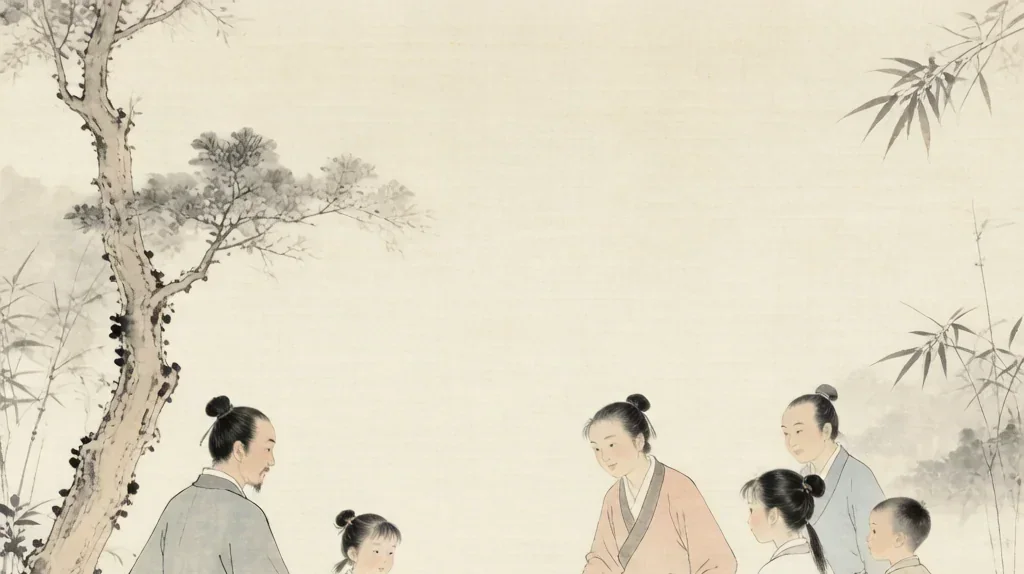
On any morning in a Chinese park, you will find circles of people — young and old, men and women — standing in a loose ring, kicking a small feathered object back and forth with remarkable grace. This is Jianzi, the ancient game of shuttlecock kicking that has delighted Chinese people for over two thousand years. Simple in its equipment yet infinite in its possibilities, Jianzi is perhaps the most accessible and democratic of all traditional Chinese sports. All you need is a shuttlecock, a small patch of ground, and a willingness to play.
A Game Two Thousand Years in the Making
Jianzi traces its origins to the Han dynasty, where it evolved from a military training exercise called "Cuju" — the same ancient football game that FIFA recognizes as the earliest form of soccer. Soldiers who wanted to practice their footwork without the full field and team requirements of Cuju developed a smaller-scale version using a feathered object. Over time, this military drill transformed into a civilian pastime, spreading from the barracks to the streets and courtyards of ordinary people.
By the Tang and Song dynasties, Jianzi had become a sophisticated recreational activity with its own vocabulary of kicks, tricks, and competitive formats. Historical records mention professional Jianzi performers who could keep the shuttlecock aloft for hundreds of kicks without letting it touch the ground. The game was particularly popular among women and children, who appreciated its graceful movements and low barrier to entry. Paintings from the period show elegant ladies in flowing silk robes engaged in spirited Jianzi games in palace gardens.
The Art of the Shuttlecock
The traditional Jianzi shuttlecock is a marvel of simple engineering. A small stack of copper coins or metal washers forms the weighted base, providing stability and a satisfying "clink" sound with each kick. Rooster feathers — traditionally from the tail, prized for their stiffness and color — are inserted into a short tube and flared outward in a radial pattern. The feathers slow the shuttlecock's descent, creating a predictable trajectory that skilled players can control with precision. Modern versions may use plastic discs and synthetic feathers, but purists insist that nothing compares to the feel of a hand-tied traditional Jianzi.
Making a Jianzi is an art in itself. The coins must be perfectly aligned, the feathers carefully selected for balance, and the binding tight enough to withstand thousands of impacts. In some regions, the number of coins and feathers follows numerological traditions — four coins for stability, five feathers for the five elements, and so on. A well-made Jianzi can last for years, becoming a treasured personal possession passed between generations.
Styles and Techniques
Jianzi playing encompasses an astonishing variety of techniques. The basic kick — using the inside of the foot, where the arch meets the ankle — is the foundation upon which all other skills are built. From there, players progress to outside kicks, knee lifts, chest bumps, head touches, and the spectacular "behind-the-back" kick where the player's heel strikes the shuttlecock from behind. Advanced players string these moves together in flowing combinations, their bodies swaying and pivoting like dancers.
The game is played in several formats. "Freestyle" Jianzi emphasizes individual creativity and technical mastery, with players competing to perform the most difficult or beautiful sequences. "Circle" Jianzi is the social form most commonly seen in parks, where a group passes the shuttlecock around, keeping it airborne as long as possible. Competitive "net" Jianzi, played on a badminton-sized court with a net at 1.5 meters, pits teams against each other in a fast-paced rally sport that demands explosive athleticism. This latter form, sometimes called "Shuttlecock Football," has grown into an international sport with world championships and professional leagues.
Health Benefits and Cultural Significance
Jianzi is more than a game — it is a form of moving meditation. The rhythmic kicking motion engages the entire body, improving balance, coordination, and cardiovascular fitness. Traditional Chinese medicine practitioners recommend Jianzi for stimulating acupressure points in the feet and promoting the flow of qi. For the elderly, it offers gentle exercise that maintains joint mobility and prevents falls. For children, it develops motor skills and spatial awareness. No wonder, then, that Jianzi has been prescribed as therapy for centuries.
Socially, Jianzi breaks down barriers. There are no language requirements, no expensive equipment, no formal teams. Strangers become friends in the Jianzi circle, and the game's egalitarian nature — everyone kicks, everyone retrieves — fosters a sense of community that is increasingly rare in modern urban life. During festivals and holidays, Jianzi competitions draw entire neighborhoods together in celebration.
Jianzi in the Modern World
While traditional Jianzi remains a beloved street and park activity throughout China, the sport has also undergone a modern renaissance. International Jianzi federations now exist in over 30 countries, from Vietnam — where the game is equally beloved — to Germany, France, and the United States. The competitive net format has been standardized with official rules, and elite athletes train year-round. In 2011, Jianzi was included in the National Games of China, the country's premier multi-sport event.
The game has also inspired hybrid sports. "Footbag" or "Hacky Sack," developed in the United States in the 1970s, shares many similarities with Jianzi, though the footbag is typically made of knitted fabric filled with beads rather than feathers. Meanwhile, Chinese school physical education programs have increasingly incorporated Jianzi as a way to preserve cultural heritage while promoting physical fitness. In parks from Beijing to Guangzhou, the timeless sight of a feathered shuttlecock arcing through the air continues to draw smiles and participants, proving that some pleasures truly are universal.
Competitive Formats and Rules
Beyond casual park play, jianzi has codified competitive formats with official rules. In the net version, two teams of typically three players rally a shuttlecock over a 1.5-meter net on a court comparable to badminton, scoring points when the opposing side lets it fall or breaks the kick sequence. Freestyle competitions reward the difficulty and artistry of individual trick combinations, judged much like figure skating on technical merit and presentation. Circle play, the social default, is usually uncounted but may be timed to see how long a group can keep the shuttlecock airborne. Standardized rules, adopted by national federations, allow international tournaments and world championships to run fairly across languages and regions. This formal layer coexists with the game's informal heart: anywhere two people and a shuttlecock meet, a match can begin without a referee in sight.
Regional and Generational Styles
Jianzi is strikingly adaptable to local taste. In northern China the hard, fast inside kick dominates playgrounds, while southern players often favor softer, flowing sequences suited to crowded courtyards. Elderly practitioners tend toward slow, meditative circles that emphasize control over spectacle, whereas schoolchildren turn the shuttlecock into a high-energy counting game. Materials also vary by region: rooster-feather sets remain the classic choice, but plastic and synthetic-feather versions thrive in wet climates and schools. The vocabulary of tricks—inside kicks, outside kicks, knee and head touches—stays constant, yet each community develops its own signature rhythms and signature moves. This balance of a shared core with endless local color is why jianzi feels both timeless and immediately local, a single game that somehow belongs to everyone who picks up the shuttlecock.
Jianzi as a Social Tradition
What sets jianzi apart from many sports is its egalitarian, welcoming spirit. A circle needs no teams, no scoreboard, and no special skill to join; a newcomer is simply handed a turn, and the group adjusts its pace to include them. In Chinese parks this makes the shuttlecock a quiet engine of community, drawing strangers of every age into a shared rhythm and easy conversation. During festivals the game scales up into open demonstrations and friendly contests that pull whole neighborhoods together. Because it asks nothing of players but a small patch of ground and a willingness to move, jianzi dissolves the usual barriers of age, class, and language. The clack of feathers on feet becomes a sound of belonging—a reminder that the simplest games often carry the strongest social glue, knotting individuals into a moment of collective play.
❓ Frequently Asked Questions
📝 Chinese Vocabulary
- 毽子 — The feathered shuttlecock used in the game
- 踢毽子 — To kick the shuttlecock, the verb phrase for playing Jianzi
- 铜钱 — Copper coins, traditionally used as the weighted base of the shuttlecock
- 花毽 — "Flower shuttlecock," referring to artistic freestyle Jianzi performance
- 网毽 — "Net shuttlecock," the competitive net-based format of Jianzi
🎉 Fun Facts
- The world record for consecutive Jianzi kicks without the shuttlecock touching the ground exceeds 40,000 — held by a Chinese athlete who trained for years to achieve this feat.
- Jianzi is one of the few sports that spans all age groups equally — it is common to see octogenarians and toddlers playing in the same circle in Chinese parks.
- The shuttlecock's characteristic "clink" sound comes from the copper coins striking each other, a sound that has become synonymous with leisure and community in Chinese culture.
- Competitive net Jianzi players can generate kick speeds exceeding 100 kilometers per hour, making it one of the fastest non-racquet sports in the world.
- In many northern Chinese schools, jianzi is taught in physical education because it builds balance and leg coordination with almost no equipment.
- The game traveled along trade routes and is now played across East and Southeast Asia, with each region adding its own kicking styles and local names.