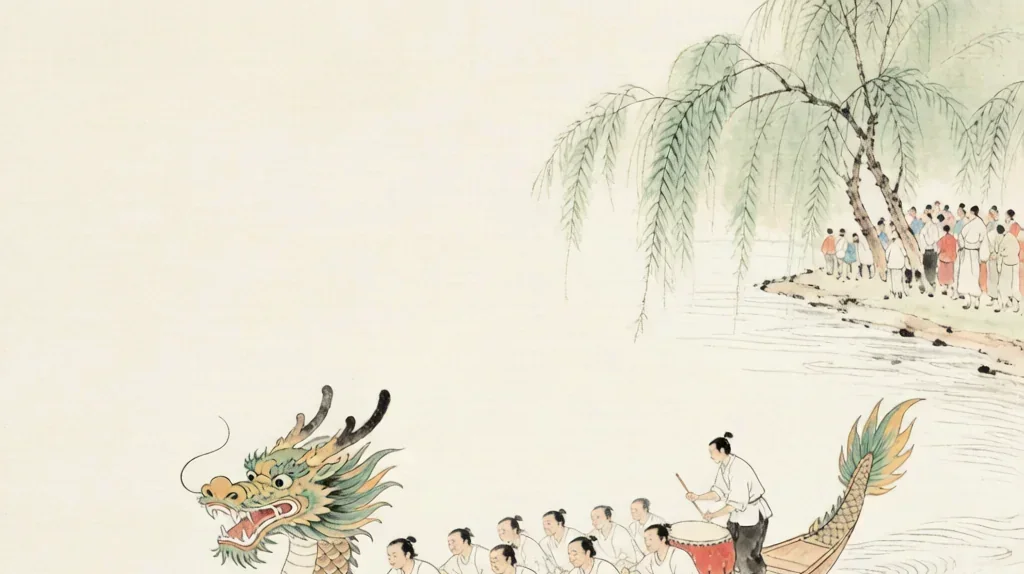
When the rhythmic beat of a drum echoes across the water and a long, slender boat adorned with a dragon's head cuts through the waves, you are witnessing one of the world's most spectacular team sports. Dragon boat racing combines ancient tradition with modern athletic competition, demanding extraordinary levels of synchronization, power, and endurance from its participants. While the festival origins are well known — commemorating the poet Qu Yuan during the Dragon Boat Festival — the sport itself deserves recognition as a serious athletic discipline that has grown into a global phenomenon with millions of participants worldwide.
The Anatomy of a Dragon Boat Team
A standard dragon boat team consists of 22 members, each with a specific role that is critical to the team's success. Twenty paddlers sit in pairs on ten benches, their paddles entering the water in perfect unison. At the front sits the drummer, who sets the pace with a powerful, steady beat that the paddlers follow as one. The drummer is the team's heartbeat — when the drummer accelerates, the entire boat accelerates. At the rear stands the steerer or sweep, who controls the boat's direction using a long steering oar. The sweep must read the water conditions, navigate turns, and keep the boat on the straightest possible course.
Each position demands different physical attributes. The front pairs, or "strokes," set the rhythm that the rest of the boat follows — they must have impeccable timing and consistency. The middle pairs, known as the "engine room," are typically the largest and strongest paddlers, providing the raw power that drives the boat forward. The back pairs must maintain the rhythm established by the strokes while also responding quickly to the steerer's commands. The drummer, often the smallest team member, needs a powerful voice and unshakeable rhythm. The steerer requires experience, spatial awareness, and the ability to make split-second decisions under pressure.
The Science of Synchronization
What makes dragon boat racing uniquely challenging is the premium it places on synchronization. Unlike rowing, where each athlete rows independently, dragon boat paddling requires twenty paddlers to move as a single organism. The paddle blades must enter the water at exactly the same instant, pull through with identical force and duration, and exit simultaneously. A single paddler who is even a fraction of a second out of sync creates drag that slows the entire boat. This is why dragon boat coaches spend countless hours drilling timing — the difference between gold and silver is often measured not in raw power but in the precision of twenty paddles moving as one.
Modern dragon boat teams use video analysis to perfect their synchronization. High-speed cameras capture every stroke from multiple angles, and coaches review the footage frame by frame to identify timing discrepancies invisible to the naked eye. Teams practice with metronomes, with the drummer gradually increasing the tempo as the paddlers' synchronization improves. Elite teams achieve a level of coordination that borders on the uncanny — from above, the boat appears to be propelled not by twenty individuals but by a single, perfectly engineered machine.
Training for the Dragon Boat
Elite dragon boat paddlers follow rigorous training regimens that rival those of Olympic athletes. A typical week includes on-water practice sessions, strength training in the gym, cardiovascular conditioning, and flexibility work. Paddlers focus on developing explosive power in the core, back, and shoulder muscles — the primary muscle groups engaged in the paddling stroke. The stroke itself is a complex movement that takes years to master: the "catch" phase where the blade enters the water, the "pull" phase where power is applied, and the "recovery" phase where the blade exits and returns for the next stroke.
Endurance is equally critical. A standard dragon boat race covers 200, 500, or 2000 meters, with 500 meters being the most common distance. At the elite level, a 500-meter race lasts approximately two minutes — two minutes of maximum effort, where paddlers maintain stroke rates of 90 to 120 strokes per minute while generating tremendous force with each pull. The physical demands are so intense that paddlers often describe the final 100 meters as operating on pure willpower, their bodies pushed far beyond normal limits.
International Dragon Boat Racing
What began as a Chinese folk tradition has evolved into a truly international sport. The International Dragon Boat Federation (IDBF), founded in 1991, now represents over 70 member countries across six continents. The IDBF World Dragon Boat Racing Championships, held every two years, attract thousands of athletes competing in categories ranging from premier open to senior grand masters. National championships are held in countries as diverse as Canada, Australia, Germany, the Philippines, and Trinidad and Tobago.
The sport's global growth has been fueled by its unique combination of accessibility and depth. Unlike many water sports that require years of training before meaningful participation, dragon boat racing allows beginners to contribute to a team almost immediately. Corporate teams, community groups, and breast cancer survivor teams have embraced the sport for its team-building benefits and inclusive culture. At the same time, the ceiling for elite performance is extraordinarily high, ensuring that the sport continues to attract world-class athletes seeking a new challenge.
The Mental Game
Beyond the physical demands, dragon boat racing is intensely psychological. The boat is a pressure cooker of shared effort — every paddler can feel whether their teammates are giving their all, and the collective will to win or the despair of falling behind spreads through the boat like electricity. Teams that train together develop an almost telepathic connection, anticipating each other's rhythms and responding to subtle shifts in the boat's movement. The drummer's call, the splash of paddles, the burning in the lungs, and the sight of the dragon head surging toward the finish line — these sensations create a bonding experience that few other sports can match.
Sports psychologists who work with dragon boat teams emphasize the importance of "collective efficacy" — the shared belief in the team's ability to succeed. Teams with high collective efficacy perform better under pressure, recover faster from setbacks, and maintain synchronization even when exhausted. Building this shared confidence requires not just physical training but trust-building exercises, communication drills, and a team culture that celebrates every member's contribution. The best dragon boat teams are not necessarily the ones with the strongest individual paddlers — they are the ones that have forged twenty-two individuals into a single, unstoppable force.
Technology and Innovation
Modern dragon boat racing has embraced technology without losing its traditional soul. Boats are now constructed from carbon fiber and other advanced composites, reducing weight while increasing stiffness and speed. Paddles are engineered using computational fluid dynamics to maximize efficiency through the water. GPS tracking systems and accelerometers provide real-time data on boat speed, stroke rate, and acceleration, allowing coaches to make tactical adjustments during training. Some teams use heart rate monitors on every paddler, tracking individual exertion levels to optimize race strategy.
Yet the essence of the sport remains unchanged. The dragon head still leads the way, the drum still beats the rhythm, and twenty paddlers still pull together as one. In an age of individualistic sports and personal brands, dragon boat racing offers something increasingly rare: the experience of submerging individual identity into a collective effort, of achieving something that no single person could accomplish alone. It is a reminder that the oldest team sport in the world is also one of the most relevant to the modern age.
The Festival Behind the Race
Dragon boat racing is inseparable from the Dragon Boat Festival, held on the fifth day of the fifth lunar month. The holiday honors Qu Yuan, the poet who drowned himself in the Miluo River, and the races are said to echo the villagers who rowed out to recover him, beating drums and splashing to drive fish away. The day's other customs reinforce the same themes of protection and memory: families eat sticky rice dumplings, hang aromatic herbs, and tie five-colored cords on children. So a race is never only a sport; it is a communal act of remembrance wrapped in celebration. Even as the competition has gone global and thoroughly athletic, the festival date and the Qu Yuan story travel with it, so a crew in Canada or Germany is still, knowingly or not, rowing inside a two-thousand-year-old ritual of grief, loyalty, and seasonal renewal.
The Boat Itself: From Cedar to Carbon Fiber
The boat is a character in its own right. Traditional hulls were carved from a single cedar or teak log, long and narrow, with a raised dragon head lashed to the bow and a curled tail at the stern; the carving of those heads was itself a folk craft, varying by region. Modern competition boats are built from fiberglass and carbon composites, lighter and stiffer, with standardized lengths for fair racing, yet they keep the dragon head and the painted scales. The paddle, once a plain wooden blade, is now shaped by fluid dynamics for efficiency. What has not changed is the silhouette: a low, fast crescent capped by a dragon. The contrast tells the sport's whole story ancient form, modern material and explains why, even at world championships, the boat still looks like the thing that slid onto a river to fetch a grieving poet two millennia ago.
❓ Frequently Asked Questions
📝 Chinese Vocabulary
- 龙舟 — Dragon boat, the traditional long canoe used in racing
- 赛龙舟 — Dragon boat racing, literally "compete dragon boat"
- 鼓手 — Drummer, the team member who sets the paddling rhythm
- 舵手 — Steerer or sweep, the person who controls the boat's direction
- 齐心协力 — "With one heart and combined strength," an idiom describing perfect teamwork
🎉 Fun Facts
- The International Dragon Boat Federation (IDBF) now has over 70 member countries, making dragon boat racing one of the fastest-growing water sports in the world.
- Elite dragon boat paddlers can generate over 300 watts of power per stroke — comparable to professional cyclists — and maintain this output for the duration of a 500-meter race.
- Breast cancer survivor dragon boat teams have become a global movement, with research showing that the paddling motion helps prevent lymphedema and promotes physical and psychological recovery.
- The longest dragon boat ever built measured over 77 meters and carried 200 paddlers — it was constructed in China and required extraordinary coordination to operate.
- A standard dragon boat race over 500 meters at the elite level is completed in under two minutes, with boats reaching speeds of over 20 kilometers per hour.
- Before racing, many teams hold an eye-dotting ceremony in which the dragon head's eyes are painted with red, a ritual believed to awaken the boat and bring it to life.