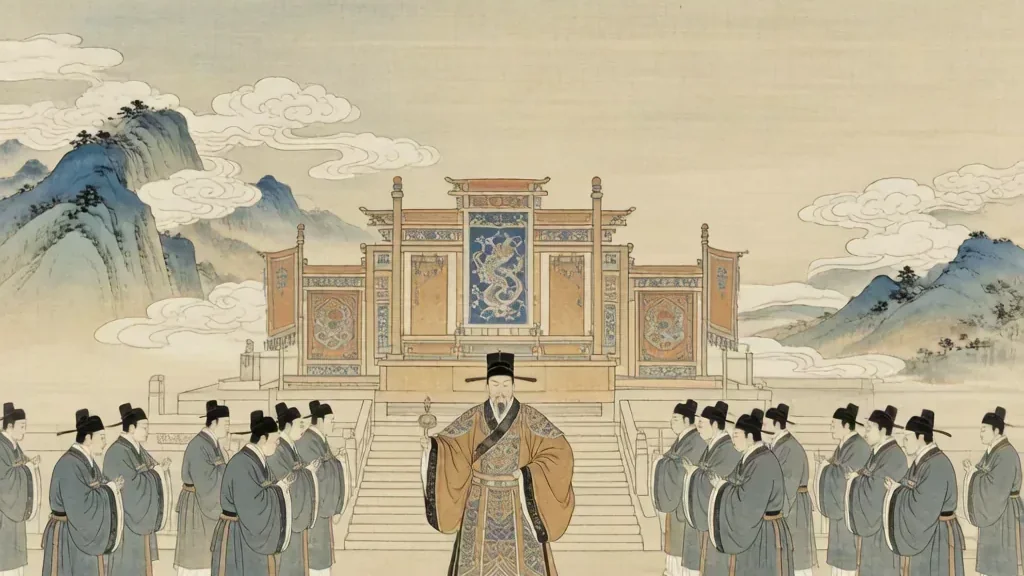
Jitian (祭天), the "sacrifice to Heaven," was the supreme state ritual of imperial China, the solemn ceremony by which the emperor—viewed as the Son of Heaven—renewed his mandate and gave thanks to the cosmic power that ordered the world. Performed most famously at the Temple of Heaven (天坛) in Beijing on the winter solstice, the rite combined astronomy, architecture, music, and liturgy into the most carefully regulated act in the Chinese political calendar. To sacrifice to Heaven was, in effect, to perform the foundations of kingship itself.
The Emperor as Son of Heaven
Chinese political theology held that the emperor ruled not by mere force but by the Mandate of Heaven (天命). Heaven (天) was the supreme cosmic authority, impersonal yet responsive, that granted order to the seasons, the harvest, and human society. The emperor's unique duty was to maintain harmony between heaven and earth through correct ritual, of which the sacrifice to Heaven was the foremost expression.
Failure to perform it properly, or the occurrence of disaster, could be read as a sign that the mandate was slipping—a powerful check on imperial behavior.
The Winter Solstice Rite
The great annual jitian took place at the winter solstice, the moment when yang energy begins to return and the celestial cycle turns toward renewal. At this pivot of the year the emperor fasted, purified himself, and led a procession to the altar to pray for a good harvest and the peace of the realm. The timing linked the human rite to the cosmos itself.
The ceremony was repeated in lesser form at other points in the calendar, but the solstice sacrifice was the crown of state religion.
The Temple of Heaven in Beijing
The architectural setting of the rite is the Temple of Heaven, built in the Ming and expanded in the Qing, a complex of circular and square structures encoding the Chinese cosmos: heaven round, earth square. The Circular Mound Altar (圜丘) is an open terrace of white marble where the emperor prayed; the Hall of Prayer for Good Harvests (祈年殿) is a triple-eaved conical tower where he interceded for crops.
Every dimension of the buildings is numerologically tuned to heaven—ninefold symmetries, circular plans—so that the architecture itself performs theology.
The Liturgy and Its Elements
The rite was minutely prescribed. The emperor approached in special robes, accompanied by court musicians playing the yayue (雅乐) ceremonial music and by dancers in antique costume. Offerings included the "three animals" (ox, sheep, pig), silk, jade, and grain, burned or buried so that the scent and substance ascended to heaven. Prayers were read from tablets of jade or gold.
The famous "blue tiles" of the temple complex signaled heaven's color, and the whole performance was staged so that the Son of Heaven stood beneath the open sky, alone with the cosmic power.
Fasting and Purification
Before the rite the emperor observed a period of fasting (斋戒) in a special palace, abstaining from meat, wine, music, and intercourse, and avoiding affairs of state. This purification marked the boundary between ordinary rule and sacred office, ensuring he approached Heaven as a clean vessel.
Officials, too, kept the fast, and the city quieted, since noise and impurity could disturb the rite's efficacy.
Connections to Earth and the Soil
Jitian was balanced by sacrifices to Earth (祭地), to the gods of soil and grain (社稷), and to ancestors. Together these rites maintained the full hierarchy of powers on which the realm depended. The pairing of heaven and earth sacrifices expressed the complementary duality at the heart of Chinese cosmology.
The Altar of Earth and Harvest (地坛) in Beijing's north answered the Temple of Heaven in the south, a geographic mirroring of cosmic order.
The Fengshan Sacrifices on Mount Tai
Beyond the annual rite, the most extraordinary form of heaven-worship was the fengshan (封禅) ceremony performed by certain emperors on Mount Tai, the eastern sacred peak. Feng denoted the rite on the summit (to Heaven), shan the rite at the foot (to Earth). Undertaking fengshan proclaimed an emperor's reign as uniquely blessed and orderly.
Only a handful of emperors in history attempted this grandest of ceremonies, making it a rare and loaded political statement.
Abolition and Legacy
The last imperial sacrifice to Heaven was conducted in the early twentieth century, and with the fall of the monarchy the rite ended as state practice. The Temple of Heaven became a public park and, later, a UNESCO World Heritage site, its buildings admired as masterpieces rather than as active altars.
Yet the idea that heaven sanctions right order survived in language and sentiment, and the solstice ceremony remains a potent symbol of China's ritual civilization.
Music and Dance of the Rite
The sacrifice to Heaven was as much a musical performance as a prayer. The yayue ensemble—strings, winds, and struck stones in antique formation—played slow, formal pieces believed to resonate with cosmic order, while rows of dancers moved in precise, symbolic patterns that mirrored the turning of the seasons. Music here was not entertainment but a language addressed to Heaven itself, a disciplined sound meant to harmonize the realm with the spheres.
The correctness of pitch and step was a matter of state concern, for any error was thought to disturb the harmony between realm and cosmos. Court musicians trained for years to perform the liturgy flawlessly, and the very instruments were treated as sacral objects. In the winter hush of the open altar, that controlled music was the emperor's voice raised, through art and ritual, to the supreme power that ordered the world.
❓ Frequently Asked Questions
What was jitian?
Jitian was the imperial sacrifice to Heaven, the supreme state ritual by which the emperor renewed the Mandate of Heaven and prayed for the realm's well-being.
Where and when was it performed?
The great rite was held at the Temple of Heaven in Beijing on the winter solstice, with lesser sacrifices through the year.
Why was the emperor the one to do it?
As the Son of Heaven he alone mediated between cosmos and realm; correct performance affirmed his right to rule.
What did the offerings include?
They included the three sacrificial animals, silk, jade, and grain, presented with ceremonial music and prayers.
What was fengshan?
Fengshan was the rare grand ceremony on Mount Tai joining a heaven-rite on the summit and an earth-rite at the base, claiming a uniquely blessed reign.
Does the rite continue today?
No; it ended with the monarchy, though the Temple of Heaven survives as a heritage site and symbol of ritual order.