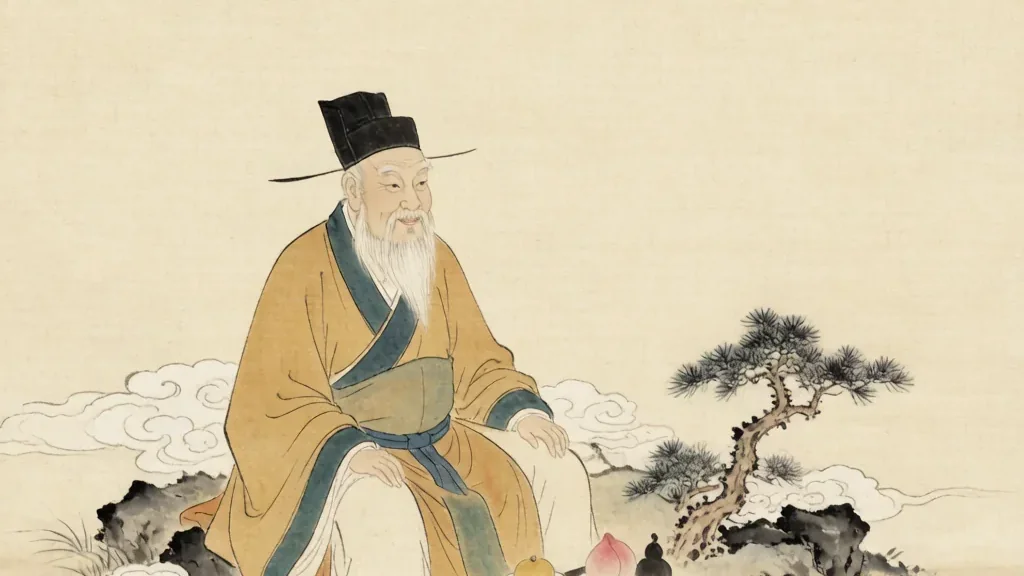
Tudigong (土地公), the "Earth God" or "Local Earth Deity," is one of the most widespread gods in Chinese folk religion — the guardian of a single neighborhood, village, or plot of land. Usually pictured as a kindly old man, he watches over local affairs, witnesses contracts, and is thanked at harvest and consulted in everyday worries. His small temples dot the countryside and city alleys alike, a humble divine neighbor to millions.
Who Is Tudigong?
Tudigong is the earth god of a specific place. Unlike great celestial deities, he governs a bounded territory — a field, a lane, a market — and is intimately tied to the people living there.
He is also known as Fude Zhengshen (福德正神), the "Righteous God of Blessing and Virtue," a formal title used in temples and prayers.
Appearance and Attributes
In art Tudigong is a white-bearded elder in plain official robes, often holding a staff or a golden ingot, accompanied by his wife Tudipo. His look is gentle, not majestic.
This grandfatherly image makes him approachable: worshippers treat him less as a distant lord than as a familiar local elder who knows their names and needs.
Role as Village Guardian
The earth god shields the community from misfortune, presides over its boundaries, and is the first to be told of births, deaths, and moves. He is the spiritual registrar of the locality.
Farmers thank him for crops and ask his leave before building or digging, since any disturbance of the soil concerns him directly.
Temples and Roadside Shrines
Tudigong shrines range from grand temples to a simple niche in a wall with a stone or tablet. A small house-shaped shrine at a field's edge is a common rural sight.
Because his domain is local, his temples are countless and unpretentious, woven into the everyday landscape rather than set apart like great monastic sites.
Rites of Worship
Offerings are modest: incense, food, and paper money burned on his birthday and at harvest. Households may pray to him for peace, a good yield, or a smooth undertaking.
His birthdays are traditionally kept on the second day of the second lunar month and the fifteenth of the eighth, though local dates vary.
Tudigong and Wealth
Though not the God of Wealth, Tudigong is often linked to local prosperity because land and livelihood are joined. Merchants sometimes honor him as a guardian of their trade spot.
This overlap explains small "earth god" niches inside shops, where the deity is asked to steady business as he steadies the soil.
Contrast with Chenghuang and Sheji
Tudigong is the lowest tier of territorial god, beneath the City God (Chenghuang) who governs a walled town, and far beneath the imperial Sheji altar of the realm.
The hierarchy — earth god, city god, state altar — shows how Chinese religion mapped divine authority onto human geography, from the lane to the empire.
Funerary and Boundary Duties
In funeral custom the earth god is informed before a burial, since the dead enter his ground. He also witnesses the setting of boundaries between properties.
These duties make him a quiet administrator of life's thresholds, present at both the founding of a home and its ending.
Presence in the Diaspora
Chinese communities abroad carried Tudigong with them, setting up earth-god shrines in Southeast Asia and beyond. In some places he merged with local land spirits.
His portability shows why he endures: a god of place travels well when "place" means the familiar corner of any new settlement.
Tudigong in Folktales
Popular stories cast the earth god as a humble, even comical figure who solves local problems with common sense rather than grand power, endearing him to tellers and listeners alike.
In many tales he mediates disputes between villagers, outwits a louder spirit, or quietly helps a poor family — a narrative role that mirrors his real function as neighborhood peacemaker.
These stories reinforce his approachability: unlike the distant gods of thunder or wealth, Tudigong is the deity you might argue with and still invite to dinner, the divine as familiar elder.
Tudigong and the Agricultural Year
In farming villages the earth god's calendar followed the fields: he was honored at sowing for a good start and at harvest in thanks, his shrine the quiet pivot of the rural year.
Before ploughing new ground, farmers might present him a simple offering, asking leave to turn his soil and blessing for the crop that would rise from it.
This closeness to the agricultural cycle made Tudigong the most lived-with of deities, present not in grand festivals alone but in the weekly rhythm of rural labor and its small rites.
Names Across the Regions
The earth god is known by many names: "Tudigong" in the north, "Bo Gong" or "Fuyou Dadi" in parts of the south, each title shading his local character slightly differently.
These regional names remind us that folk deities are intensely local, shaped by the speech and needs of the place that keeps them, even when the role stays the same.
A Neighbor Deity
What sets Tudigong apart is intimacy: he is the god you pass on the way to market, the elder at the lane's end who knows the neighborhood's every name.
In a pantheon of distant and majestic powers, the earth god's closeness makes him the most constantly consulted, a daily rather than occasional presence in local life.
That steady nearness is his special grace: he asks little, stays put, and watches over the ordinary ground where most lives are actually lived. In his quiet way, he is the most present of all the gods, known and loved by all.
❓ Frequently Asked Questions
Who is Tudigong?
Tudigong is the local Earth God who guards a single village, lane, or plot of land, pictured as a kindly old man.
What does he do for the community?
He protects the locality, witnesses life events like births and burials, and is thanked for harvests and consulted in daily worries.
How is he worshipped?
With modest offerings of incense, food, and paper money on his birthdays and at harvest, asking for peace and a good yield.
How does he differ from the City God?
The City God governs a walled town, while Tudigong guards a small territory — a lower tier in the hierarchy of place gods.
Is he a god of wealth?
Not formally, but he is linked to local livelihood and honored by some merchants as guardian of their spot.
Why does he appear in funerals?
Because the dead enter his ground, the earth god is informed before burial and helps mark the boundary between worlds.