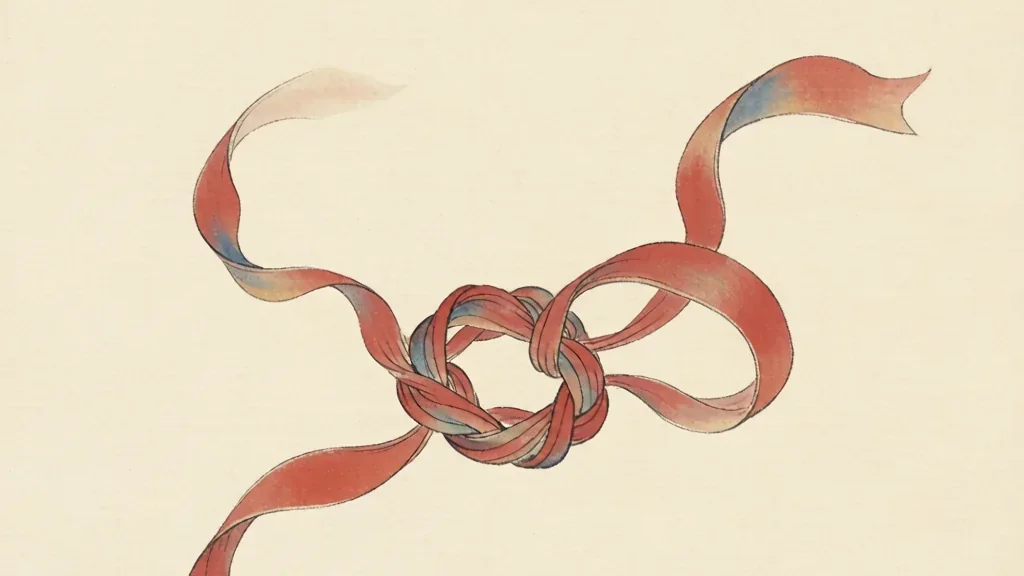
Take a single length of red silk cord, loop it over itself, pull it through, tighten — and a knot appears. Loop it again in the opposite direction, pull, and the knot has grown into a pattern. Keep going, weaving one continuous cord in and out of itself, and you may end with a flat coin-shaped medallion, a three-dimensional butterfly, or a swirling, endless knot that has no beginning and no end. This is 中国结 (zhōng guó jié), "Chinese knotting" — a folk art in which a single thread becomes a blessing, a charm, a gift, and a wish.
Chinese knots are everywhere in Chinese life: dangling from the rearview mirrors of cars, hanging on the walls of temples and homes, attached to jade pendants, embroidered onto the corners of wedding gifts. Each knot has a name, a story, and a meaning. To tie one is to invoke good fortune, longevity, harmony, or peace — and to do so with a craft that, like so much of Chinese culture, finds its profundity in the patient working of a simple material.
One Cord, No Cuts: The Philosophy of the Knot
The defining rule of traditional Chinese knotting is that a knot is tied from a single continuous cord. The cord is not cut, glued, or sewn. Whatever shape the knot takes — a button, a flower, a dragon, a Buddha's hand citron — it is woven from one unbroken thread, then finished by tucking the two ends discreetly into the body of the knot.
This rule is not just technical. It is philosophical. The unbroken cord symbolizes continuity — of family, of life, of blessing. It suggests that all things are connected, that beginnings and endings are joined, and that good fortune should "never be cut off." The Chinese word for knot, 结 (jié), carries meanings of "to tie," "to bond," "to conclude," and "to unite" — and it appears in words for marriage (结婚, jié hūn), friendship (结交, jié jiāo), and results or outcomes (结果, jié guǒ). To tie a knot is, in a sense, to seal a promise.
The Chinese also love knots for the way they embrace the pun. Because so many Chinese words share pronunciations, almost every knot carries a second, hidden meaning through sound. "结" (jié, "knot") sounds like "吉" (jí, "auspicious"). "绳" (shéng, "cord") sounds like "神" (shén, "divine"). "盘长" (pán cháng, the name of the most famous knot) sounds like a wish for endless continuity. To hang a Chinese knot is, in effect, to recite a silent poem of good wishes in the language of homophones.
The Pan Chang Knot: The Endless Loop
If there is one knot that defines the art, it is the 盘长结 (pán cháng jié), the "pan chang knot" or "endless knot." It is a complex, symmetrical pattern woven from a single cord that loops back and forth on itself, forming a closed lattice with no visible beginning or end. The design is one of the Eight Auspicious Symbols of Buddhism, where it represents the infinite wisdom of the Buddha and the interdependence of all things. In Chinese folk culture, it has come to mean endless longevity, unbroken prosperity, and the continuity of the family line.
The pan chang knot is the visual signature of Chinese knotting. It appears on temple banners, on the sashes of Buddhist monks, on the covers of New Year almanacs, and on the dashboard of nearly every taxi in Beijing. The intricate symmetry of its loops — typically built around a central diamond, with swirling arms extending in four directions — is at once mathematical and meditative. To tie one well requires patience, a clear mental image of the pattern, and a steady hand.
Many of the larger Chinese knots you see hanging in shops and homes are in fact composite pieces, built by combining a pan chang knot with other knots — a coin knot, a flower knot, a tassel — to create a finished ornament. The pan chang provides the structural and symbolic heart; the other knots add color, form, and additional layers of meaning.
A Garden of Knots and Their Meanings
Beyond the pan chang, Chinese knotting includes dozens of named patterns, each with its own meaning. A few of the most beloved:
· The Ping'an Knot (平安结, píng ān jié) — "peace and safety knot." A simple, rounded knot often worn as a pendant or attached to a child's clothing. The phrase 平安 (píng ān) is one of the most universal Chinese wishes: not "excitement" or "triumph," but the deeper blessing of a life free from harm.
· The Coin Knot (铜钱结, tóng qián jié) — woven in the shape of an ancient Chinese coin with a square hole in the middle. It invokes wealth and prosperity, and is often given to business owners or hung in shops at New Year.
· The Double Coin Knot (双钱结, shuāng qián jié) — two coin knots joined, doubling the wish for wealth and, through the doubled shape, hinting at harmony between two parties.
· The Flower Knot (花结, huā jié) — a decorative knot shaped like a peony, lotus, or chrysanthemum, used on gifts and as a brooch. Different flowers carry different meanings: peony for wealth, lotus for purity, chrysanthemum for longevity.
· The Butterfly Knot (蝴蝶结, hú dié jié) — a graceful knot in the shape of a butterfly. The word for butterfly (蝴蝶, hú dié) sounds like 福叠 (fú dié), "fortune piling up," so the knot is a wish for accumulating blessings.
· The Ruyi Knot (如意结, rú yì jié) — based on the shape of the ruyi, a ceremonial scepter whose name means "as you wish." The knot is a wish that everything the wearer desires may come true.
· The Lucky Knot (吉祥结, jí xiáng jié) — a symmetrical, cross-shaped knot often seen in temples, representing good fortune in all directions.
A Thousand Years on a Single Thread
Knotting is one of the oldest crafts in China — older than paper, older than silk painting, perhaps older than writing. Archaeologists have found knotted cords in tombs dating back to the Zhou Dynasty (1046–256 BCE), and some scholars believe that knotting was a system of record-keeping before the invention of writing, much as the Inca used quipu. The Yi Jing (易经, "Book of Changes") mentions "knotted cords" as the recording method of ancient times before the invention of writing.
Through the Han and Tang dynasties, knots were used to decorate clothing, swords, mirrors, and personal ornaments. The Tang court sent silk knots as diplomatic gifts; the Song refined the art into delicate jewelry. By the Ming and Qing, every well-dressed woman wore knotted buttons and tassels, and every literati's writing desk had a small knotted pull for the inkstone. Knots were not a luxury — they were a basic part of being dressed, of being equipped, of being Chinese.
The art nearly disappeared in the early 20th century, replaced by machine-made tassels and Western-style fastenings. But in the 1970s, a Taiwanese knot enthusiast named Chen Hsia-Sheng (陈夏生) began collecting old knots from antique clothing, decoding their patterns, and teaching the craft anew. She and a small group of practitioners gave the art the name "中国结" — "Chinese knot" — to distinguish it from Western macramé and Japanese kumihimo, and the term caught on across the Chinese-speaking world. Today, Chinese knotting is taught in schools, practiced as a hobby, and displayed in museums — a craft reborn in the modern era.
Knots in Daily Life
Walk through any Chinese market, and you will see Chinese knots in a dozen uses. Large red knots hang in shop entrances to invite prosperity. Smaller knots dangle from car mirrors and mobile phones for safety on the road. A jade pendant is almost always strung on a knotted red cord — the knots spaced evenly along the cord both decorative and functional, keeping the jade from sliding. Temple visitors buy knotted amulets blessed by monks. Brides receive knotted decorations on the bridal chest. Children are given tiny ping'an knots to wear on their first day of school.
The knots also mark the seasons. At Spring Festival, every home hangs a large red knot beside the door — often a pan chang with tassels — to invite a year of unbroken fortune. At Mid-Autumn Festival, smaller knots decorate lanterns. At weddings, the double happiness knot (a composite design incorporating the 囍 character) appears on gifts, mirrors, and the bridal bed. Each season and occasion has its appropriate knot, its appropriate color, its appropriate size.
What makes Chinese knots so enduring is precisely their simplicity. A few meters of red cord, a pair of hands, and a quiet hour are enough to make a charm that can outlast a photograph. In a culture that prizes continuity above almost everything else, the unbroken thread — woven into a knot whose meaning everyone knows — is one of the quietest and most eloquent blessings a person can offer.
Knots as Gifts: A Silent Poem of Wishes
A Chinese knot is rarely a neutral decoration; it is a message sent without words. Given as a gift, a small red knot carries the giver's hopes for the receiver's safety, prosperity, or long life. A ping'an knot offered before a journey is a quiet prayer for safe return, while a ruyi knot handed to a graduate wishes every endeavor to succeed. Because the meaning is widely understood, the gift needs no card; the knot itself speaks. This is why knots appear at so many turning points, from a child's first day of school to a friend's new home. The custom turns a humble length of cord into a portable blessing, one that can be worn, hung, or tucked into a bag, and that keeps giving its silent good wish long after the moment of parting.
The Craft Today: Cord, Color, and Technique
Although the symbolism is ancient, the making of Chinese knots is thoroughly alive today. Practitioners work with smooth cords of cotton, silk, or brightly colored nylon, choosing width and sheen to suit the design. The only real tools are a pinboard and a few straight pins to hold loops in place while the pattern is built, though many beginners start with printed diagrams or instructional kits. Classes are offered in community centers and schools, and video tutorials have carried the craft to a new generation online. What has not changed is the patience the work demands: a complex pan chang or composite ornament can take hours, and a single mistake means loosening the cord and starting the section again. The craft remains, as ever, a calm discipline of hand and attention.
Knots Across the Life Cycle
Chinese knots mark the seasons and the stages of a life. At birth, a tiny safety knot may be tied to an infant's clothing; at the first day of school, a small knot wishes the child focus and protection. Weddings are the great occasion for knots, above all the double happiness design that appears on the bridal bed, the mirror, and the gifts exchanged by the two families. At Spring Festival, a large red pan chang with tassels hangs by the door to invite a year of unbroken fortune, while Mid-Autumn lanterns may carry smaller knots. In this way the same simple object travels with a person from cradle to celebration, a quiet, repeated reassurance that life's key moments are held within a circle of blessing and continuity.
❓ Frequently Asked Questions
📝 Chinese Vocabulary
中国结 — : "Chinese knot"; the modern name for the traditional folk art of weaving a single unbroken cord into decorative, symbolic patterns.
盘长结 — : the pan chang or "endless knot," the most iconic Chinese knot, symbolizing continuity, longevity, and unbroken prosperity; one of the Eight Auspicious Symbols of Buddhism.
平安结 — : the "peace and safety knot," a simple rounded knot worn as a charm to invoke a life free from harm.
结 — : knot; also "to tie, bond, conclude, unite" — appearing in words for marriage (结婚), friendship (结交), and outcome (结果), making the knot a symbol of connection in every sense.
双钱结 — : The double coin knot, a wish for doubled wealth and partnership.
如意结 — : The ruyi knot, shaped after a ceremonial scepter, expressing the wish that all goes as you desire.
吉祥结 — : The auspicious knot, a symmetrical design used to invite good fortune in all directions.
囍 — : The doubled happiness character, the centerpiece of wedding knots and bridal decoration.
🎉 Fun Facts
- By strict tradition, every Chinese knot is tied from a single unbroken cord, with the two ends tucked inside at the finish — symbolizing that fortune and family continuity should never be "cut off."
- The pan chang knot is one of the Eight Auspicious Symbols of Buddhism, where it represents the infinite wisdom of the Buddha and the interdependence of all things — adopted by Chinese folk culture as a wish for endless longevity.
- The modern revival of Chinese knotting in the 1970s is credited to Chen Hsia-Sheng, a Taiwanese researcher who decoded old knot patterns from antique clothing and coined the term "中国结" to distinguish the craft from Western macramé.
- Red dominates Chinese knots because red is the color of luck and protection, believed to ward off misfortune.
- The double happiness knot built around the character is a wedding staple, hung on mirrors, gifts, and the bridal bed.
- A jade pendant is traditionally strung on a knotted red cord, the knots both keeping the stone in place and adding a blessing.