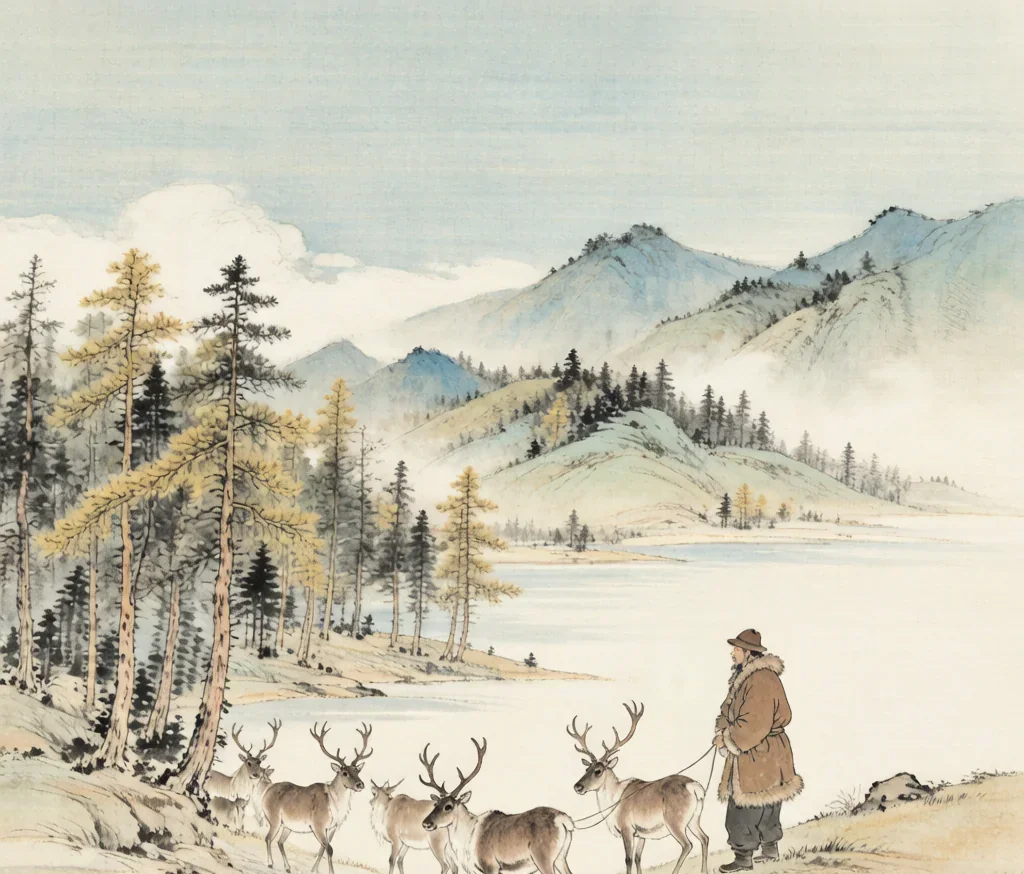
The Ewenki, or Ewenkezu (鄂温克族), are a Tungusic people of about 30,000 in China, spread across the Inner Mongolian grasslands and the forests of northern Heilongjiang, with kindred groups across the Russian border. They are best known for the "reindeer Ewenki" of the Greater Khingan Range, one of the last nomadic reindeer-herding cultures on earth, who migrate with their herds through the taiga. Alongside these forest hunters dwell Ewenki horse-herders of the Hulun Buir steppe, making the group a study in contrasts between tundra, taiga, and grassland, bound together by a shared language, shamanic heritage, and a deep bond with animals.
Name and Identity
"Ewenki" is a self-designation meaning roughly "people of the forest" or "those who live in the mountains." In China the name covers several local groups once categorized separately, including the "Solon," "Tungus," and the reindeer-herding "Kamnigan" of the north. Each of these subgroups brought its own ecology and custom under a single umbrella, so that "Ewenki" describes less a uniform nation than a family of kindred northern peoples bound by language and myth. This internal diversity is the key to understanding why Ewenki life ranges from tundra to steppe.
These groups speak closely related Tungusic dialects and share myth and custom, but their economies differ sharply — a reminder that "Ewenki" is an umbrella rather than a single uniform culture.
Homeland and Distribution
Chinese Ewenki live mainly in the Evenki Autonomous Banner of Inner Mongolia, the Oroqen Autonomous Banner, and settlements along the Erguna and Gen rivers of the Hulun Buir region, plus forest towns in Heilongjiang such as Aoluguya.
The steppe Ewenki herd horses and cattle on the open grasslands, while the forest Ewenki inhabit the coniferous taiga of the Greater Khingan Range. Across the border, Ewenki peoples are found in Russia's Siberia.
The Reindeer Herders
The most famous Ewenki are the reindeer herders of the northern forests, who keep semi-domesticated reindeer for transport, milk, and meat. The animals browse on lichen in the winter forest, and families move camp to follow the herds.
Living in conical tents (chums) of birch bark and skins, these herders maintain a lifestyle akin to Arctic Sami or Nenets reindeer pastoralism. Their numbers are tiny — only a few hundred — and they are among the last such nomads in China.
Steppe Horse-Herders
The grassland Ewenki of Hulun Buir are accomplished horse and cattle herders, riding the vast meadows in a manner reminiscent of the Mongols. Their annual round includes branding, migration to summer pasture, and the autumn roundup.
For these Ewenki, horsemanship is central to identity, and the horse features in sport, song, and ritual. The open steppe economy connects them culturally to the wider Mongolian world while keeping a distinct Ewenki tongue.
Language
Ewenki is a Tungusic language related to Even, Oroqen, and Manchu. Dialects vary between the forest and steppe groups, and the language is oral with no widely used traditional script; today literacy passes through Mongolian or Chinese.
Because speakers are few and dispersed, the language is vulnerable, and documentation projects record vocabulary and folklore before fluent elders pass. Bilingual education efforts aim to slow the shift to Mandarin and Mongolian.
Shamanism and Belief
Traditional Ewenki religion is shamanism, in which shamans (samans) mediate with spirits of animals, ancestors, and the natural world. The bear holds special reverence, and hunting rituals express gratitude to the prey's spirit.
Shamans used drum and song to enter trance, heal the sick, and guide communal rites. Though suppressed in the twentieth century, shamanic memory and symbolism persist in festival and story, and some revival of ritual has occurred.
Bears and Hunting Customs
The Ewenki traditionally hunted elk, wild reindeer, and bear, and the bear occupied an ambivalent sacred status: respected as a kin-like being yet taken for sustenance. Special ceremonies accompanied the bear hunt and the sharing of its meat.
Hunting was governed by taboos meant to keep the forest's spirits appeased, ensuring future success. With protected-area rules and resettlement, subsistence hunting has largely ended, but the customs remain in oral tradition.
Clothing and Material Culture
Forest Ewenki made clothing from reindeer hide and birch bark, suited to the cold taiga; the steppe Ewenki wore felt, wool, and leather like their Mongolian neighbors. Ornament included beadwork and silver.
Birch-bark crafting — boxes, boats, and containers — is a signature skill of the northern Ewenki, who exploited the abundant birch of the taiga. These light, durable wares suited a mobile life.
Festivals and Food
The "Milk Festival" (Naadam-like gatherings) and horse races mark steppe Ewenki life, while forest families celebrate the seasonal movement of reindeer. Roast meat, dairy, and wild herbs form the traditional diet.
Reindeer milk and venison, now rare, were staples of the taiga diet; on the steppe, mutton, milk tea, and cheese predominate. Hospitality obliges the offering of food and the sharing of the hearth.
Modern Relocation and Heritage
In the twenty-first century many reindeer Ewenki were resettled from the forest into fixed settlements near Aoluguya to improve schooling and healthcare, a move that disrupted nomadic herding and sparked debate over cultural cost.
Today some families still keep reindeer in the forest while living partly in town, and cultural bureaus support reindeer husbandry as heritage. The Ewenki story — of animals, mobility, and survival — has become a symbol of China's northern indigenous peoples.
Food of the Northern Forest and Steppe
Ewenki cuisine follows environment: the forest people eat reindeer milk, venison, and preserved berries, while steppe families rely on mutton, beef, and milk tea with salt and butter. Both prize hearty broths against the cold.
Wild mushrooms, pine nuts, and fish from northern rivers supplement the diet, and the hearth is the social center where food is shared. Hospitality demands that a guest never leave the tent hungry.
❓ Frequently Asked Questions
Where do the Ewenki live?
Across Inner Mongolia's Hulun Buir grasslands and the forests of northern Heilongjiang, with relatives in Russia's Siberia.
What makes them famous?
The reindeer-herding Ewenki of the Greater Khingan taiga are among the last nomadic reindeer pastoralists in the world.
What language do they speak?
A Tungusic language related to Even, Oroqen, and Manchu, oral with no traditional script; literacy uses Mongolian or Chinese.
What is their traditional religion?
Shamanism, with spirits of animals and nature; the bear held special sacred status and hunting followed strict rites.
How do steppe and forest Ewenki differ?
Steppe Ewenki herd horses and cattle like Mongols; forest Ewenki herd reindeer and hunt in the coniferous taiga.
What happened to the reindeer herders?
Many were resettled into fixed towns near Aoluguya for services, though some families still keep reindeer in the forest.