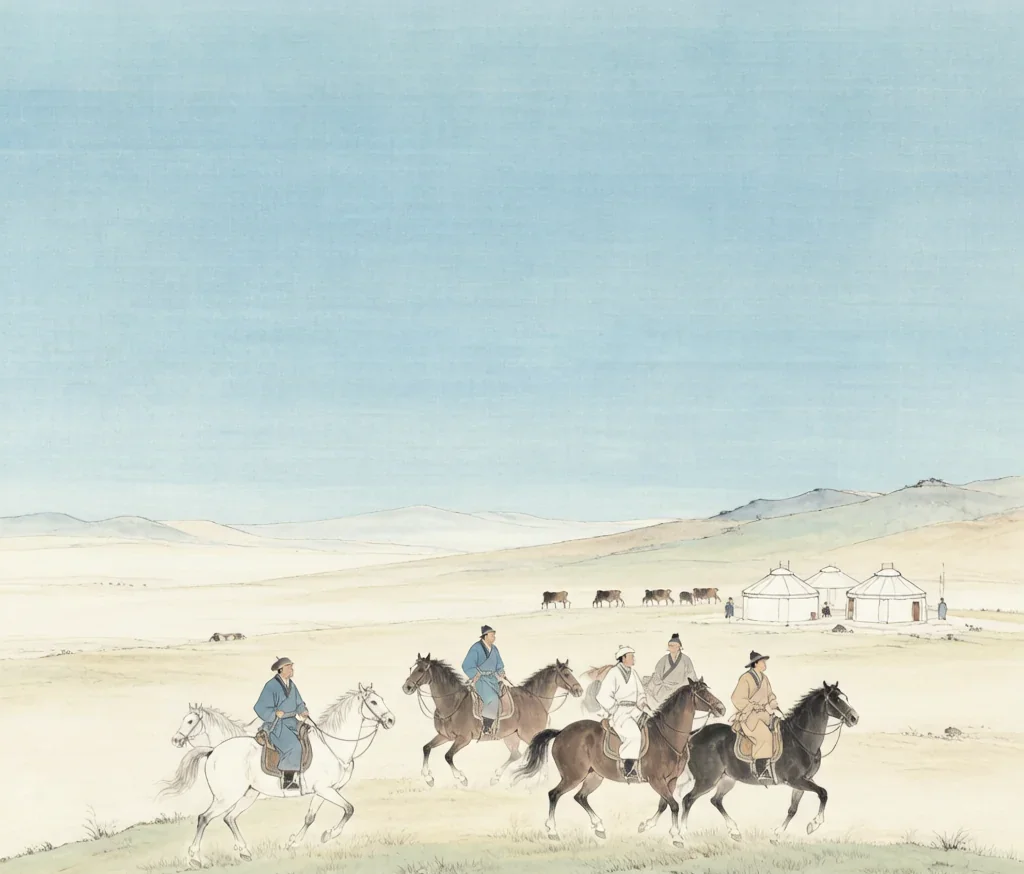
Beneath the vast dome of the Mongolian sky, where the steppe stretches to every horizon and the wind carries the scent of grass and distance, a nomadic civilization has thrived for millennia. The Mongolian people, known in Chinese as 蒙古族 (Měng gǔ zú), are the heirs of Genghis Khan's empire-builders, but their culture runs far deeper than conquest. It is a culture shaped by the land itself — by the endless grasslands, the fierce winters, and the eternal blue sky that the Mongols have worshipped since before recorded history.
The Nomadic Way of Life
Mongolian culture is inseparable from nomadism, a way of life that has persisted on the Eurasian steppe for at least four thousand years. This is not nomadism as aimless wandering but as a sophisticated system of seasonal migration, moving herds between summer and winter pastures in a carefully managed cycle. The five traditional Mongolian livestock — horses, cattle, camels, sheep, and goats — each play specific roles in the nomadic economy, and the health of the herds is the measure of a family's prosperity.
The rhythm of nomadic life follows the seasons with precision. In spring, when the first green shoots appear and livestock births peak, families are busiest — tending newborn animals, shearing sheep, and preparing dairy products from the abundant milk. Summer brings movement to higher, cooler pastures, where the grass is richest. Autumn is the season of preparation — slaughtering animals for winter meat, drying dairy products, and repairing equipment. Winter is the time of endurance, when families huddle in their felt tents against temperatures that can drop below minus forty degrees Celsius, sustained by the stores accumulated through the year.
This nomadic way of life has produced a culture of extraordinary hospitality. On the steppe, a traveler is always welcome — the next ger (yurt) might be hours away, and refusal of hospitality could mean death in harsh weather. Mongolian hospitality is legendary: any visitor to a ger is offered milk tea and food before any questions are asked. The custom of sharing what one has, even with strangers, reflects the reality that on the steppe, survival depends on mutual aid.
The Ger: Home on the Steppe
The Mongolian ger (known in the West as a yurt) is one of humanity's most elegant solutions to the challenge of mobile shelter. A circular structure of wooden lattice walls, radial roof poles, and a central crown, all covered with layers of felt made from sheep's wool, the ger can be assembled or disassembled by a family in under an hour. It weighs little enough to be transported by a few camels or a single truck, yet it withstands the fierce winds of the steppe and provides effective insulation against both summer heat and winter cold.
The interior of the ger is a microcosm of the Mongolian universe. The door always faces south, toward the sun. The north side, opposite the door, is the place of honor where sacred objects, family photographs, and Buddhist images are kept. The west side is traditionally the men's area, where saddles, tools, and hunting equipment are stored. The east side is the women's area, with cooking implements and food supplies. The central hearth, beneath the crown opening to the sky, is the heart of the home — the place where meals are cooked, tea is brewed, and the family gathers against the cold.
Every aspect of ger etiquette reflects the deep structure of Mongolian social life. Entering a ger, one steps over the threshold rather than on it — stepping on the threshold is considered disrespectful to the spirit of the home. One moves clockwise around the central hearth. The seat of honor is offered to elders and guests. These customs, maintained over centuries, create a portable civilization that travels with the herds across the endless grasslands.
Naadam: The Three Manly Games
Each summer, across the grasslands of Inner Mongolia and Mongolia, communities gather for Naadam (那达慕, nà dá mù) — the festival of the "three manly games" that has been the highlight of the Mongolian calendar for centuries. The three competitions — wrestling, horse racing, and archery — are not merely sports but the distilled essence of the skills that enabled the Mongols to create the largest contiguous land empire in history.
Mongolian wrestling (搏克, bó kè) differs significantly from other wrestling traditions. There are no weight classes — a small wrestler may face a giant, and technique matters more than size. Wrestlers wear distinctive costumes: tight-fitting jackets that leave the chest exposed (a tradition said to date from when a woman disguised as a man won a wrestling competition), brief shorts, and leather boots. Before each match, wrestlers perform the "eagle dance" — a stylized imitation of an eagle's movements that serves as both warm-up and display of strength. The goal is to force any part of the opponent's body above the knee to touch the ground.
Horse racing at Naadam is remarkable for the age of the jockeys — children as young as five race horses across distances of fifteen to thirty kilometers. This is not a sport for the wealthy; it is a demonstration of the horsemanship that every Mongolian child learns almost as soon as they can walk. The relationship between Mongol and horse is legendary — Mongolian horses, though small, are extraordinarily hardy, capable of surviving winter on the open steppe by pawing through snow to find grass. Genghis Khan's armies conquered half the known world on the backs of such horses.
Archery completes the triad, and Mongolian archery has its own distinctive character. The traditional Mongolian bow is a composite recurve bow, made from layers of horn, wood, and sinew glued together and shaped into a curve that stores enormous energy. Archers shoot at targets made of leather cylinders stacked in a pyramid, and the competition involves not just accuracy but also the distance and style of the shot. Traditional Mongolian archery includes shooting while standing, while kneeling, and — most spectacularly — while riding at full gallop.
Khoomei: The Art of Throat Singing
Among the most distinctive Mongolian art forms is khoomei (呼麦, hū mài) — throat singing, a vocal technique in which a single singer produces two or more distinct pitches simultaneously. The technique involves manipulating the resonances of the mouth and throat to isolate overtones from a fundamental drone, creating an otherworldly sound that seems to come from the landscape itself — the whistle of wind over the steppe, the rumble of distant thunder, the murmur of a mountain stream.
Khoomei developed among the nomadic herders of the Altai Mountains and the Mongolian steppe, and its origins are rooted in the animistic spirituality of the region. The sounds of khoomei imitate the sounds of nature — not as entertainment but as a form of communion. A khoomei singer does not merely represent nature; in some sense, the singer becomes the mountain, the river, the wind. This connection between music and landscape is fundamental to Mongolian culture, where the natural world is not a backdrop to human activity but a living presence to be honored and engaged.
There are several distinct styles of khoomei, each producing different sonic effects. Kharkhiraa produces a deep, growling fundamental with ethereal overtones above. Sygyt creates a clear, flute-like whistle above the drone. Kargyraa is a deeper, more resonant style associated with the Tuvan tradition. Learning khoomei requires years of practice to develop the precise control of the vocal apparatus needed to isolate and amplify specific harmonics. Master khoomei singers can produce three or even four distinct tones simultaneously.
The Spirit of the Eternal Blue Sky
At the heart of traditional Mongolian spirituality is the worship of Tenger, the Eternal Blue Sky (长生天, cháng shēng tiān). This is not a god in the anthropomorphic sense but an impersonal cosmic force, the sky itself as a manifestation of the ultimate power that governs the universe. The vastness of the Mongolian sky, unbroken by mountains or forests across much of the steppe, makes this form of worship natural — the sky is always present, always visible, always reminding the nomad of forces larger than human life.
Mongolian shamanism, which coexists with Tibetan Buddhism in modern Mongolian culture, centers on the figure of the shaman (博, bó) who serves as intermediary between the human world and the spirit world. The shaman's primary tool is the drum, its rhythmic beating inducing the trance state in which the shaman's soul journeys to the spirit realm. The shaman's costume — heavy with iron ornaments, ribbons, and bells — represents the spiritual armor that protects the shaman during these dangerous journeys. Even today, in an age of smartphones and satellite television, shamans continue to practice in many Mongolian communities, addressing the spiritual needs that organized religion does not always meet.
Mongolian culture, shaped by the demands of nomadic life on the vast Eurasian steppe, offers a profound alternative to sedentary civilizations' understanding of the relationship between humans and their environment. The Mongol does not seek to transform the landscape but to move through it, following the rhythms of grass and water and season. This is not passivity but a different kind of mastery — the mastery of adaptation, of movement, of living lightly on the earth. Beneath the eternal blue sky, the descendants of Genghis Khan continue to ride.
Mongolian Cuisine and Dairy Culture
Mongolian food follows the rhythm of the herds. Meat — especially mutton and beef — is boiled, roasted, or dried for winter, while dairy provides much of the daily nutrition. Herders make a remarkable range of milk products: dried curds (奶豆腐), butter, cheese, and airag, a mildly alcoholic drink of fermented mare's milk served to guests in a spirit of hospitality. Milk tea with salt is a constant companion on the steppe. The 哈达, a blue or white silk scarf, is offered when welcoming visitors or honoring elders. These foods are not merely sustenance but a way of sharing the wealth of the flocks and binding host and guest in steppe courtesy.
Mongolian Horsemanship and Herding
Horses lie at the center of Mongolian life. Children learn to ride almost as soon as they can walk, and the bond between herder and horse is built through daily herding, rounding up sheep and goats, and long seasonal moves. Mongolian horses are small but exceptionally hardy, able to graze beneath snow in winter. Skill with horses extends to the cavalry traditions honored at Naadam, where child jockeys race across open grassland. Beyond transport and sport, horses supply milk and, on occasion, meat. To be Mongolian is, in a real sense, to be a rider: mobility, herding, and horsemanship together define the nomadic economy of the grasslands.
Mongolian Traditional Clothing
Traditional Mongolian dress suits a life of riding and cold winters. Men and women wear a del (a long robe) belted at the waist, with the left flap crossed over the right, and high boots suited to the stirrup. The robe's loose cut allows freedom of movement on horseback and can be adjusted for warmth. Hats mark status and season, from summer brimmed caps to winter furs. Women's attire includes embroidered ties and silver ornaments. Fabrics once came from Chinese trade, but the cut remained distinctly Mongolian. Practiced herders still wear the del daily, and festival dress revives the full splendor of boots, sashes, and ornament for Naadam and weddings.
❓ Frequently Asked Questions
The Mongol people (蒙古族, Měnggǔ zú) live mainly in the Inner Mongolia Autonomous Region, with communities in Xinjiang, Qinghai, and the northeastern provinces.
The traditional Mongol lifestyle is nomadic pastoralism, living in portable felt tents called yurts (蒙古包, měnggǔ bāo) and herding sheep, goats, cattle, and horses.
Mongol culture is famous for its throat singing (呼麦, hūmài), the horse-head fiddle (马头琴, mǎtóuqín), and a cuisine rich in dairy and meat.
The most important festival is Nadam (那达慕, Nàdámù), featuring the 'three manly sports' — wrestling, horse racing, and archery.
The traditional Mongolian diet is rich in meat and dairy from the herds. Staples include boiled mutton (手把肉), dairy products such as dried curds (奶豆腐), and drinks like milk tea and fermented mare's milk.
A ger (蒙古包) is a round felt tent of wooden lattice walls, roof poles, and a central crown, covered with felt from sheep's wool. It can be raised or taken down quickly and withstands the winds of the steppe.
📝 Chinese Vocabulary
- 蒙古族 (Měng gǔ zú) — The Mongolian ethnic group
- 那达慕 (nà dá mù) — Naadam; the Mongolian festival of the three manly games
- 呼麦 (hū mài) — Khoomei; Mongolian throat singing
- 搏克 (bó kè) — Mongolian wrestling
- 长生天 (cháng shēng tiān) — The Eternal Blue Sky; the supreme power in traditional Mongolian spirituality
🎉 Fun Facts
- Mongolian children typically learn to ride horses before they learn to walk — it is common to see toddlers tied into saddles while their parents work nearby.
- The Mongolian ger (yurt) has been used for at least 3,000 years — depictions of similar structures appear in Bronze Age rock art across Central Asia.
- Genghis Khan's empire established the first international postal system, known as the Yam, with relay stations every 30-40 kilometers where messengers could change horses — a system that could transmit messages at speeds of up to 300 kilometers per day.
- Mongolian dairy products such as airag (fermented mare's milk) and dried curds are dietary staples and are offered to guests as a sign of respect.
- The felt of a ger is traditionally made from sheep's wool, and a single ger can be loaded onto camels or a cart for seasonal moves.
- Mongolian horsemanship is so central that traditional training begins in early childhood, with horses regarded as companions rather than mere livestock.