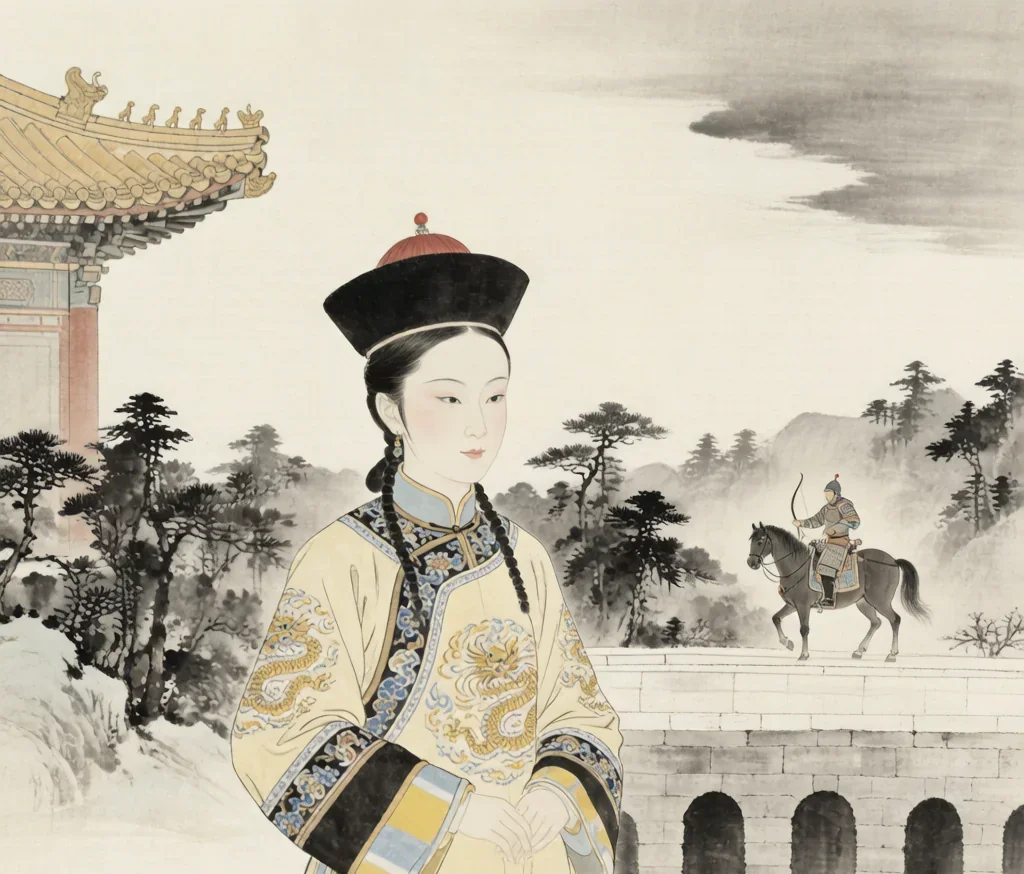
From the forests and plains of Manchuria emerged a people who would conquer China and rule it for nearly three centuries. The Manchu (满族, Mǎn zú), descendants of the Jurchen tribes who had menaced China's northern borders for centuries, established the Qing Dynasty (1644-1912), China's last imperial dynasty. Their culture — forged in the harsh environment of the northeast, enriched by contact with Mongol, Korean, and Chinese civilizations, and refined during centuries of imperial rule — represents one of the great synthesis traditions of East Asian history.
From Jurchen to Manchu
The Manchu people trace their origins to the Jurchen tribes who inhabited the forests and river valleys of what is now northeastern China. The Jurchen were a Tungusic people, related linguistically and culturally to other groups scattered across Siberia and the Russian Far East. Their traditional economy combined hunting, fishing, and limited agriculture, and their social organization centered on clans (哈拉, hā lā) that traced descent through the male line.
The Jurchen had already ruled northern China once before — their Jin Dynasty (1115-1234) controlled the territory from the Great Wall to the Yangtze River before falling to the Mongols. After the Jin's collapse, the Jurchen retreated to their Manchurian homeland, where they maintained their distinct identity through the Yuan and Ming dynasties. In the late sixteenth century, a chieftain named Nurhaci began the process of unifying the Jurchen tribes, creating the political and military foundations that would enable his descendants to conquer all of China.
Nurhaci's most important innovation was the Eight Banners (八旗, bā qí) system, a military-social organization that integrated Manchu, Mongol, and Han Chinese followers into a unified structure. Each banner had its own color — yellow, white, red, and blue, both plain and bordered — and membership in a banner determined a person's military obligations, social status, and economic entitlements. The banner system provided the organizational framework for Manchu conquest and remained the backbone of Qing military and social organization throughout the dynasty.
In 1635, Nurhaci's son Hong Taiji formally adopted the name "Manchu" (满洲, mǎn zhōu) to replace "Jurchen," creating a new ethnic identity that subsumed the various Jurchen tribes. This was a political act as much as a cultural one — the creation of a unified Manchu identity was essential to the project of conquest and rule. The name itself may derive from the Bodhisattva Manjusri, reflecting the Buddhist influences that had entered Manchu culture through contact with Mongols and Tibetans.
The Qipao: From Manchu Gown to Global Icon
Perhaps no Manchu cultural artifact has achieved greater global recognition than the qipao (旗袍, qí páo), the close-fitting dress that has become synonymous with Chinese femininity. The irony is that the qipao, in its modern form, is a twentieth-century Shanghai creation — but its origins lie in the traditional clothing of Manchu women, and its name literally means "banner gown," referring to the Eight Banners of the Manchu people.
The traditional Manchu gown (changpao, 长袍) was a loose-fitting, one-piece garment that covered the body from neck to ankles. Unlike Han Chinese women's clothing, which typically consisted of a jacket and skirt, the Manchu gown was a single garment that allowed freedom of movement — appropriate for a people whose women, unlike their Han counterparts, were not subject to foot-binding and were expected to ride horses and participate in physical activities.
During the Qing Dynasty, the Manchu gown became the standard formal dress for both Manchu and Han women at court, though significant differences in cut, decoration, and accessories distinguished the two groups. After the dynasty's fall, the gown evolved in Shanghai's fashion houses into the form-fitting, high-collared, side-slit dress that we know today as the qipao. This modern qipao is a hybrid creation — Manchu in origin, Han and Western in its subsequent evolution, and thoroughly modern in its aesthetic.
The qipao's journey from Manchu court dress to global fashion icon reflects the larger story of Manchu culture — a tradition that has been continuously transformed through contact with other cultures while retaining distinctive elements that mark its origins. Today, the qipao is worn by Chinese women of all ethnic backgrounds, and its Manchu origins are often forgotten. But the garment's name — "banner gown" — preserves the memory of the people who created it.
Shamanism: The Spiritual World of the Manchu
Before the adoption of Buddhism and the incorporation of Chinese state Confucianism, the Manchu practiced a form of shamanism that connected them to the spiritual traditions of other Tungusic and Siberian peoples. Manchu shamanism centered on the figure of the shaman (萨满, sà mǎn — the Manchu word from which the English term "shaman" ultimately derives), who served as intermediary between the human community and the spirit world.
Manchu shamanic practice involved elaborate rituals in which the shaman, dressed in a special costume hung with bronze mirrors and iron bells, would enter a trance state through drumming and dancing. In this state, the shaman's soul was believed to journey to the spirit world, where it could intercede with spirits on behalf of the community — healing the sick, ensuring successful hunts, protecting against misfortune, and guiding the souls of the dead to the afterlife.
The Manchu shamanic pantheon included a complex hierarchy of spirits. At the apex were the sky god Abka Enduri and the earth goddess Banamu Enduri. Below them were spirits of mountains, rivers, animals, and ancestors. Each clan had its own specific spirits and rituals, and the shaman's knowledge of these clan-specific traditions was essential to his or her function. Women could serve as shamans, and female shamans were particularly associated with healing and domestic rituals.
The Qing imperial court maintained an elaborate shamanic establishment, with the imperial shamans performing rituals at the Shamanic Shrine in the Forbidden City. These state rituals, which included sacrifices to heaven, earth, and the imperial ancestors, continued until the dynasty's end in 1912. At the popular level, Manchu shamanic practices gradually syncretized with Chinese folk religion and Buddhism, but elements of the shamanic tradition — particularly ancestor veneration and certain ritual forms — persist in Manchu communities today.
Ice Skating and Winter Sports
The Manchu originated in a region of bitter winters, and their culture developed distinctive adaptations to the cold. Among the most remarkable is the tradition of ice skating, which the Manchu elevated from a practical means of winter transportation to a sophisticated sport and military skill. The frozen rivers and lakes of Manchuria provided natural skating surfaces, and Manchu hunters used bone or iron blades attached to their boots to travel across the ice in pursuit of game.
Under the Qing Dynasty, ice skating became a formalized military exercise and imperial spectacle. The "Ice Play" (冰嬉, bīng xī), held annually on the frozen lakes of the imperial parks, involved hundreds of skaters from the Eight Banners performing elaborate maneuvers. The skaters would race across the ice, shoot arrows at targets while skating at full speed, and perform acrobatic feats. The event was both military training and entertainment, demonstrating the martial skills that had enabled the Manchu conquest.
Qing emperors took personal interest in the Ice Play. The Qianlong Emperor, in particular, was an enthusiastic patron, and paintings from his reign depict the spectacle in vivid detail — hundreds of skaters in banner uniforms, flags flying, officials watching from elaborate tents, and the emperor himself observing from a throne on the ice. These paintings provide a remarkable record of a sport that has largely disappeared but that represents one of the earliest organized ice-skating traditions in the world.
Today, the Manchu ice-skating tradition lives on in modified form. In the winter months, the frozen lakes of Beijing's parks fill with skaters, and ice sports have become popular throughout northern China. The connection to Manchu heritage is not always explicit, but the tradition of taking to the ice when the waters freeze is a living link to the culture of China's northeastern peoples.
The Manchu-Han Imperial Feast
The Manchu-Han Imperial Feast (满汉全席, mǎn hàn quán xí) represents the culinary culmination of the Qing Dynasty's cultural synthesis. This legendary banquet, said to have originated in the Kangxi Emperor's reign, combined Manchu and Han Chinese dishes in a multi-course extravaganza that could last for three days and include over three hundred dishes. The feast embodied the Qing imperial project of uniting Manchu and Han cultures under a single ruling house.
The Manchu contribution to the feast reflected their northeastern heritage — dishes based on game meats, fish from northern rivers, and the hearty, substantial fare of a hunting people. Roast suckling pig, bear paw, deer tail, and fish from the Amur River were characteristic Manchu dishes. The Han contribution drew from the refined culinary traditions of China's great regional cuisines — delicate seafood dishes, elaborate vegetable preparations, and the sophisticated use of seasonings that characterized elite Chinese cooking.
The feast was served in a precise sequence that reflected the hierarchical organization of Qing society. Manchu dishes were served first, honoring the ruling ethnicity, followed by Han dishes. Within each category, dishes were arranged according to their prestige and the status of the diners. The service was accompanied by elaborate rituals — the emperor's chopsticks were lifted first, signaling that others could begin eating; specific dishes were reserved for the imperial table; the sequence of courses followed a prescribed order that could not be altered.
Today, the Manchu-Han Feast has become a legend of Chinese gastronomy, and attempts to recreate it are undertaken by ambitious restaurants and culinary historians. The full three-hundred-dish version is almost never served — the resources, skills, and appetites required are beyond most modern capabilities — but scaled-down versions offer a taste of the culinary grandeur that once characterized the Qing court. The feast stands as a monument to the cultural synthesis that the Manchu achieved, a gastronomic expression of the empire they built.
The Manchu Language and Cultural Preservation
Perhaps the greatest challenge facing Manchu culture today is the preservation of the Manchu language. Manchu is a Tungusic language, related to Xibe (still spoken in Xinjiang) and more distantly to Evenki and other Siberian languages. During the Qing Dynasty, Manchu was the official language of the court alongside Chinese, and all important documents were produced in both languages. The Manchu script, adapted from the Mongolian alphabet, was used for everything from imperial edicts to personal letters.
However, as the Qing Dynasty progressed, the use of Manchu declined even among the Manchu themselves. By the nineteenth century, many Manchu nobles spoke Chinese as their first language, and Manchu was increasingly a ceremonial language rather than a living tongue. After the dynasty's fall in 1912, the decline accelerated. Today, out of over ten million people who identify as Manchu, fewer than one hundred are native speakers of the Manchu language.
Efforts to preserve and revitalize the Manchu language have gained momentum in recent decades. Universities in China and abroad offer courses in Manchu, and the vast corpus of Manchu-language documents in the Qing archives — millions of documents that remain largely unstudied — provides both a resource for language learning and a motivation for language preservation. For the Manchu people, language revival is not merely an academic exercise but an effort to reconnect with a heritage that was nearly lost.
The Manchu story is one of extraordinary transformation — from forest tribes to imperial rulers, from conquerors to assimilated citizens, and now to a people rediscovering and reclaiming their heritage. The qipao, the shamanic drums, the ice skates, and the imperial feasts are all fragments of a culture that once ruled the world's most populous empire. Today, as the Manchu people navigate the complexities of modern Chinese identity, these fragments serve as touchstones, connecting the present to a past that continues to shape the culture of China and the world.
Manchu Daily Cuisine
Beyond the legendary Manchu-Han Feast, everyday Manchu food reflects the northeast's harsh climate and resources. A staple is suan cai, cabbage fermented with salt, which appears in soups, stews, and alongside dumplings and steamed buns. The Manchu popularized dishes such as baozi (steamed buns) and various filled pastries, and they favored boiled and roasted meats over heavily spiced cooking. Millet and sorghum once formed the grain base before rice became common. Shared hot pots and large communal platters suited both family meals and banner gatherings. Many of these homely dishes entered wider Chinese cuisine, so traces of the Manchu table are familiar across northern China today.
Manchu Architecture and the Capital
Manchu building traditions combined northeastern timber-frame houses with the monumental stone-and-wood architecture of the Qing court. The most famous expression is the Forbidden City in Beijing, expanded and used by Qing emperors, with its courtyards, yellow-tiled roofs, and strict axial layout. Manchu nobles' residences, by contrast, were more modest timber dwellings heated by a kang (heated platform). In the capital the Manchu also built banner garrison quarters that separated banner households from the civilian city. Temple and shrine architecture likewise blended Manchu ritual needs with Chinese forms. These structures materialize the synthesis at the heart of Manchu rule: a conquering elite that governed through adopted Chinese forms while marking its own identity in plan and ornament.
❓ Frequently Asked Questions
The Manchu people (满族, Mǎn zú) originated from Manchuria in northeastern China. They founded the Qing Dynasty (1644–1912), China's last imperial dynasty.
Today, many Manchu live in Liaoning, Hebei, and Heilongjiang provinces, with the largest concentration in the Xiuyan Manchu Autonomous County.
The Manchu language belongs to the Manchu-Tungus branch of the Altaic language family. It uses a script derived from Mongolian, but most Manchu now speak Chinese.
Manchu culture is known for the emperor's robe (longpao), the traditional 'qipao' dress, and the sauerkraut-based cuisine featuring hotpot and dumplings.
The Manchu arose from the Jurchen tribes of the northeast under Nurhaci and Hong Taiji, who unified the Eight Banners. In 1644 they entered China amid the collapsing Ming and founded the Qing Dynasty, which ruled until 1912.
Very few Manchu speak the language natively today, as most now use Mandarin Chinese, but academic and community revival programs offer Manchu classes and study the extensive Qing-era Manchu archives.
📝 Chinese Vocabulary
- 满族 (Mǎn zú) — The Manchu ethnic group
- 旗袍 (qí páo) — Qipao; the close-fitting dress that originated from Manchu clothing
- 八旗 (bā qí) — The Eight Banners; the Manchu military-social organization
- 萨满 (sà mǎn) — Shaman; the Manchu word from which the English term derives
- 满汉全席 (mǎn hàn quán xí) — The Manchu-Han Imperial Feast; the legendary Qing court banquet
🎉 Fun Facts
- The English word "shaman" ultimately derives from the Manchu word "saman" (萨满), which entered European languages through Russian explorers who encountered Tungusic shamanism in Siberia.
- Qing emperors were required to be proficient in three languages — Manchu, Chinese, and Mongolian — and important imperial documents were produced in all three scripts.
- The Manchu hairstyle — shaving the front of the head and wearing the remaining hair in a long braid (queue) — was imposed on Han Chinese men as a sign of submission to Qing rule, and its removal in 1911 was one of the first acts of the Republican Revolution.
- The Manchu built the last great nomadic-founded empire in China, yet their Beijing court adopted many Chinese administrative institutions while keeping distinct Manchu rituals.
- Manchu women traditionally did not bind their feet, which set them apart from Han Chinese women of the same period.
- The Qing court maintained a vast Manchu-language archive, and millions of Manchu documents survive in repositories today.