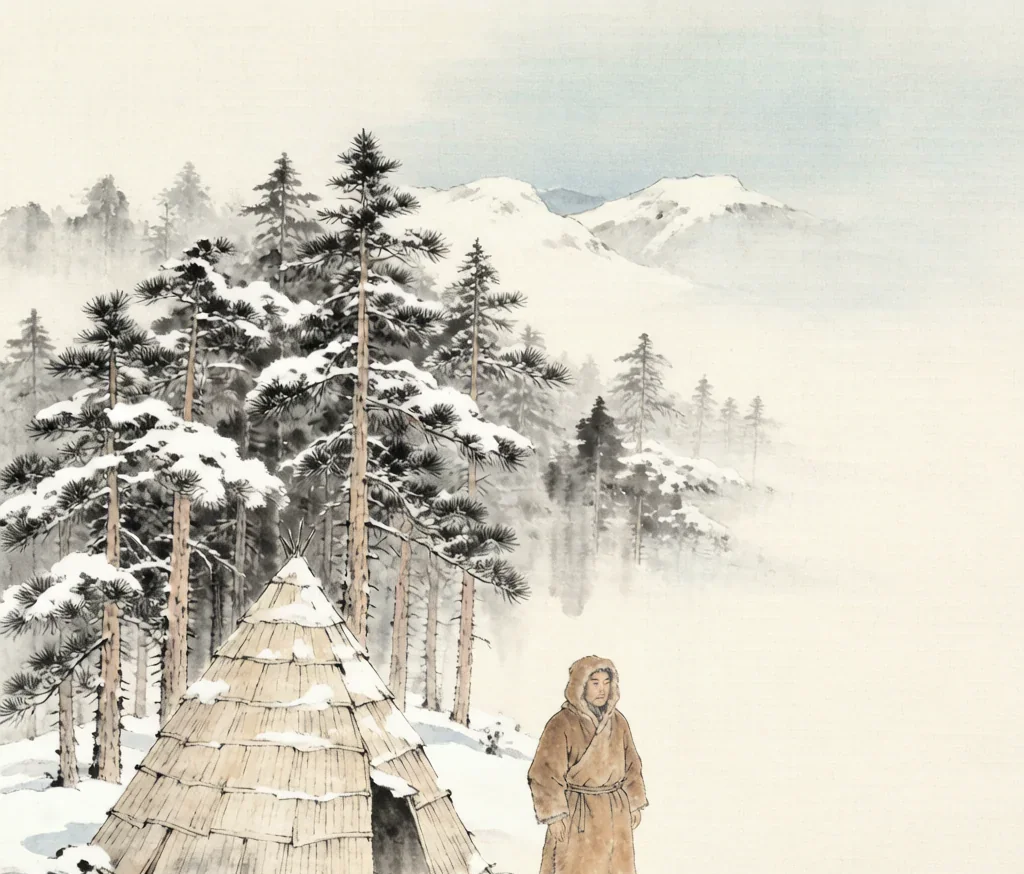
The Oroqen, also written Elunchun, are a Tungusic hunting people of the Greater and Lesser Khingan ranges in northeast China, historically renowned as the reindeer herders and forest hunters of the northern taiga. Speaking a language of the Manchu-Tungus branch of the Altaic family, the Oroqen pursued a mobile life of chasing moose and bear, training eagles, and navigating the boreal woods from birch-bark canoes and on skis. In the mid twentieth century the people were settled into villages and gave up a purely hunting existence, yet they retain a vivid inheritance of shamanism, oral epic, and a material culture of birch bark and fur that records an intimate mastery of the cold forest world.
Homeland of the Northern Forest
The Oroqen range across the Khingan mountains, a vast expanse of conifer taiga, bog, and river valley where winter lasts more than half the year and temperatures plunge far below freezing. This boreal world supplies the game, fish, and birch that sustained the people, and its rhythms of migration, rut, and ice set the pattern of life. The forest was not a resource but a homeland charged with spirit.
Mobility defined settlement: families moved with the game between winter hunting grounds and summer fishing rivers, carrying possesions in pack frames and living in conical tents of birch bark and skins pitched quickly and struck just as fast. The birch-bark canoe allowed travel on the numerous streams, and skis and snowshoes made the deep snow passable for the hunter.
The transition to settled village life in the twentieth century ended constant movement but left a people intimately versed in the ecology of the taiga. Their place-names, trails, and weather lore remain a detailed map of a forest that newcomers still struggle to read.
Language and Oral Tradition
The Oroqen language belongs to the Manchu-Tungus group of the Tungusic family, related to Evenki and Manchu, and was traditionally unwritten, preserved entirely through speech. Neighboring peoples and later administration used Manchu and Chinese characters, while modern schooling introduces Mandarin as the language of public life.
Oral literature carries the culture: the epic of the culture hero who taught hunting, beast fables explaining the ways of animals, and lament songs for the dead and the lost. Storytelling by the fire is the chief school, and the skilled narrator holds the people's memory. Proverbs encode forest law—when to move, when to spare, how to read tracks.
Documentation projects now transcribe tales and vocabulary in Latin script to support teaching, aware that a language with few speakers needs deliberate transmission. The spoken word remains the vessel of an identity shaped by the silence of snow and the cry of the loon.
Hunting and the Reindeer
Hunting was the core of Oroqen existence, focused on moose, deer, bear, and furbearers taken with the rifle, the bow, and the snare. The hunter read tracks, wind, and weather with precision, and the success of the chase determined the village's welfare, making skill a public virtue honored in song and story. Bears were taken with ritual respect, their spirit appeased to ensure future fortune.
Reindeer herding distinguished a branch of the people, the animals providing transport, milk, and hide across the tundra edge, tended by women and moved to fresh lichen ground. Though many Oroqen relied more on horses and foot travel, the reindeer remain a powerful symbol of the northern hunting heritage and appear in origin myth as a gift of the forest spirit.
The eagle was trained for falconry against small game and hares, and the dog was the indispensable companion of the trail. The relationship with prey was reciprocal: a kill required thanks, and overhunting was taboo, an ethic that conserved game in a lean land long before modern wildlife law.
Shamanism and Belief
Oroqen religion is classic northern shamanism, built on a world of sky, earth, and underworld spirits and on the shaman who journeys between them to heal, divine, and protect. The shaman's drum is the vehicle of the spirit flight, and the costume of iron and hide marks the mediator chosen by the powers through illness and dream.
Nature is inhabited throughout: the bear is a kinsman, the river a deity, the birch a helper, and the hearth a guardian against cold and evil. Hunting and life-cycle rites open with offering and chant, and the soul of the dead is guided to the ancestral land. Omens read from animal behavior still guide the hunt.
Although settlement and official atheism weakened formal practice, the worldview lingers in respect for animals, in the taboo on certain slopes, and in the stories told to children. The shaman's drum, now often a museum piece, still sounds in memory as the instrument that kept the people balanced with the forest.
Material Culture and Birch Bark
The Oroqen are famed for birch-bark craft: lightweight, waterproof containers, canoes, tent covers, and decorated plaques incised with geometric and animal motifs. Bark was gathered in season, peeled in sheets, and sewn with root thread, producing objects both practical and beautiful that defined the mobile household.
Clothing and housing used tanned moose and reindeer hide, sewn into trousers, coats, and boots lined with fur for the bitter cold, while summer brought lighter skin and birch-bark garments. The conical tent of bark and pole could be raised by a family in an hour, a masterpiece of portable architecture suited to the chase.
Decoration was restrained but meaningful: carved and painted birch plaques recorded clan marks and hunting tallies, and bead and applique trimmed festival dress. This material culture expresses a philosophy of lightness, mobility, and respect for the forest's gifts, where nothing is wasted and everything has use.
Dress for the Taiga
Oroqen dress is engineered for extreme cold and movement. Men wear hooded hide coats, trousers, and long boots of smoked skin, with caps trimmed in fur, while women wear similar attire with beaded front panels and the distinctive birch-bark or hide apron of the household worker. Layers of scraped, fur-lined hide keep out the wind on the longest sits.
The robe is cut wide for squatting and shooting, and the boots are laced for snowshoe and ski. Festival and ceremony add bright cloth inserts, silver, and coral traded from the south, marking the wearer as a person of standing. Children's suits mirror the adult in miniature, and the cradle is a hide pouch that travels on the mother's back.
Because the forest supplied the material, dress also proclaimed skill: a finely tanned coat spoke of a good hunter and tanner, just as a well-pulled sledge spoke of a good driver. Clothing was thus biography as well as protection in the taiga.
Festivals and Seasonal Rites
The Oroqen year follows the game and the ice. A spring bear festival honors the slain animal with feast and lament, acknowledging kinship and seeking continued favor. Summer gatherings at the fishing river combine catching, drying, and courtship, while autumn brings the bulk of the hunt before snow.
Shamanic rites at crisis—sickness, failed hunt, bad weather—seek restoration, and the new tent and the first kill are blessed. Weddings and name-givings join families in exchange of hides, meat, and beadwork, scheduled by the movement of animals and the reading of signs.
These occasions are also the stage for epic and dance, ensuring the calendar teaches cooperation and reverence in alternating rhythm. The frozen river and the birch grove, not a stone square, are the true centers of Oroqen celebration.
Music, Epic and Dance
Oroqen music is vocal and drum-led, the shaman's frame drum setting the trance rhythm and the hunt song steadying the walker. Group dances mimic the gait of the bear and the flight of the eagle, mapping the forest onto the body, and the epic of the hero is sung in a low narrative tone across the evening.
Oral narrative preserves the knowledge of animals: which track means moose at dusk, how the loon warns of storm, why the bear must be thanked. Children learn these through lullaby and tale, so that the forest is inherited as story before it is known by trail. The voice is the chief instrument because the people kept no notation.
Dance and song at festival let isolated families meet as one people, and the best singers are remembered in later epics as ancestors worthy of recall. Performance thus binds memory, ecology, and alliance in a single act.
Social Order and Kinship
Oroqen society rested on clans and bands bound by kinship and the authority of skilled hunters and the shaman. Marriage was negotiated with bride wealth of hides and dogs and was exogamous across clans; the household was the economic unit, and the band shared large catches according to custom.
Elders advised on movement and rite, and the shaman held spiritual authority in matters of health and fortune. Reciprocal sharing of meat and labor embedded mutual aid, essential in a land where a failed hunt could mean starvation. Hospitality to the traveler was a strict norm born of the forest's isolation.
Settlement brought elected committees and schools atop the clan structure, yet traditional sharing and respect for the hunter's skill persist. Kinship remains the safety net, and visiting obligations keep far bands connected across the vast taiga.
Settlement and Modern Life
In the twentieth century the Oroqen were encouraged to settle in permanent villages, take up farming and animal husbandry, and send children to school, ending the purely nomadic hunt. This brought health, literacy, and security but also disrupted the mobile skills and the shamanic framework that had ordered life for centuries.
Today cultural centers document the language, the birch-bark craft, and the epic, and festivals revive the drum and the dance as heritage. Reindeer are kept by some families as a living link to the past, and tourism introduces visitors to the tent and the ski. The challenge is to honor the hunting inheritance without romanticizing a life of privation.
The Oroqen stand as keepers of the northern forest's memory, a people who read snow and spirit where others see only wilderness. Their continuity enriches the Tungusic and boreal heritage of China's northeast.
Cuisine of the Hunt
Oroqen food centered on game—moose, deer, bear, and fish—eaten smoked, dried, or boiled, with wild berries, roots, and birch sap in season. Meat was shared by strict custom, and the beaten marrow and the roasted rib marked feast and rite alike. Tea and grain entered later through trade, softening the pure protein diet.
Hospitality demanded that a guest be fed the best cut, a norm born of the danger of the taiga where the next hearth might be days away. The shared carcass, like the shared trail, remains the fundamental bond of Oroqen social life and the practical expression of their reciprocal ethic toward both forest and kin.
❓ Frequently Asked Questions
Where do the Oroqen live?
They live in the Greater and Lesser Khingan ranges of northeast China, a boreal forest region of conifer taiga and long, severe winters.
What language do the Oroqen speak?
They speak a Tungusic language of the Manchu-Tungus group, traditionally unwritten and preserved orally, with Mandarin used in modern life.
What were the Oroqen traditionally known for?
They were renowned as reindeer herders and skilled forest hunters of moose and bear, with a birch-bark material culture and shamanic belief.
What do the Oroqen believe?
They practice northern shamanism centered on nature spirits and a mediating shaman whose drum carries the soul on spirit journeys for healing and protection.
How did Oroqen life change?
In the twentieth century they were settled into villages and took up farming and herding, ending the nomadic hunt while preserving craft and epic as heritage.
What is distinctive about Oroqen dress?
They wear hooded moose-hide coats, fur-lined boots, and birch-bark or hide aprons engineered for extreme cold, movement, and the hunt.