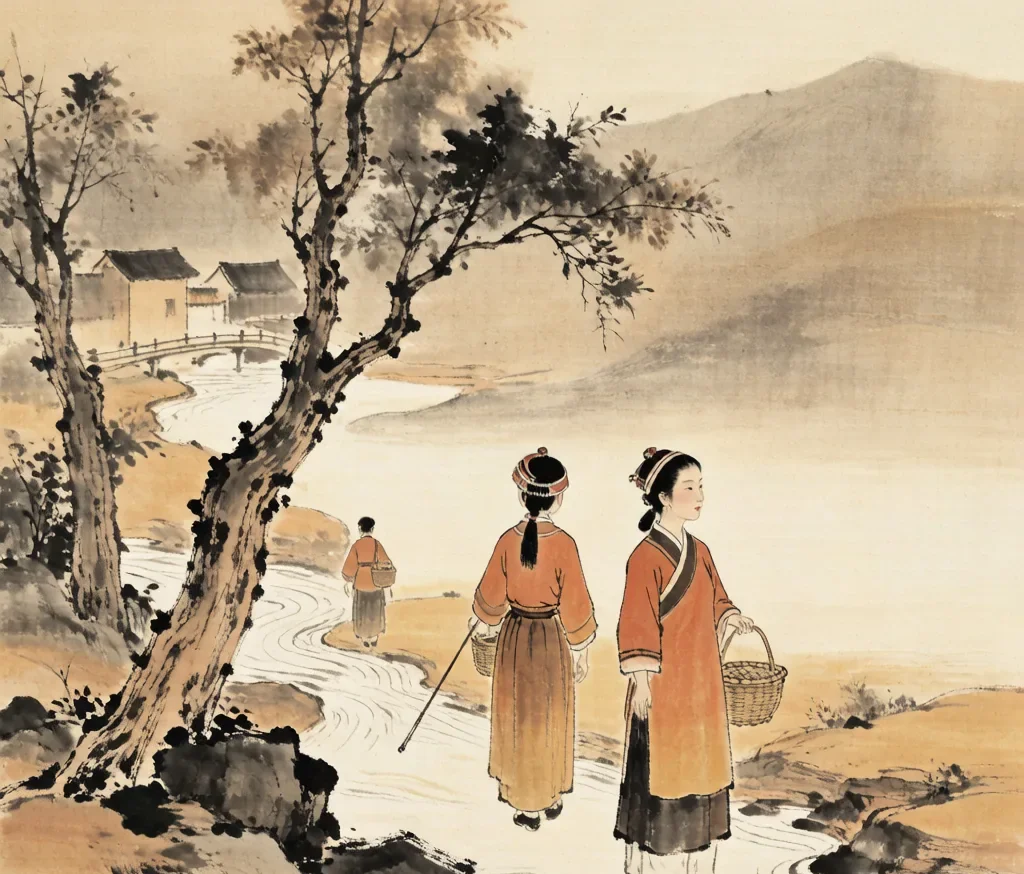
The Hezhen, or Hezhezu (赫哲族), also known as the Nanai, are one of the smallest of China's recognized minorities, with a population of only about 5,000, living along the Heilong (Amur), Songhua, and Ussuri rivers in northeastern Heilongjiang. A Tungusic fishing people of the cold north, they are renowned for clothing made of fish skin (yupi yi) and for the "Yimakan," an epic oral tradition of sung narrative now honored by UNESCO as intangible heritage. Once reliant entirely on the rivers for food, transport, and dress, the Hezhen embody a fragile, remarkable riverine culture at the edge of the Chinese northeast. Their name is sometimes rendered as "Hezhen" meaning people of the lower reaches, and their entire material world — from the boats they carved to the clothes on their backs — was drawn from the abundant yet unforgiving waters they called home.
Origins and the River Homeland
The Hezhen are descendants of the "Gilli" (Jurchen-related) fishing peoples of the Amur basin, with deep roots along the rivers that form China's border with Russia. Their name is variously explained as "people of the lower reaches" or "eastern people."
Living at the confluence of the Heilong, Songhua, and Ussuri rivers, they built a culture entirely oriented to freshwater: fish in summer, hunting on the frozen river in winter, and travel by dugout and sled.
Distribution in Heilongjiang
Most Hezhen reside in Tongjiang, Fuyuan, and Raohe counties of Heilongjiang, in villages such as Jiejinkou and Bacha along the rivers. Some also live near the Russian side as the Nanai, kin across the border.
Their settlements are strung along the waterways rather than inland, reflecting a lifeway tied to the annual run of fish and the ice roads of winter.
Language
Hezhen is a Tungusic language closely related to Nanai in Russia and more distantly to Manchu and Ewenki. It is an oral language with no traditional script; today literacy is in Chinese, and fluent speakers are very few.
The language survives chiefly through the Yimakan epics and everyday speech of elders. Its endangerment has made documentation a priority for linguists working with the community.
Fish-Skin Clothing
The most famous Hezhen craft is yupi yi — garments made from the skin of large fish (such as salmon and sturgeon), stripped, dried, tanned, and sewn into tough, water-resistant clothing suited to a riverine life.
Decorated with fish-skin appliqué and embroidery, these clothes were both practical armor against cold and spray and a marker of identity. The craft is now rare, practiced by a handful of artisans and displayed as heritage.
Fishing and Subsistence
The Hezhen were master fishermen, using nets, spears, and weirs to catch the seasonal salmon and sturgeon runs, and preserving surplus by drying and freezing. Fish provided food, oil for lamps, glue, and raw material for clothing. The annual return of the salmon was the hinge of the year, and the skill of reading the current, the ice, and the weather was the core of a Hezhen man's competence. Women processed the catch and the skins, so that the labor of the river was shared across the household and the season.
In winter they hunted deer, bear, and furbearers on the ice and traveled by dog sled and skis. This dual economy of river and ice defined survival in the harsh northeast.
The Yimakan Epic
The Yimakan is a Hezhen oral epic tradition in which a performer sings long narrative cycles of heroes, battles, and the origin of the people, accompanied by self-made rhythm and gesture rather than instruments.
Listed by UNESCO as intangible cultural heritage in need of urgent safeguarding, the Yimakan is carried by a declining number of singers. It is the supreme vessel of Hezhen memory and worldview.
Shamanism and Belief
Traditional Hezhen religion was shamanism blended with animism: spirits of water, animals, and ancestors were placated through rituals, and shamans healed and divined. The bear and the tiger were especially revered.
Fishing rites gave thanks to the river's spirits before the first catch, and taboos protected the salmon runs. With modern change, such practices survive mainly in story and festival. The respect encoded in these taboos, however, echoes a practical ecology: by limiting the take and honoring the source, the Hezhen sustained the very runs on which they depended, a wisdom now recalled as both heritage and quiet environmental lesson from a people of the river.
Music and Instruments
Beyond the Yimakan, Hezhen music includes the "kongkong" mouth harp and drum songs. The mouth harp's twang accompanied lullabies and love songs, while drums marked ritual.
The soundscape is sparse and northern, matching a life of long winters and quiet rivers. Song remains the chief artistic expression in the absence of a written literature.
Clothing and Ornament
Aside from fish-skin wear, Hezhen used animal pelts and birch bark. Women's dress featured aprons and beadwork; both sexes wore practical, warm garments. Birch-bark cones and boxes were everyday vessels.
Ornament was minimal but meaningful: appliquéd fish-skin patterns and beaded bands signaled community and occasion. The overall aesthetic was one of northern utilitarian elegance.
Modern Life and Survival
Resettlement into fixed villages, river pollution, and the decline of wild salmon have undermined the traditional fishery, and most Hezhen now farm, fish part-time, or work for wages.
Cultural revival efforts support Yimakan singers, fish-skin artisans, and heritage festivals to keep a tiny but extraordinary culture visible. The Hezhen stand as a testament to the river peoples of the Amur.
Birch Bark and Daily Objects
Besides fish skin, the Hezhen crafted birch bark into cones, boxes, and canoe sheathing, light yet waterproof vessels suited to river travel. The skill of peeling, soaking, and sewing bark was passed from elder to child.
Such objects filled the winter dwelling and the summer camp, illustrating a material culture built entirely from the river's and forest's gifts — a quiet testament to adaptation at the edge of the northeast.
❓ Frequently Asked Questions
Where do the Hezhen live?
Along the Heilong, Songhua, and Ussuri rivers in Tongjiang, Fuyuan, and Raohe counties of Heilongjiang.
What is unique about their clothing?
They traditionally made garments from fish skin (yupi yi), tanned from sturgeon and salmon, decorated with appliqué.
What is the Yimakan?
A sung oral epic of heroes and origins, performed without instruments, now a UNESCO intangible heritage needing safeguarding.
What language do they speak?
A Tungusic language related to Nanai and Manchu, oral with no native script; literacy is in Chinese.
What was their traditional livelihood?
River fishing for salmon and sturgeon, plus winter hunting, travel by dugout and dog sled.
What is their religion?
Shamanism blended with animism, revering river and animal spirits, especially the bear and tiger.