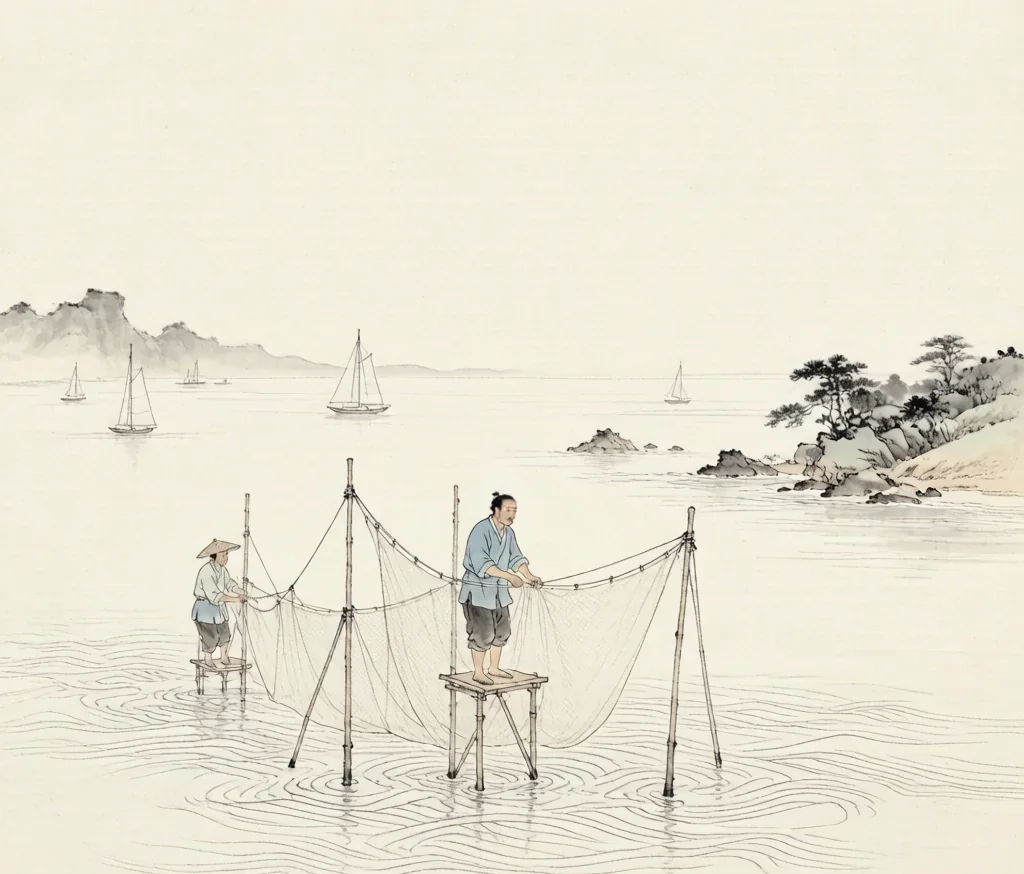
The Jing, or Jingzu (京族), also called the Gin, are a people of roughly 33,000 in China and hold a unique place among the country's minorities: they are the only one with a maritime, fishing-based culture, descended from Vietnamese (Kinh) settlers who came to the Guangxi coast centuries ago. Concentrated on three small islands — Wanwei, Wutou, and Shanxin, the "three islands of the Jing" — near Dongxing on the border with Vietnam, they speak a Viet-Muong language, practice a distinctive "Ha Festival" honoring their tutelary goddess, and have long lived from the sea, weaving fish nets and making the fermented fish sauce that flavors their cuisine.
Origins on the Coast
The Jing are descendants of Kinh (Vietnamese) migrants who crossed from northern Vietnam to the Guangxi coast several centuries ago, settling on sandbar islands at the mouth of the Beilun River where it marks the China-Vietnam border. Over generations they adapted a mainland Southeast Asian heritage to a life of tides and storms, building stilt houses against the spray and organizing the year around the fishing cycle. Despite cross-border kinship, the Chinese Jing developed a distinct local identity shaped by isolation on their low islands and by centuries of separation from the Vietnamese mainland.
Their ethnonym "Jing" (Gin) is the Chinese rendering of "Kinh," the majority ethnicity of Vietnam. Despite cross-border kinship, the Chinese Jing have developed a distinct local identity over generations of separation.
The Three Islands
The Jing homeland is the "Jing族三岛" — the three islands of Wanwei, Wutou, and Shanxin — low sandy islands in Dongxing city, Fangchenggang, Guangxi. These were once true islands cut off at high tide and later connected to the mainland by causeways.
Life on the narrow islands revolved entirely around the sea: fishing, fish processing, and the rhythms of tide and monsoon. The compact settlements fostered a tight-knit, sea-oriented community.
Language
The Jing speak a language of the Viet-Muong branch of the Austroasiatic family, closely related to Vietnamese. Traditionally written in the Vietnamese script (chữ Nôm and later Latin-based quoc ngu) introduced via cross-border contact.
Today most Jing also speak Mandarin and the local Cantonese-related dialect, and Chinese is the language of school. The mother tongue persists in homes and song, with older speakers most fluent.
A People of the Sea
Unique among China's minorities, the Jing are a fishing people whose livelihood depends on the ocean. They work inshore waters for fish, shrimp, and shellfish using small boats, nets, and traps suited to shallow coastal seas.
The sea governs the calendar: boat-launching rites, the first catch, and storms shape ritual and rest. This maritime identity distinguishes the Jing from the overwhelmingly agrarian minority peoples of China's interior.
The Ha Festival
The Ha Festival (Ha Jie) is the Jing's central celebration, held in the sixth or eighth lunar month in a communal "Ha Pavilion." It honors the tutelary sea goddess and the ancestors, praying for calm seas and abundant catches.
The festival combines ritual offering, the singing of "Ha songs" by trained vocalists, and feasting. The Ha Pavilion itself is the spiritual and social heart of each Jing village, where the community convenes.
Ha Songs and Music
The "Ha songs" are a celebrated Jing vocal art, performed by a lead singer with choral response, accompanied by moon-shaped stringed instruments and drums. The repertoire praises the sea, love, and history.
Recognized among China's intangible cultural heritage, Ha singing is taught to apprentices to keep the tradition alive. Its melodic style reflects both Vietnamese roots and local coastal character.
Fish Sauce and Cuisine
The Jing are famed for nuoc mam-style fermented fish sauce, a pungent condiment they both consume and trade. Made by salting and fermenting small fish in vats, it is the signature flavoring of Jing cooking.
The diet centers on rice with seafood — steamed fish, shrimp, and shellfish — seasoned by the homemade sauce and chili. Sea produce and rice define a cuisine shaped entirely by the coast. At the Ha Festival and family feasts, the sauce anchors a table of shared dishes, and the art of judging a good batch is a point of household pride passed from mother to daughter. The pungent condiment thus ties the Jing kitchen to the rhythm of the catch and to a Vietnamese heritage carried across the border.
Net-Weaving and Crafts
Jing material culture includes the weaving and mending of fish nets, the making of bamboo fish traps, and the carving of boats. Women traditionally weave the fine nets, a skill transmitted within families.
Distinctive too are the Jing hats — conical, with a fringe — and their use of the moon-shaped "duk lam" zither. These crafts mark a cultural vocabulary shared with northern Vietnam yet localized on the islands.
Clothing
Traditional Jing dress is light and suited to the subtropical coast: women wear close-fitting tunics with long skirts or trousers and the characteristic fringe hat, while men wear short jackets and head cloths.
Festive attire adds color and silver, but everyday dress prioritizes the practicality of fishing life. The aesthetic is simpler and more Viet-influenced than that of inland minorities.
Modern Life and Border Identity
Cross-border trade, tourism, and the opening of the Dongxing border zone have brought prosperity to the Jing islands, now linked to the mainland and visited for their beaches and heritage.
The Jing balance a Vietnamese cultural inheritance with Chinese citizenship, maintaining the Ha Festival and fish-sauce craft as markers of a singular maritime identity within China's minority landscape.
Boat Rituals and the Sea
The sea enters Jing ritual as well as work. Before the fishing season boats are blessed, and the first catch is offered to the water's spirits, acknowledging the ocean's power over livelihood and life.
Storms and safe returns are marked by communal prayer at the Ha Pavilion, binding neighbors through shared dependence on the waters. This maritime piety sets the Jing apart from the agricultural rituals of inland minorities.
❓ Frequently Asked Questions
Where do the Jing live?
On three islands — Wanwei, Wutou, and Shanxin — near Dongxing in Guangxi, on the border with Vietnam.
Why are they unique among China's minorities?
They are the only minority whose traditional livelihood is marine fishing rather than farming or herding.
What language do they speak?
A Viet-Muong language related to Vietnamese; most also speak Mandarin and the local Guangxi dialect.
What is the Ha Festival?
A festival in the Ha Pavilion honoring the sea goddess and ancestors, with Ha songs and feasting for good catches.
What food are they known for?
A fermented fish sauce (yu lu) akin to Vietnamese nuoc mam, central to their seafood-and-rice cuisine.
What is their ancestry?
They descend from Kinh (Vietnamese) migrants who settled the Guangxi coast centuries ago.