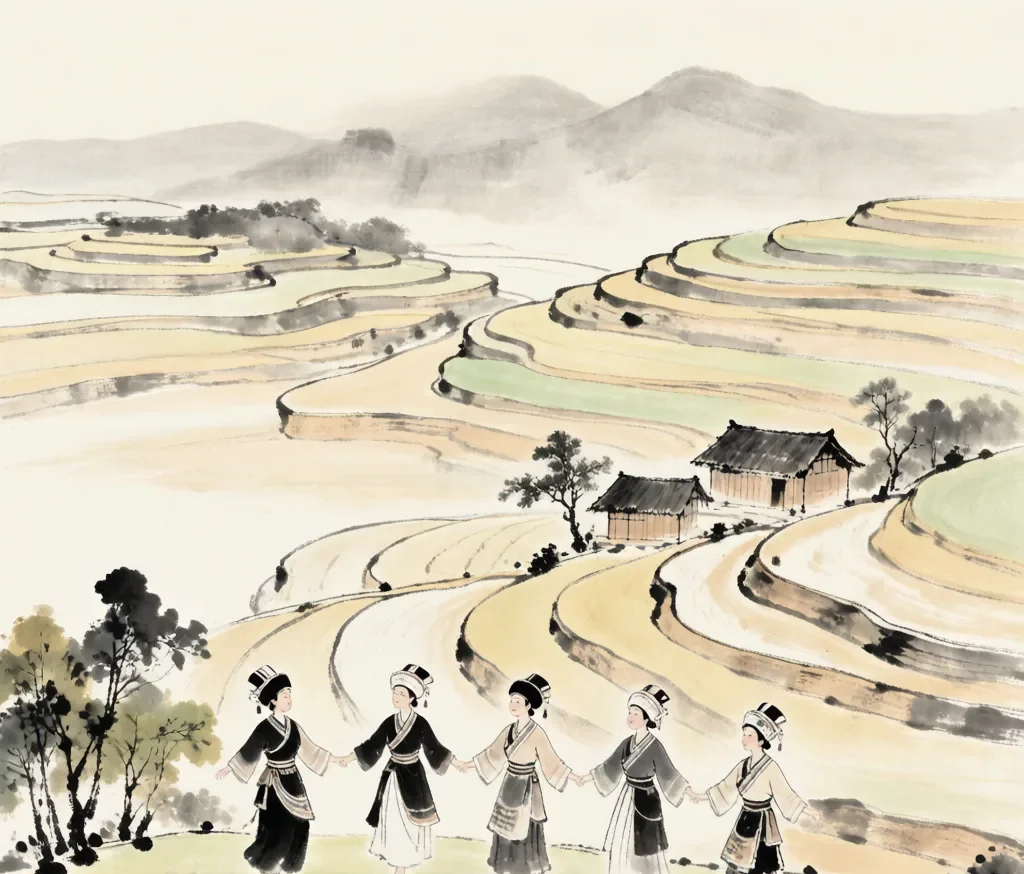
With a population exceeding eighteen million, the Zhuang people (壮族, Zhuàng zú) constitute China's largest ethnic minority — a vibrant community whose culture has shaped the landscape of southern China for millennia. Centered in the Guangxi Zhuang Autonomous Region, with communities extending into Yunnan, Guangdong, and Guizhou, the Zhuang have developed a civilization deeply rooted in the karst mountains and rice terraces of their homeland. Their culture, expressed through song, textile art, and a profound connection to the land, represents one of the great indigenous traditions of southern China.
The Singing People
If there is one cultural practice that defines the Zhuang, it is singing. The Zhuang are famous throughout China as "the singing people," and their tradition of antiphonal singing — improvised verses traded between groups of singers — is among the most developed in the world. The Zhuang saying goes: "Singing lightens the burden of labor, singing dissolves life's sorrows, singing expresses love's longings." For the Zhuang, song is not entertainment but a fundamental mode of human expression and social interaction.
The Zhuang singing tradition reaches its zenith during the San Yue San (三月三, sān yuè sān) festival, held on the third day of the third lunar month. This "Singing Festival" draws thousands of participants to designated singing grounds, where young people gather to display their vocal skills and seek romantic partners. The format is competitive and collaborative — groups of young men and women face each other, trading improvised verses on themes of love, nature, work, and daily life. A successful exchange can last for hours, even days, with singers demonstrating not just vocal ability but wit, knowledge of traditional formulas, and the capacity for creative improvisation.
The songs follow established melodic patterns that vary by region, but the lyrics are created in the moment, drawing on a vast repertoire of traditional imagery and formulaic expressions while responding to the specific context. The ability to compose and deliver verses spontaneously is highly prized, and accomplished singers enjoy considerable social prestige. In traditional Zhuang society, the ability to sing well was a significant factor in marriage prospects — a beautiful voice could compensate for modest circumstances.
Beyond courtship, Zhuang singing serves multiple social functions. Work songs coordinate the rhythm of collective labor in the rice fields. Ritual songs accompany weddings, funerals, and religious ceremonies. Historical songs preserve the memory of important events and legendary figures. Lullabies soothe children to sleep with melodies that have been sung for countless generations. In all these contexts, song is the medium through which Zhuang culture is transmitted and community bonds are maintained.
The Brocade of the Zhuang
Alongside song, textile art stands as the great aesthetic achievement of Zhuang culture. Zhuang brocade (壮锦, zhuàng jǐn) is one of China's four famous brocades, alongside those of the Han, Dai, and Tibetan peoples. Woven on traditional looms using silk and cotton threads, Zhuang brocade features bold geometric patterns in rich colors — deep reds, bright yellows, greens, and blues — that create textiles of striking visual impact.
The designs of Zhuang brocade draw from the natural world and Zhuang cosmology. The most characteristic motifs include geometric representations of flowers, birds, butterflies, and fish. The phoenix, a symbol of beauty and auspiciousness, appears frequently. Diamond and lozenge patterns represent the scales of the dragon or the markings of the frog — both sacred animals in Zhuang tradition. The patterns are not merely decorative but carry layers of symbolic meaning, encoding Zhuang beliefs about the cosmos, fertility, and good fortune.
The production of Zhuang brocade is labor-intensive, requiring exceptional skill and patience. The warp threads are prepared on the loom, and the weft threads are inserted by hand, following complex patterns that the weaver must hold in memory or read from pattern charts. A skilled weaver can produce only a few centimeters of fine brocade in a day, and a complete bedcover or wall hanging can require months of work. This investment of time and skill gives Zhuang brocade its value — each piece represents not just material and labor but the accumulated cultural knowledge of generations of weavers.
Traditionally, Zhuang brocade served both practical and ceremonial functions. It was used for bedding, clothing, baby carriers, and household decorations. The finest pieces were included in wedding dowries, where they demonstrated the bride's skill and her family's prosperity. Today, Zhuang brocade has gained recognition as a national intangible cultural heritage, and efforts to preserve and promote the tradition include training programs for young weavers and the development of contemporary products that bring traditional designs to new audiences.
The Frog Totem
Among the most distinctive elements of traditional Zhuang religion is the worship of the frog. In Zhuang mythology, the frog is a sacred creature with the power to bring rain, ensure fertility, and communicate with the heavens. The croaking of frogs is believed to summon rain clouds, and the appearance of frogs after rain confirms their connection to water. This association made the frog a central figure in the agricultural religion of a rice-farming people for whom rain was literally a matter of life and death.
The Frog Festival (蛙婆节, wā pó jié), celebrated in some Zhuang regions during the first lunar month, centers on the ritual capture, veneration, and burial of a frog. The festival begins with young men searching the fields for the first frog of the new year. The captured frog is placed in a decorated shrine and carried through the village in procession, accompanied by singing, dancing, and the beating of bronze drums. After a period of veneration, the frog is buried with ceremony, and its remains are later examined for signs that predict the coming year's weather and harvest.
Bronze drums, among the most important ritual objects in Zhuang culture, feature prominently in frog worship. Ancient Zhuang bronze drums, some dating back over two thousand years, are decorated with frog figures around their rims — three-dimensional castings of frogs, sometimes stacked on top of each other, that reinforce the drum's association with rain-making. The drums themselves, when struck, produce a sound that the Zhuang describe as resembling thunder, creating a sonic connection between the ritual, the frogs, and the rain they are meant to summon.
The Rice Terraces
The Zhuang homeland in Guangxi is defined by its spectacular karst landscape — limestone peaks rising abruptly from flat plains, creating one of the world's most dramatic terrains. In this challenging environment, the Zhuang have developed agricultural systems of extraordinary sophistication. The Longji (Dragon's Backbone) Rice Terraces, though often associated with the Yao and Zhuang peoples jointly, represent the culmination of centuries of Zhuang agricultural engineering.
Zhuang rice cultivation is an intricate dance with water. The terraces must be precisely leveled to hold water at a uniform depth. Channels and sluices distribute water from mountain streams to every terrace. The timing of flooding, planting, and draining must be coordinated across entire watersheds. This system requires not just individual skill but collective organization — the management of water is necessarily a community enterprise, and Zhuang villages developed sophisticated institutions for coordinating agricultural activities.
The agricultural calendar structures Zhuang life. The spring planting, the summer tending, the autumn harvest, and the winter fallow each have their associated rituals, festivals, and social activities. The Frog Festival in spring prays for rain. The Singing Festival coincides with a lull in agricultural work when young people have time for courtship. The harvest brings celebrations of gratitude and abundance. Through this annual cycle, Zhuang culture renews itself, reaffirming the connection between human community, agricultural labor, and the natural world.
The Zhuang Script and Written Heritage
The Zhuang have a complex linguistic and literary heritage. The Zhuang language belongs to the Tai language family, related to Thai, Lao, and the language of the Dai people. For centuries, the Zhuang used a character-based writing system known as Sawndip (方块壮字, fāng kuài zhuàng zì), which adapted Chinese characters and created new characters to represent Zhuang words. Sawndip was used primarily for recording folk songs, religious texts, and local histories, and it represents one of the few indigenous writing systems developed by a non-Han people in China.
The Zhuang literary tradition is predominantly oral, with the song as its primary form. The great Zhuang epic "Baeu Rodo" tells the story of a cultural hero who taught the Zhuang people agriculture, weaving, and the arts of civilization. Other narrative songs recount historical events, legendary romances, and moral tales. The song tradition serves as the Zhuang people's collective memory, preserving knowledge that in literate cultures would be stored in books.
In the modern era, a standardized Zhuang writing system based on the Latin alphabet was introduced in the 1950s, and Zhuang-language education, media, and publishing have developed within the framework of China's minority language policies. However, the dominance of Mandarin Chinese in education and economic life presents ongoing challenges for Zhuang language maintenance. Community efforts to preserve and revitalize the Zhuang language, often centered on the song tradition that has always been its most powerful vehicle, continue across the Zhuang regions.
The Zhuang people, China's largest minority, embody a distinctive vision of human flourishing — one in which song is as essential as rice, beauty as important as utility, and the relationship between human communities and the natural world is sustained through ritual, art, and collective memory. In the karst mountains of Guangxi, beneath peaks that rise like dragon's teeth from the misty plains, the Zhuang continue to sing the songs their ancestors sang, weaving their culture into the fabric of the twenty-first century.
Zhuang Architecture and Villages
Traditional Zhuang settlements are shaped by the warm, humid climate of southern China and by life close to rivers and rice fields. Many Zhuang build stilted wooden dwellings called diaojiaolou, raised on sturdy posts so that the living quarters sit above the damp ground, with space beneath for storage, livestock, or simply cool shade. Walls and floors are of timber, and steep tiled roofs shed the heavy rains of the monsoon season. Whole villages often cluster on hillsides or along valley terraces, arranged to make the best use of scarce flat land and to keep homes above seasonal flooding. Communal spaces, ancestor halls, and the open areas used for song festivals sit at the heart of the community. Though concrete and brick now appear in many places, the raised wooden house remains a recognizable emblem of Zhuang village life.
Zhuang Cuisine and Staple Foods
Rice is the center of the Zhuang table. Living in one of China's great rice-growing regions, the Zhuang eat rice at nearly every meal, most often as plain steamed grains but also as sticky rice prepared for festivals and guests. A distinctive festive dish is five-colored sticky rice, in which glutinous rice is divided and dyed red, yellow, black, purple, and white using the juices of local plants, then steamed — a treat associated with the Sanyuesan song festival. Daily cooking makes use of river fish, freshwater shellfish, poultry, and a wide range of wild greens, often prepared sour or pickled to preserve them through the hot months. Bamboo tubes are sometimes used to steam rice and meat, lending a subtle fragrance. The result is a cuisine that is simple, seasonal, and closely tied to the land.
Zhuang Folk Religion and Ritual
Before the widespread arrival of Buddhism and other faiths, the Zhuang upheld an indigenous religious world of nature spirits, ancestors, and shamans. At its heart lies the Mo tradition, built around the epic of Buluotuo, the culture hero said to have created the world, taught farming, and given the Zhuang their customs. Ritual specialists, sometimes called mo or shamans, chant portions of this vast oral literature at festivals, funerals, and rites for harvest and healing, acting as mediators between the living and the spirit world. Ancestor veneration is central: families maintain altars and offer food, wine, and paper offerings to deceased kin. Over the centuries these older beliefs blended with elements of Daoism and Buddhism, producing a layered local spirituality in which mountains, trees, and streams are still honored as dwelling places of powerful spirits.
❓ Frequently Asked Questions
The Zhuang people (壮族, Zhuàng zú) live mainly in the Guangxi Zhuang Autonomous Region, with significant populations in Yunnan, Guangdong, and Guizhou.
The Zhuang language belongs to the Tai-Kadai language family and is closely related to Thai. A Latin-based writing system was standardized in the 1950s.
Zhuang culture is famous for their magnificent bronze drums, the 'March Third Festival' singing fair, and exquisite brocade weaving (壮锦, zhuàng jǐn).
The most important festival is the 'March Third Festival' (三月三, Sān Yuè Sān), where young people gather on hillsides for singing competitions and courtship.
The Zhuang traditionally practice a layered spirituality centered on ancestor worship and nature spirits, with an indigenous Mo tradition built around the epic of Buluotuo. Over time these beliefs blended with Daoist and Buddhist elements, and ritual specialists still chant the old epics at festivals and funerals.
Zhuang cuisine is rice-centered, featuring steamed and sticky rice alongside river fish, poultry, and wild greens, often prepared sour or pickled. A celebrated festive dish is five-colored sticky rice dyed with plant juices and served at the Sanyuesan festival.
📝 Chinese Vocabulary
- 壮族 (Zhuàng zú) — The Zhuang ethnic group; China's largest minority
- 三月三 (sān yuè sān) — San Yue San; the Zhuang Singing Festival on the third day of the third lunar month
- 壮锦 (zhuàng jǐn) — Zhuang brocade; one of China's four famous brocades
- 蛙婆节 (wā pó jié) — The Frog Festival; a traditional Zhuang ritual for rain and fertility
- 方块壮字 (fāng kuài zhuàng zì) — Sawndip; the traditional Zhuang character-based writing system
🎉 Fun Facts
- The Zhuang singing tradition is so central to their culture that historically, a young person who could not sing well faced serious disadvantages in marriage prospects — a good voice was considered as important as good looks or family background.
- Ancient Zhuang bronze drums, some weighing over 300 kilograms, were so valuable that they were sometimes buried during times of war to prevent capture — and some have been discovered by archaeologists over 2,000 years later.
- The Longji Rice Terraces, partly built and maintained by Zhuang farmers, cover an area of over 66 square kilometers and were constructed without modern engineering tools, relying entirely on traditional knowledge of hydrology and slope management.
- The Zhuang epic 'Buluotuo' is a long oral creation myth, sung or chanted by ritual specialists at ceremonies rather than written down in a single book.
- Traditional Zhuang homes are often stilted wooden houses called diaojiaolou, raised on posts above the damp, rainy ground of the south.
- At festivals the Zhuang prepare 'five-colored sticky rice,' tinting glutinous rice with natural plant dyes in red, yellow, black, purple, and white.