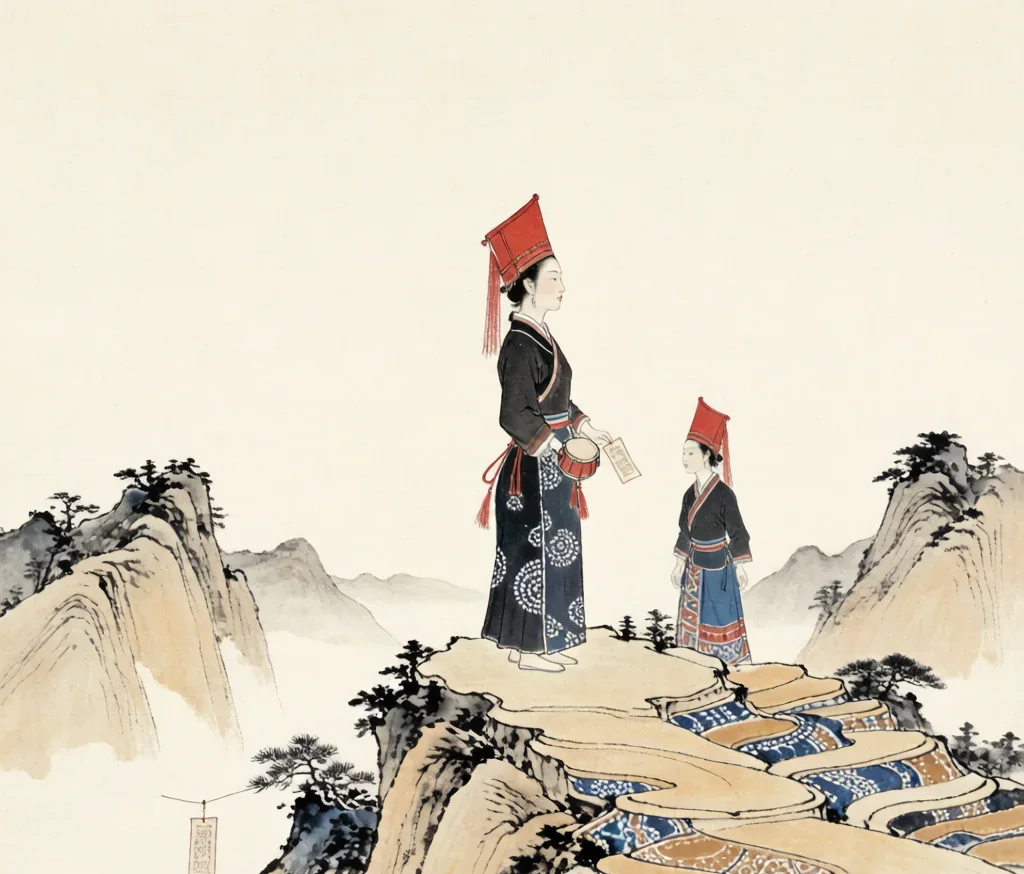
The Yao people (瑶族, Yáo zú), numbering approximately 3.3 million, are among the most widely distributed ethnic minorities in southern China, with communities spread across Guangxi, Hunan, Yunnan, Guangdong, and Guizhou provinces. The Yao are not a single homogeneous group but a constellation of related peoples who share linguistic and cultural affinities while maintaining distinct local identities. Their name in Chinese — 瑶 (yáo), meaning "precious jade" — reflects the high esteem in which their rich cultural traditions have been held throughout Chinese history. The Yao are also one of China's most internationally dispersed minorities, with significant Yao communities in Vietnam, Laos, Thailand, and the United States.
The Long Drum Dance
The Long Drum Dance (长鼓舞, cháng gǔ wǔ) is the most iconic performance tradition of the Yao people. The long drum itself is a distinctive instrument — a wooden drum body, often over a meter in length, with a narrow waist and flared ends covered with animal skin. The drum is slung diagonally across the dancer's body, and the dance involves striking the drum in complex rhythmic patterns while executing athletic movements — jumps, spins, and acrobatic poses that require tremendous physical skill and stamina. The dance has its origins in Yao mythology, commemorating Pan Wang (盘王), the legendary ancestor of the Yao people. According to tradition, Pan Wang was killed by a wild goat while hunting, and the Yao made a drum from the goat's skin and wood from the forest, dancing to honor his spirit.
The Pan Wang Festival
The Pan Wang Festival (盘王节, Pán wáng jié), celebrated on the sixteenth day of the tenth lunar month, is the most important religious and cultural event in the Yao calendar. Pan Wang (King Pan) is the mythical ancestor of all Yao people, a divine figure who, according to Yao origin myths, was a dragon-dog (龙犬, lóng quǎn) who transformed into a human and married a princess. Their descendants became the Yao people. This origin story, which features a half-animal, half-divine ancestor, is unique among Chinese ethnic groups. The festival involves elaborate rituals, the chanting of sacred texts by Yao priests (师公, shī gōng), the Long Drum Dance, singing, feasting, and the offering of sacrifices. It is also an occasion for Yao communities scattered by migration to reunite, strengthening bonds of shared identity.
Yao Traditional Medicine
The Yao are renowned throughout southern China for their traditional medical knowledge. Living in mountainous regions rich in medicinal plants, Yao healers have developed an extensive pharmacopoeia of herbal remedies, many validated by modern scientific research. Yao medicine emphasizes medicinal baths (药浴, yào yù) — herbal infusions in which patients soak to treat a wide range of conditions. Yao women are famous for bathing in herbal preparations shortly after childbirth and returning to work within days, a practice that has attracted considerable scientific interest. Yao medical knowledge is transmitted orally from master to apprentice, often within families, encompassing herbal remedies, acupuncture, moxibustion, bone-setting, and spiritual healing practices.
Clothing and Silver Ornaments
Yao clothing is among the most elaborate and visually striking of any Chinese ethnic group. Different Yao subgroups are identified by their distinctive dress — the Red Yao (红瑶, hóng yáo) wear red embroidered jackets; the White Yao (白瑶, bái yáo) favor white trousers; the Long-Shirt Yao (长衫瑶, cháng shān yáo) wear long blue robes. Yao women's headdresses are particularly remarkable — some subgroups wear towering headdresses that can reach a meter in height, constructed from layers of embroidered cloth, silver ornaments, and, among the Red Yao of Guangxi, the woman's own hair, which is never cut. These headdresses carry symbolic meaning related to Yao cosmology, social status, and life stage, changing throughout a woman's life to mark her passage through the stages of Yao womanhood.
More About This Ethnic Group
The ethnic minority groups of China represent an extraordinary tapestry of cultural diversity, stretching across the vast landscapes of this ancient land. With 55 officially recognized minority nationalities alongside the Han majority, each group contributes unique traditions, languages, and customs that have been carefully preserved and passed down through countless generations. These communities are primarily concentrated in the autonomous regions of Tibet, Xinjiang, Inner Mongolia, Ningxia, and Guangxi, as well as in the culturally rich provinces of Yunnan, Guizhou, Sichuan, and Qinghai, where some of the most diverse concentrations of ethnic cultures in the world can be found.
China's ethnic minority policies provide important protections for minority languages, cultural practices, and regional autonomy. Many minority communities have autonomous prefectures or counties where their languages are used in local government, education, and media. Traditional festivals, such as the Dai Water-Splashing Festival, the Yi Torch Festival, and the Mongolian Naadam, are celebrated with government support and draw visitors from around the world. These celebrations are not merely tourist attractions but living expressions of cultural identity that reinforce community bonds and transmit cultural knowledge to younger generations.
The cultural heritage of these communities extends to every aspect of daily life — from distinctive architectural styles adapted to local environments, to colorful traditional costumes that encode social information through their patterns and designs, to unique musical instruments and dance forms that express the community's relationship with nature and the cosmos. Embroidery, silverwork, textile weaving, paper-cutting, and countless other handicrafts continue to thrive in minority regions, with many recognized as national or even UNESCO Intangible Cultural Heritage. These crafts are not frozen museum pieces but living traditions that evolve while maintaining their essential character.
In recent decades, concerted efforts to document and preserve minority languages and oral traditions have intensified across China. Scholars and cultural workers collaborate with community elders to record epic poems, folk songs, creation myths, and traditional ecological knowledge before they fade from living memory. Many minority languages that once had no written form now have standardized writing systems, and bilingual education programs help ensure that children can learn both their mother tongue and Mandarin Chinese. Museums, cultural centers, and digital archives have been established to safeguard this heritage for future generations.
Tourism has also played a significant role in the revitalization of minority cultures, offering economic opportunities while raising awareness of the importance of cultural preservation. Ethnic tourism allows visitors to experience traditional architecture, sample distinctive cuisines, purchase handmade crafts directly from artisans, and participate in local festivals. When managed responsibly, this engagement provides income that supports the continuation of traditional practices and gives communities a stake in preserving their cultural heritage. For travelers and culture enthusiasts, visiting minority villages and participating in local festivals offers an authentic window into China's remarkable cultural mosaic and the enduring vitality of its ethnic traditions.