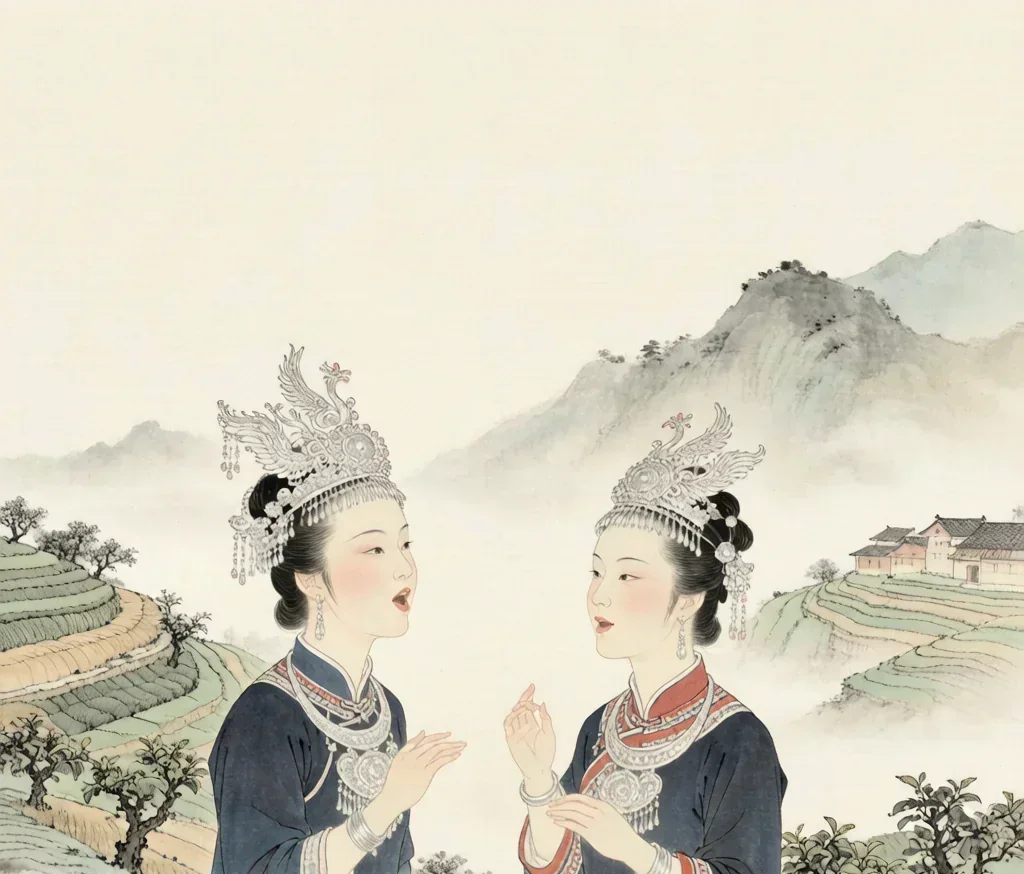
In the misty mountains of southeastern China, where Fujian and Zhejiang provinces meet, the She people (畲族, Shē zú) have maintained a distinctive mountain culture for over a thousand years. With a population of approximately 746,000, the She are the largest ethnic minority in southeastern China. Their name means "slash-and-burn," referencing their traditional swidden agriculture.
The San Yue San Festival
The Third Day of the Third Month festival (三月三, sān yuè sān) is the most important She celebration. The festival features wumi fan (乌米饭, wū mǐ fàn) — black glutinous rice dyed with wild plant juice — which according to legend was first made to commemorate a heroic figure who was imprisoned. The festival includes antiphonal singing, wrestling, archery, and traditional She operas recounting She history and legends.
She Embroidery and Textile Arts
She women are renowned for their embroidery, producing textiles with bold, colorful designs on dark backgrounds. The phoenix is particularly significant — the She consider themselves descendants of the phoenix. The traditional phoenix headdress (凤凰装, fèng huáng zhuāng) is an elaborate headpiece incorporating silver ornaments, beads, and embroidery. Different She subgroups have developed distinctive variations of the phoenix costume.
The She Language and Oral Tradition
The She language belongs to the Hmong-Mien family. The most important She epic is the "Gao Huang Ge" (高皇歌) — the "Song of the High Emperor" — recounting the origin of the She from Pan Hu (盘瓠), a divine dog who helped an ancient emperor win a battle and married the emperor's daughter. This canine ancestor origin story is unique among Chinese ethnic groups.
She Tea Culture
The She have a long history of tea cultivation in the mountainous regions of Fujian and Zhejiang. Their tea gardens are planted on mountain slopes interspersed with forest, a traditional agroforestry system. The She practice a distinctive tea ceremony emphasizing simplicity and connection to nature, with tea served to guests as the first act of hospitality.
More About This Ethnic Group
The ethnic minority groups of China represent an extraordinary tapestry of cultural diversity, stretching across the vast landscapes of this ancient land. With 55 officially recognized minority nationalities alongside the Han majority, each group contributes unique traditions, languages, and customs that have been carefully preserved and passed down through countless generations. These communities are primarily concentrated in the autonomous regions of Tibet, Xinjiang, Inner Mongolia, Ningxia, and Guangxi, as well as in the culturally rich provinces of Yunnan, Guizhou, Sichuan, and Qinghai, where some of the most diverse concentrations of ethnic cultures in the world can be found.
China's ethnic minority policies provide important protections for minority languages, cultural practices, and regional autonomy. Many minority communities have autonomous prefectures or counties where their languages are used in local government, education, and media. Traditional festivals, such as the Dai Water-Splashing Festival, the Yi Torch Festival, and the Mongolian Naadam, are celebrated with government support and draw visitors from around the world. These celebrations are not merely tourist attractions but living expressions of cultural identity that reinforce community bonds and transmit cultural knowledge to younger generations.
The cultural heritage of these communities extends to every aspect of daily life — from distinctive architectural styles adapted to local environments, to colorful traditional costumes that encode social information through their patterns and designs, to unique musical instruments and dance forms that express the community's relationship with nature and the cosmos. Embroidery, silverwork, textile weaving, paper-cutting, and countless other handicrafts continue to thrive in minority regions, with many recognized as national or even UNESCO Intangible Cultural Heritage. These crafts are not frozen museum pieces but living traditions that evolve while maintaining their essential character.
In recent decades, concerted efforts to document and preserve minority languages and oral traditions have intensified across China. Scholars and cultural workers collaborate with community elders to record epic poems, folk songs, creation myths, and traditional ecological knowledge before they fade from living memory. Many minority languages that once had no written form now have standardized writing systems, and bilingual education programs help ensure that children can learn both their mother tongue and Mandarin Chinese. Museums, cultural centers, and digital archives have been established to safeguard this heritage for future generations.
Tourism has also played a significant role in the revitalization of minority cultures, offering economic opportunities while raising awareness of the importance of cultural preservation. Ethnic tourism allows visitors to experience traditional architecture, sample distinctive cuisines, purchase handmade crafts directly from artisans, and participate in local festivals. When managed responsibly, this engagement provides income that supports the continuation of traditional practices and gives communities a stake in preserving their cultural heritage. For travelers and culture enthusiasts, visiting minority villages and participating in local festivals offers an authentic window into China's remarkable cultural mosaic and the enduring vitality of its ethnic traditions.
China's Ethnic Diversity
China is home to 56 officially recognized ethnic groups, including the Han majority and 55 minority nationalities. These minority communities are primarily concentrated in autonomous regions and provinces such as Yunnan, Guizhou, Sichuan, Guangxi, Xinjiang, Tibet, and Inner Mongolia. Each ethnic group has its own distinct language, customs, traditional costumes, and festivals, contributing to the rich cultural mosaic of the nation.
In recent decades, significant efforts have been made to document and preserve the languages, oral traditions, and cultural practices of China's ethnic minorities. Many traditional crafts, festivals, and art forms have been recognized as National Intangible Cultural Heritage, ensuring their protection and transmission to future generations. Through cultural tourism, academic research, and government support, these unique traditions continue to thrive and gain appreciation both within China and internationally.