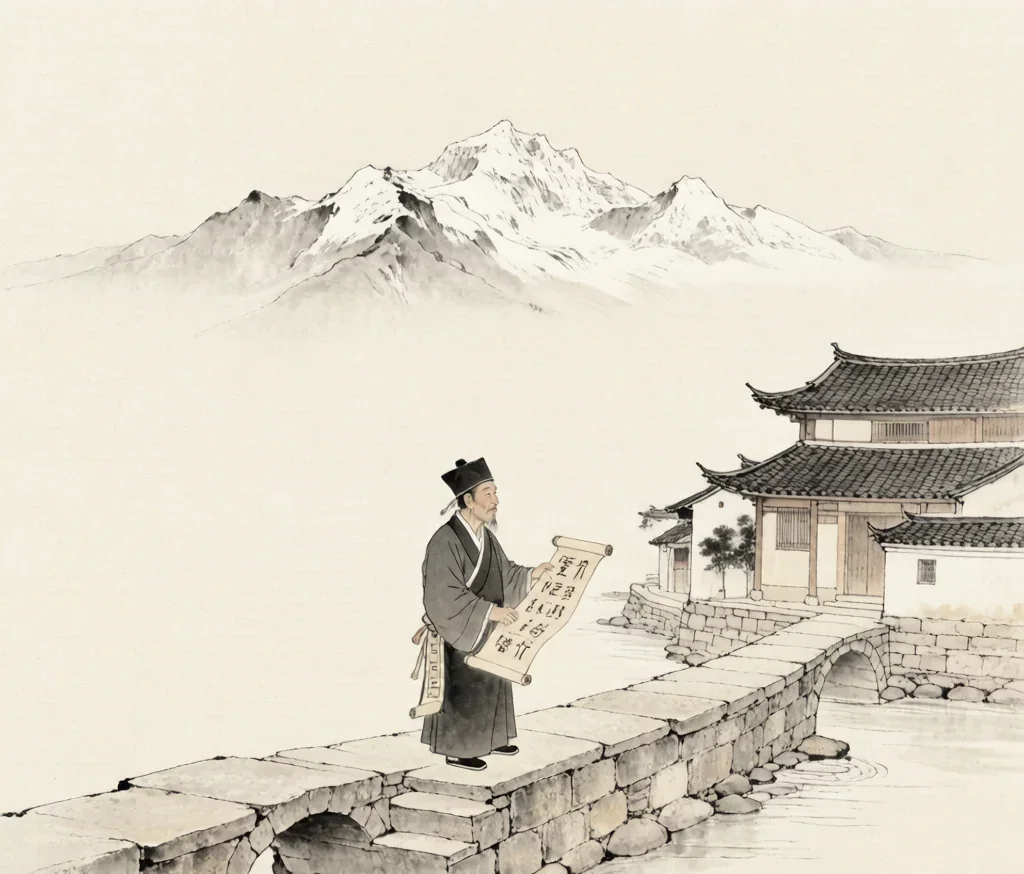
The Naxi, or Naxizu (纳西族), are a Tibeto-Burman people of about 320,000 in China, world-renowned for the Dongba culture of southwest Yunnan, centered on the ancient town of Lijiang. Their greatest treasure is the Dongba script, one of the world's few surviving pictographic writing systems, inscribed in the epic "Classic of Creation" and ritual texts now honored by UNESCO. Ruled for centuries by the Mu clan, the Naxi blend Tibetan-Burmese heritage with influences from Han, Tibetan, and Bai neighbors, and their music, murals, and the matrilineal customs of the related Mosuo make them one of China's most studied minorities.
Origins and the Lijiang Heartland
The Naxi are among the long-established peoples of the northwestern Yunnan plateau, with ancestors migrating into the upper Yangtze (Jinsha) valley over a millennium ago. Their core homeland is Lijiang, where the old town sits beneath the Jade Dragon Snow Mountain. The dramatic karst and alpine setting shaped a culture of terraced agriculture, trade, and temple-building. Lijiang's position on routes between Tibet, Sichuan, and Dali made it a meeting point of civilizations, and the Naxi absorbed influences from each while holding fast to their own script and ritual life. This borderland position helps explain the unusual synthesis seen in Naxi art and faith.
The dramatic karst and alpine setting shaped a culture of terraced agriculture, trade, and temple-building. Lijiang's position on routes between Tibet, Sichuan, and Dali made it a meeting point of civilizations.
The Mu Clan and Lijiang Kingdom
From the late thirteenth century, Lijiang was governed by the Mu (Mö) clan, local rulers who owed allegiance to the Yuan, Ming, and Qing dynasties while exercising real autonomy. The Mu tusi (native chieftains) patronized architecture, Buddhism, and Daoism.
Under Mu rule Lijiang flourished as a regional power bridging Tibeto-Burman and Han worlds. The clan's fortified residence and the planned old town remain tangible legacies, and the Mu name is woven into Naxi memory.
The Dongba Script
The Dongba script is a pictographic writing system used by Naxi ritual specialists (dongba) to record scriptures, liturgies, and cosmogony. Each character is a stylized drawing — of the sun, a mountain, an animal — and the corpus runs to thousands of signs.
Crucially, it is one of the last actively used pictographic scripts on earth. The "Classic of Creation" and other Dongba manuscripts were inscribed on the UNESCO Memory of the World register, marking their global significance.
Dongba Religion
Dongba is the indigenous Naxi faith: a shamanic, animistic religion in which dongba priests conduct rituals of creation, healing, and funerals using pictographic texts, masked dances, and offerings to nature and ancestor spirits. The dongba undergoes long training to master the thousands of signs and the accompanying chants, and his role as both priest and scribe made the pictographic script a living liturgical tool rather than a dead cipher. In this way belief and writing were inseparable in Naxi society, each sustaining the other across generations.
It shares the Tibetan-Burmese shamanic substratum but absorbed Tibetan Buddhist and Daoist elements. The dongba's role as scribe-priest made the pictographic script a living liturgical tool rather than a dead cipher.
The Mosuo and Matriliny
The Mosuo, often described as a Naxi subgroup living around Lugu Lake, are famed for a matrilineal social order in which descent and inheritance pass through women and households are headed by senior females.
Their "walking marriage" (tisese) custom allows partners to visit one another without formalized co-residence, a practice that has drawn intense anthropological interest. Though distinct in some respects, the Mosuo are culturally kin to the Naxi.
Naxi Music
Naxi instrumental music, especially the "Lijiang ancient music" ensemble, preserves melodies claimed to derive from Song and Yuan court and Daoist repertoires, performed on zithers, flutes, and stringed instruments by elderly ensembles.
This "living fossil" of Chinese music is treasured locally and has been performed abroad. The Naxi also have vigorous folk song and the "Lijiang Baisha" mural traditions linking painting and sound.
Murals and Art
The Baisha murals, produced under Mu patronage, fuse Han, Tibetan, and Naxi Buddhist and Daoist imagery in a syncretic style unique to Lijiang. They depict cosmological, religious, and daily-life scenes in layered color.
Alongside murals, Naxi artisans produced carved beams, painted scrolls, and the embossed "Lijiang" textiles. Art was a language of the multi-faith court and remains a visitor draw today.
Language
Naxi is a Tibeto-Burman language with several dialects; the pictographic Dongba script is ritual-only, while a syllabic "geba" script exists for some texts. Everyday writing uses Chinese, and Mandarin is the school language.
UNESCO recognition has spurred documentation of both the spoken language and the Dongba corpus, with dictionaries and digital archives preserving signs that few living people can fully read.
Clothing and Daily Life
Traditional Naxi dress features blue or black tunics with embroidered aprons for women, who also wear a distinctive "sheepskin shawl" with seven embroidered discs said to represent the stars or the seven cosmic bodies.
The old town's courtyards, canals, and stone lanes reflect a settled, trade-oriented life. Naxi cuisine uses cured pork ("babao," a Lijiang ham), mushrooms, and barley, suited to the cool plateau.
Modern Heritage and Tourism
Lijiang Old Town's UNESCO World Heritage listing transformed the Naxi homeland into a global tourist destination, bringing prosperity and pressure alike. Dongba scripts appear on souvenirs even as authentic practice narrows.
Heritage institutes train new dongba, archive manuscripts, and stage cultural shows, striving to keep the pictographic tradition meaningful rather than merely decorative in a commodified landscape.
Festivals and the Naxi Year
The Naxi year turns on a round of festivals tied to agriculture and faith: the "Sanduo" festival honors the Naxi war god Sanduo with processions to his mountain shrine, while lunar new year and mid-autumn bring family rites and temple visits.
These occasions fuse Dongba offering, Tibetan Buddhist prayer, and Han-style custom, showing how the Naxi weave multiple traditions into a single community calendar centered on Lijiang's courtyards and peaks.
❓ Frequently Asked Questions
Where do the Naxi live?
Primarily around Lijiang in northwestern Yunnan, with related Mosuo near Lugu Lake.
What is the Dongba script?
A pictographic writing used by Naxi priests to record rituals and cosmogony; it is one of the few living pictographic scripts and is listed by UNESCO.
Who were the Mu clan?
The native rulers of Lijiang from the Yuan through Qing eras, who patronized art, architecture, and religion.
What is special about the Mosuo?
They are known for matrilineal households and the "walking marriage" custom of visiting partners.
What religion do the Naxi follow?
The indigenous Dongba shamanic faith, blended with Tibetan Buddhist and Daoist influences.
What language do they speak?
A Tibeto-Burman language; the Dongba script is ritual-only, and daily writing uses Chinese.