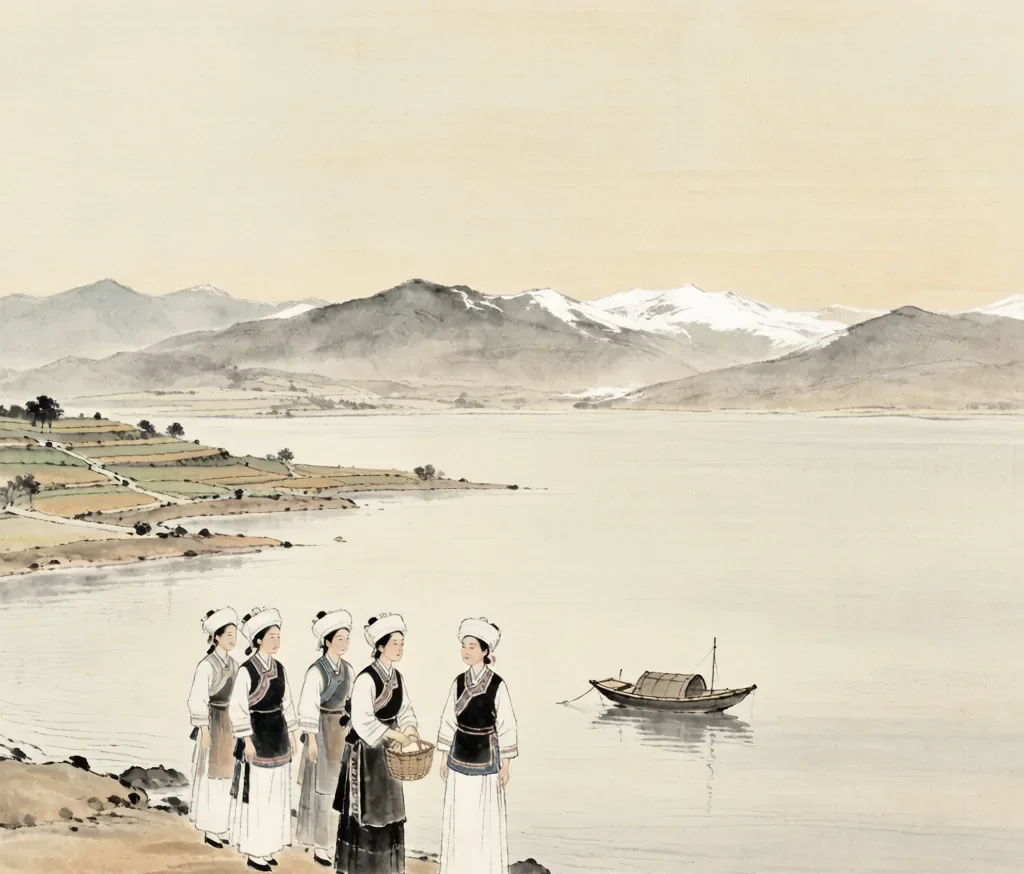
On the shores of Erhai Lake, with the snow-capped Cangshan Mountains rising behind them like a painted screen, the Bai people (白族, Bái zú) have created one of China's most sophisticated regional cultures. With a population of approximately 2.1 million, the Bai are centered in the Dali Bai Autonomous Prefecture in western Yunnan, a region of extraordinary natural beauty that has been a crossroads of trade and culture for over two millennia. The Bai name means "white," and white is their sacred color — the color of purity, dignity, and the snow that caps their beloved Cangshan peaks.
The Three-Course Tea Ceremony
The Three-Course Tea ceremony (三道茶, sān dào chá) is the quintessential expression of Bai hospitality and philosophy. When a guest arrives at a Bai home, they are served three successive cups of tea, each with a distinct flavor and meaning. The first course is bitter tea (苦茶, kǔ chá) — strong, roasted tea that represents the hardships and struggles of youth. The second course is sweet tea (甜茶, tián chá) — tea with brown sugar, walnut, and cheese that represents the sweetness of middle age, when one's efforts bear fruit. The third course is "aftertaste tea" (回味茶, huí wèi chá) — tea with ginger, pepper, and honey that leaves a complex, lingering taste, representing the reflective wisdom of old age. This seemingly simple ritual encapsulates a profound philosophy: life, like the three courses of tea, progresses through bitterness, sweetness, and reflection.
The Ancient City of Dali
Dali Ancient City (大理古城, Dà lǐ gǔ chéng) is the cultural capital of the Bai people and one of China's most beloved historical destinations. The city preserves a remarkable ensemble of traditional Bai architecture — whitewashed walls with grey tile roofs, elaborate gates with carved and painted decorations, and courtyards filled with flowers. The Bai are the heirs of the Nanzhao Kingdom (南诏, 738-937 CE) and its successor, the Dali Kingdom (大理国, 937-1253 CE), which ruled over much of what is now Yunnan for over five centuries. The Dali Kingdom was known for its devotion to Buddhism — remarkably, 9 of its 22 kings abdicated to become Buddhist monks, a rate of royal renunciation probably unique in world history. The Three Pagodas (三塔, sān tǎ), dating from the Nanzhao period, stand as enduring symbols of the region's Buddhist heritage.
Bai Architecture and Courtyard Homes
Traditional Bai architecture is among the most refined in China. The classic Bai courtyard home (三坊一照壁, sān fāng yī zhào bì) consists of three buildings around a central courtyard, with a decorative screen wall on the fourth side. The buildings feature whitewashed exterior walls with grey tile roofs and carved wooden doors. The screen wall serves practical and symbolic functions — providing privacy, blocking wind, and deflecting evil spirits that in Chinese folk belief can only travel in straight lines. The screen wall is often decorated with the character 福 (fú, "good fortune") or painted landscapes.
Festivals and the Third Month Fair
The most important Bai festival is the Third Month Fair (三月街, sān yuè jiē), held annually at the foot of the Cangshan Mountains near Dali. This week-long event attracts hundreds of thousands of participants and is simultaneously a trade fair, cultural festival, and religious pilgrimage. The Torch Festival (火把节, huǒ bǎ jié) in the sixth lunar month features villagers carrying lit torches through fields to drive away pests and evil spirits. The Bai also celebrate the unique "Winding Around the Three Temples" festival (绕三灵, rào sān líng), a pilgrimage-carnival in which thousands process between three major temples around Erhai Lake, singing, dancing, and offering prayers. The Bai people, with their three-course tea and white-walled courtyards, represent a civilization of extraordinary grace and refinement.
More About This Ethnic Group
The ethnic minority groups of China represent an extraordinary tapestry of cultural diversity, stretching across the vast landscapes of this ancient land. With 55 officially recognized minority nationalities alongside the Han majority, each group contributes unique traditions, languages, and customs that have been carefully preserved and passed down through countless generations. These communities are primarily concentrated in the autonomous regions of Tibet, Xinjiang, Inner Mongolia, Ningxia, and Guangxi, as well as in the culturally rich provinces of Yunnan, Guizhou, Sichuan, and Qinghai, where some of the most diverse concentrations of ethnic cultures in the world can be found.
China's ethnic minority policies provide important protections for minority languages, cultural practices, and regional autonomy. Many minority communities have autonomous prefectures or counties where their languages are used in local government, education, and media. Traditional festivals, such as the Dai Water-Splashing Festival, the Yi Torch Festival, and the Mongolian Naadam, are celebrated with government support and draw visitors from around the world. These celebrations are not merely tourist attractions but living expressions of cultural identity that reinforce community bonds and transmit cultural knowledge to younger generations.
The cultural heritage of these communities extends to every aspect of daily life — from distinctive architectural styles adapted to local environments, to colorful traditional costumes that encode social information through their patterns and designs, to unique musical instruments and dance forms that express the community's relationship with nature and the cosmos. Embroidery, silverwork, textile weaving, paper-cutting, and countless other handicrafts continue to thrive in minority regions, with many recognized as national or even UNESCO Intangible Cultural Heritage. These crafts are not frozen museum pieces but living traditions that evolve while maintaining their essential character.
In recent decades, concerted efforts to document and preserve minority languages and oral traditions have intensified across China. Scholars and cultural workers collaborate with community elders to record epic poems, folk songs, creation myths, and traditional ecological knowledge before they fade from living memory. Many minority languages that once had no written form now have standardized writing systems, and bilingual education programs help ensure that children can learn both their mother tongue and Mandarin Chinese. Museums, cultural centers, and digital archives have been established to safeguard this heritage for future generations.
Tourism has also played a significant role in the revitalization of minority cultures, offering economic opportunities while raising awareness of the importance of cultural preservation. Ethnic tourism allows visitors to experience traditional architecture, sample distinctive cuisines, purchase handmade crafts directly from artisans, and participate in local festivals. When managed responsibly, this engagement provides income that supports the continuation of traditional practices and gives communities a stake in preserving their cultural heritage. For travelers and culture enthusiasts, visiting minority villages and participating in local festivals offers an authentic window into China's remarkable cultural mosaic and the enduring vitality of its ethnic traditions.
Bai Tie-Dye and Indigo Cloth
The Bai have practiced tie-dye (扎染, zā rǎn) for centuries, especially around Zhoucheng village near Dali. Artisans bind and stitch cloth before dyeing it in indigo, creating the characteristic blue-and-white patterns that decorate clothing, scarves, and household items. The craft is recognized as part of China's intangible cultural heritage and continues to support local workshops.
The Cangshan Mountains and Erhai Lake
The Bai homeland is framed by two natural landmarks: the Cangshan (苍山) range of nineteen peaks with snow-capped summits, and Erhai (洱海), a highland lake whose name means 'Ear Sea' for its shape. These waters and mountains have shaped Bai agriculture, fishing, and cosmology, and they remain the backdrop for festivals such as the Third Month Fair held at the mountain's foot.
Bai Cuisine and Everyday Food
Beyond the famous Three-Course Tea, Bai cooking reflects the temperate Yunnan climate, with an emphasis on freshwater fish from Erhai, wild mushrooms, and preserved vegetables. The 'Eight Bowls' (八碗, bā wǎn) banquet is a traditional way to host guests at weddings and festivals, balancing sour, savory, and aromatic flavors drawn from local ingredients.