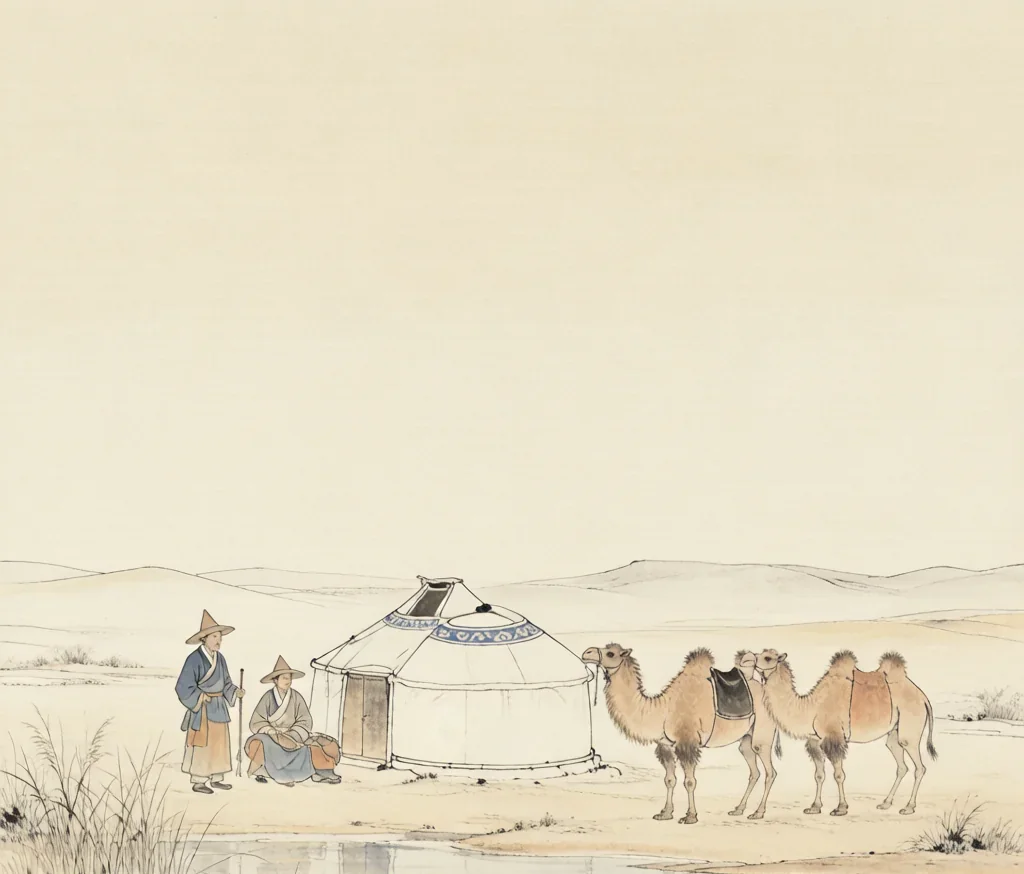
The Yugur, or Yuguzu (裕固族), are a distinctive Turkic-Mongolic pastoral people of about 14,000, almost all resident in the Sunan Yugur Autonomous County of Gansu, on the eastern edge of the Hexi Corridor beneath the Qilian Mountains. Uniquely among China's minorities, they speak two unrelated mother tongues — a Mongolic language in the east and a Turkic language in the west — yet possess no indigenous script, using Chinese for writing. Long famed for their striking embroidered head ornaments, their yak-and-sheep herding on high meadows, and their Tibetan Buddhist faith, the Yugur are heirs to the legacy of the medieval Uyghur kingdoms of Gansu.
Historical Roots
The Yugur trace their ancestry to the Gansu Uyghurs, descendants of the nomadic Uyghur confederation that established the Ganzhou Uyghur Kingdom (around the ninth to eleventh centuries) in the Hexi Corridor after the fall of the Uyghur Khaganate on the Mongolian plateau.
Over centuries these oasis-and-steppe Uyghurs absorbed Mongolic and Tibetan influences while retaining a separate identity. The name "Yugur" is a Mandarin rendering of an old ethnonym linked to the Uyghur past, and the group was formally recognized as a distinct minority in the mid-twentieth century.
Two Languages, No Script
The most remarkable feature of Yugur linguistics is diglossia without a writing system. Eastern Yugur is a Mongolic language, while Western Yugur is a Turkic language close to old Uyghur and situated among the "Siberian" Turkic tongues. The two speech communities live in different parts of Sunan and have long functioned as distinct subgroups within one recognized minority. Because neither tongue was ever written down, the boundary between them was maintained by oral tradition and local custom rather than by documents, making the Yugur a rare case of a people unified by identity but divided by language family.
Neither has a traditional script. For administration, education, and record-keeping the Yugur use Chinese characters. Scholars have produced descriptive grammars and romanizations, but everyday literacy passes through Chinese, making the two spoken languages the carriers of oral heritage.
Homeland in the Qilian Mountains
Sunan Yugur Autonomous County sprawls across the northern slopes of the Qilian range, where alpine meadows alternate with arid foothills. The altitude and short growing season make pastoralism the natural economy rather than farming.
Scattered herding camps and small township centers define settlement. The county's position along the old Silk Road has also left layers of Tibetan, Han, and Mongol presence alongside the Yugur.
Pastoral Life
The Yugur are nomadic and semi-nomadic herders of yaks, sheep, goats, and horses, moving seasonally between winter valleys and summer high pastures. Yak and sheep provide meat, milk, wool, and transport, anchoring both diet and trade.
Daily herding life demands skill in animal husbandry, cheese- and butter-making, and felt production. The rhythm of the year follows the grazing cycle, and household wealth is traditionally measured in livestock.
Religion and Monasteries
The Yugur are adherents of Tibetan Buddhism (Vajrayana), and several monasteries dot the Sunan landscape, serving as religious, educational, and festival centers. Lamas conduct prayers for the community's well-being and lead major rites.
Alongside Buddhist practice survive older elements: reverence for mountains and water, and shamanic-style rituals of healing and purification. This blend reflects the Yugur's position at a cultural crossroads of steppe and plateau.
Distinctive Clothing and Head Ornaments
Yugur dress is among the most recognizable in China. Women wear high-collared robes with colorful woven sashes and, most famously, elaborate "head ornaments" (tou mian) — panels of coral, silver, and shell that frame the face and denote marital status and regional subgroup.
Men wear long gowns with belts and round caps; both sexes use boots suited to the cold plateau. The tou mian is so central that it is often treated as the emblem of Yugur identity in exhibitions and photography.
Cuisine
Yugur food is that of highland herders: mutton (often boiled simply with salt), milk tea with butter and salt, yogurt, and cheese. Wheat and barley noodles and steamed buns round out the diet when traded from lowland farmers.
Hospitality centers on repeatedly refilled bowls of milk tea and offered hunks of boiled mutton. The diet reflects both pastoral self-sufficiency and exchange with neighboring agricultural communities.
Music and Oral Tradition
Yugur song spans herding tunes, lullabies, and long narrative ballads performed to the accompaniment of the two-stringed fiddle or simple flute. The "En'er" songs are prized for their melodic contour and emotional depth.
Because the Yugur lack a script, epics and genealogies are carried orally, and skilled singers are respected as keepers of memory. Tibetan Buddhist chant also forms part of the soundscape of monastery festivals.
Festivals
The great Tibetan Buddhist festivals — Losar (the Tibetan new year) and the monetering (ritual dances) at monasteries — are central to Yugur public life, drawing herders down from the meadows for communal worship and trade.
Seasonal celebrations also mark the movements of the herds and give thanks for fertility of livestock. Weddings are elaborate, multi-day affairs combining Buddhist blessing with Yugur custom.
Modern Challenges and Revival
Settlement programs, schooling in Chinese, and out-migration have pressured the Yugur languages, both of which are now spoken mainly by older generations. The two tongues face different futures, with Western Yugur especially endangered.
Cultural workers record vocabularies, support head-ornament embroidery workshops, and stage heritage performances to sustain identity. The Yugur's rare dual-language heritage makes its documentation a priority for linguists and the community alike.
Embroidery and Textile Art
Beyond the head ornaments, Yugur women are skilled embroiderers who decorate robes, belts, and boots with geometric and floral patterns in coral, turquoise, and gold thread. The work signals both beauty and belonging, with motifs differing by subgroup.
Weaving and felting supply the household with rugs, saddle blankets, and tent linings, turning the products of the herd into art. Textile skill is thus a quiet but central pillar of Yugur cultural expression on the plateau.
❓ Frequently Asked Questions
Where do the Yugur live?
Almost all live in Sunan Yugur Autonomous County, Gansu, on the northern slopes of the Qilian Mountains.
Why are their languages unusual?
They speak Eastern Yugur (Mongolic) and Western Yugur (Turkic) but have no indigenous script, writing in Chinese instead.
What is their history?
They descend from the Gansu Uyghurs of the Hexi Corridor, heirs to a medieval Uyghur kingdom.
What is their religion?
They are Tibetan Buddhists, with monasteries central to community life and older nature rites persisting alongside.
What are Yugur known for?
Striking embroidered head ornaments, pastoral herding, and a rare dual-language heritage.
What is their traditional livelihood?
Semi-nomadic herding of yaks, sheep, goats, and horses, moving with the seasons between valleys and high pastures.