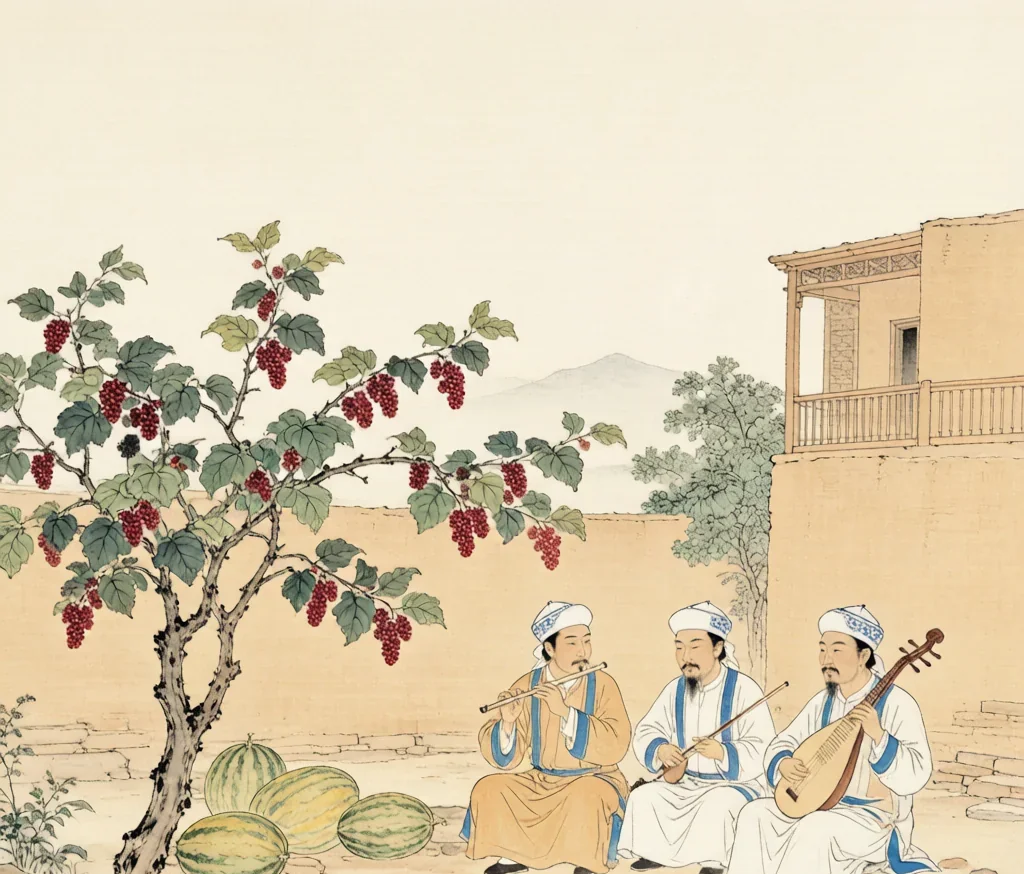
Along the ancient Silk Road, where the Taklamakan Desert meets the Tian Shan mountains, lies a chain of oasis cities that have nurtured one of Central Asia's most sophisticated cultures. The Uyghur people, known in Chinese as 维吾尔族 (Wéi wú ěr zú), are the inheritors of a civilization that has flourished at the crossroads of empires for over two millennia. Their culture — a brilliant synthesis of Turkic, Persian, Islamic, and Chinese influences — represents one of the world's great examples of cultural fusion.
The Oasis Civilization
Xinjiang, the vast northwestern region that is the Uyghur homeland, is a land of dramatic contrasts. Towering mountain ranges — the Tian Shan, Kunlun, and Altai — feed glacial meltwater to rivers that descend into the Tarim Basin, where they vanish into the sands of the Taklamakan, one of the world's most inhospitable deserts. Between mountain and desert, however, these rivers create oases — islands of intense green in a sea of sand — where Uyghur civilization has flourished for millennia.
The oasis environment shaped Uyghur society in fundamental ways. Water management was the foundation of all civilization — the karez underground irrigation systems, some dating back over two thousand years, transported water from mountain aquifers to the oases through networks of subterranean tunnels. This technology, shared with Persian and Central Asian civilizations, allowed the oases to support populations far larger than surface water alone could sustain. The management of these water systems required sophisticated social organization, giving rise to the urban civilization that characterized the Silk Road oases.
The Silk Road was not merely a trade route but a cultural conduit, and the Uyghur oases were its essential way stations. Caravans carrying silk from China, glass from Rome, spices from India, and jade from Khotan all passed through these cities. With the goods came ideas — Buddhism, Manichaeism, Nestorian Christianity, and finally Islam all reached the Uyghur people through the Silk Road. This history of cultural exchange has left the Uyghurs with a remarkable heritage of tolerance and synthesis.
The Twelve Muqam: Music of the Soul
Perhaps the greatest cultural treasure of the Uyghur people is the Twelve Muqam (十二木卡姆, shí èr mù kǎ mǔ), a monumental cycle of musical compositions that UNESCO has recognized as a Masterpiece of the Oral and Intangible Heritage of Humanity. Each of the twelve muqams is a suite lasting approximately two hours, combining sung poetry, instrumental music, and dance in a structure of extraordinary complexity.
The Muqam tradition draws on the modal systems of Persian and Arabic music, the rhythmic patterns of Central Asian folk traditions, and the poetic heritage of Turkic literature. The lyrics, sung in Uyghur, draw from the work of classical poets and Sufi mystics, expressing themes of love — both human and divine — longing, the pain of separation, and the joy of union. To hear a skilled muqamchi (muqam performer) is to experience a musical form that has been refined over centuries into one of the world's most sophisticated art music traditions.
The instruments of the Muqam ensemble are themselves cultural artifacts. The rawap, a long-necked lute with a snakeskin soundboard, provides the melodic foundation. The dutar, a two-stringed lute, adds texture and counterpoint. The satar, a bowed instrument, sings with a voice remarkably like the human voice it often accompanies. The dap, a frame drum, drives the rhythm, its variations signaling changes in tempo and mood. Together, these instruments create a sound world that is unmistakably Uyghur — at once deeply rooted in tradition and endlessly inventive.
Traditionally, learning the Muqam required years of apprenticeship with a master. The complete cycle of twelve muqams, with all its instrumental preludes, songs, and dance sections, could take over twenty hours to perform in full. In the twentieth century, as oral transmission declined, efforts were made to record and notate the complete Muqam, preserving it for future generations. Today, the Muqam is taught in conservatories and performed in concert halls, but it remains, at its heart, the music of the Uyghur soul.
The Art of Naan and Uyghur Cuisine
No food is more central to Uyghur life than naan (馕, náng), the round, flat bread baked in tandoor ovens that has sustained Central Asian peoples for millennia. In Uyghur culture, naan is never merely food — it is a symbol of life itself, treated with a reverence that borders on the sacred. Naan is never thrown away; if it falls to the ground, it is picked up and kissed. It is never placed face down. It is never cut with a knife but broken by hand. These customs reflect the profound respect for bread that characterizes Central Asian cultures.
The varieties of Uyghur naan are astonishing. The classic "big naan" (阿克馕) is a simple disc of wheat dough, stamped with a decorative pattern and baked until golden. Girda naan is thicker and richer, made with sheep fat and milk. Toqach naan is small and dense, ideal for traveling. Piti naan is stuffed with lamb and onions, a complete meal in bread form. Each variety has its proper context — which naan is served tells the guest something about the occasion and the host's regard.
Beyond naan, Uyghur cuisine offers a rich palette of flavors. Polo (抓饭, zhuā fàn) — rice pilaf cooked with lamb, carrots, and raisins — is the festive dish par excellence, served at weddings, holidays, and to honored guests. Laghman, hand-pulled noodles served with a savory meat and vegetable topping, reflects the Central Asian love of noodle dishes. Kebab of lamb, seasoned with cumin and chili and grilled over charcoal, fills the air of Uyghur bazaars with an aroma that is impossible to resist. And the fruits of Xinjiang — Hami melons, Turpan grapes, Korla pears — are legendary throughout China for their intense sweetness, concentrated by the desert sun and the long, dry growing season.
The Emin Minaret and Islamic Architecture
Rising above the oasis city of Turpan, the Emin Minaret (苏公塔, Sū gōng tǎ) stands as one of the most distinctive examples of Uyghur Islamic architecture. Built in 1777 by the local ruler Emin Khoja, the forty-four-meter tower is constructed entirely of sun-dried bricks, its tapering cylindrical form decorated with fifteen different geometric patterns — each band of brickwork forming a different design. No two bands are alike, yet the whole achieves a unity that is both mathematically rigorous and aesthetically sublime.
The Emin Minaret exemplifies the Uyghur architectural tradition, which adapted Islamic forms to local materials and aesthetic sensibilities. Unlike the tile-covered minarets of Iran or the carved stone minarets of India, the Emin Minaret celebrates the humble brick, transforming it through the geometry of its arrangement into something transcendent. This aesthetic of transforming simple materials through skilled craftsmanship characterizes Uyghur art across all media.
Uyghur mosques throughout Xinjiang display this same sensibility. The Id Kah Mosque in Kashgar, the largest mosque in China, features a courtyard shaded by poplar trees, its prayer hall supported by carved wooden pillars that display the intricate geometric and floral patterns characteristic of Islamic art. The absence of figurative imagery, in accordance with Islamic prohibition, has driven Uyghur artists to extraordinary heights of abstract and geometric creativity.
Xinjiang Carpets: Art Underfoot
The carpet-weaving tradition of Xinjiang is among the oldest in the world, with examples dating back nearly two thousand years discovered in the desert tombs of the region. Uyghur carpets, like those of Persia and Anatolia, are knotted by hand on vertical looms, each knot tied individually by women who learn the art from their mothers and grandmothers. A single carpet can require months of work, and the finest examples are works of art that happen to be walked upon.
The designs of Uyghur carpets reflect the cultural crossroads that produced them. The "pomegranate" pattern, with its stylized fruit and flowers, echoes Persian garden carpet traditions. Geometric medallion designs reflect the influence of Turkmen and other Central Asian weaving traditions. Chinese motifs — clouds, dragons, and the endless knot — appear in carpets produced for the Chinese market. The resulting synthesis is uniquely Uyghur, a visual language that speaks of the Silk Road's long history of cultural exchange.
The colors of Uyghur carpets are derived primarily from natural dyes. Madder root produces the deep reds that are the signature color of Xinjiang carpets. Indigo yields blues ranging from pale sky to deep midnight. Walnut husks give browns, pomegranate skins produce yellows, and combinations of these basic dyes create an infinite range of hues. The mastery of natural dyeing, like the mastery of weaving itself, represents generations of accumulated knowledge.
In the bazaars of Kashgar, Hotan, and Urumqi, Uyghur culture continues to thrive. The calls to prayer echo from minarets. The smell of fresh naan wafts from tandoor ovens. The sound of the rawap drifts from teahouses where old men play chess and sip black tea. This is a culture that has survived the rise and fall of empires, the opening and closing of trade routes, and the transformations of the modern world. At the crossroads of Central Asia, the Uyghur people continue to weave the threads of their ancient heritage into the fabric of contemporary life.
The Meshrep Gathering
The Meshrep (麦西来普, Mài xī lái pǔ) is the social heart of Uyghur community life. Held in tea houses, courtyards, and village squares, it brings people together for singing, dancing, improvised verse, and games under the guidance of a host who keeps order and good cheer. More than entertainment, the Meshrep transmits manners, proverbs, and solidarity, and UNESCO has recognized it as intangible cultural heritage.
Uyghur Musical Instruments
Uyghur music rests on a family of distinctive instruments. The rawap (热瓦普, Rè wǎ pǔ) is a long-necked lute with a resonant soundboard, the dutar a two-stringed lute, the satar a bowed lute whose voice resembles the human singing it accompanies, and the dap a framed drum that drives the rhythm. Together they carry the Twelve Muqam and the lighter folk songs heard in every oasis bazaar.
Nowruz and the Uyghur Year
Nowruz (诺鲁孜, Nuò lǔ zī), celebrated at the spring equinox, is among the Uyghur year's key turning points. Families prepare a special porridge of grains and dried fruit, set out sprouted wheat as a symbol of renewal, and visit relatives with music and dance. Rooted in the wider Persian-world New Year, Nowruz reflects the deep cultural interchange that has long defined the Uyghur oases of Xinjiang.
❓ Frequently Asked Questions
The Uyghur people (维吾尔族, Wéiwú'ěr zú) live mainly in the Xinjiang Uyghur Autonomous Region in northwestern China.
The Uyghur language belongs to the Turkic branch of the Altaic language family. It uses the Arabic-based Uyghur Ereb Yéziqi script.
Uyghur culture is famous for its lively 'Meshrep' gatherings with music and dance, the twelve-muqam classical music tradition, and dishes like 'polo' and 'laghman'.
The most important festival is 'Roza Heyt' (Eid al-Fitr, 肉孜节), celebrated after Ramadan with prayers, feasting, and traditional dances.
A Meshrep (麦西来普, Mài xī lái pǔ) is a traditional Uyghur gathering combining music, dance, games, and community guidelines. It functions as both entertainment and a way of passing on etiquette and cultural values, and is recognized as intangible cultural heritage.
The Muqam ensemble is built around plucked and bowed lutes and frame drums: the rawap (热瓦普, Rè wǎ pǔ), dutar, satar, and the dap frame drum, each carrying a distinct part of the suite.
📝 Chinese Vocabulary
- 维吾尔族 (Wéi wú ěr zú) — The Uyghur ethnic group
- 十二木卡姆 (shí èr mù kǎ mǔ) — The Twelve Muqam; Uyghur classical music cycle
- 馕 (náng) — Naan; the round flatbread central to Uyghur cuisine
- 抓饭 (zhuā fàn) — Polo; rice pilaf with lamb, carrots, and raisins
- 苏公塔 (Sū gōng tǎ) — The Emin Minaret; a masterpiece of Uyghur brick architecture
🎉 Fun Facts
- The Uyghur language uses a modified Arabic script, but historically Uyghurs have written their language in at least seven different scripts, including Syriac, Brahmi, and Cyrillic — a testament to the region's cultural crossroads position.
- Xinjiang's Turpan Depression is the third-lowest point on Earth (154 meters below sea level), and its extreme heat makes it one of the best places in the world for drying grapes into raisins.
- The Uyghur Muqam was nearly lost in the 20th century until a massive government-sponsored project in the 1950s recorded the complete cycle from Turdi Akhun, an elderly muqamchi who was the last person to know the entire Twelve Muqam by heart.
- Uyghur bazaars are lively centers of daily life where dried fruit, spices, carpets, and crafts are traded amid the call to prayer from the minarets.
- The Uyghur spring festival Nowruz (诺鲁孜, Nuò lǔ zī) is marked at the equinox with communal meals, music, and trays of sprouted wheat grass.
- Uyghur dishes such as polo and laghman show clear Persian and Central Asian roots, a legacy of the Silk Road's kitchen exchange.