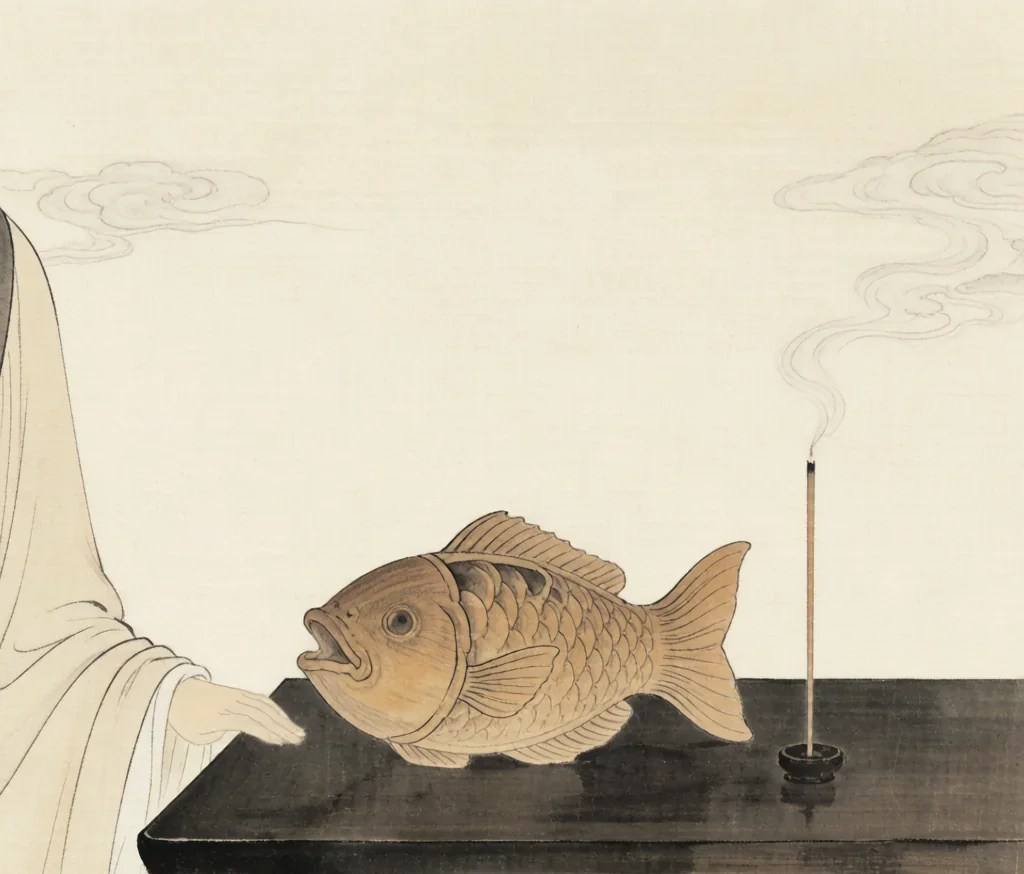
Carved in the shape of a fish and struck with a wooden stick, the muyu (木鱼, mù yú) is one of the most familiar sounds of the Chinese Buddhist temple. Its name means simply "wooden fish," and the resemblance is plain: a rounded, hollow block of wood, often with stylized scales and a gaping mouth, that produces a dry, hollow knock when hit. Yet this humble percussion instrument carries a quiet symbolism. In Buddhist teaching the fish never closes its eyes, and so the wooden fish is a reminder to practitioners to stay watchful and never doze in their devotion. For centuries the muyu has kept the beat of sutra chanting across China, a steady wooden pulse beneath voices raised in prayer. It is an instrument that turns rhythm into a form of attention.
A Fish That Never Sleeps
The most charming thing about the muyu is its form. Rather than a plain block, it is carved to suggest a fish, complete with a rounded body, a tail, and often a row of scales and an open mouth. The hollow interior and a slit cut into the wood give the instrument its characteristic tone when struck. The symbolism is gentle but pointed: because fish are believed never to sleep, the wooden fish stands for constant wakefulness, urging monks and lay practitioners to keep their minds alert through long sessions of chanting. In this way the instrument is both a musical tool and a small sermon in wood.
Made usually from a single block of hardwood, the muyu ranges in size from a small hand-held version to a large temple drum mounted on a stand. The bigger the fish, the deeper and more resonant the knock. Whatever its size, the sound is percussive and dry rather than ringing, a "tok" that marks time without sustaining, which is exactly what a chant leader needs to keep a group together.
Keeping the Beat of the Temple
In Buddhist ritual the muyu's practical job is to govern tempo. Monks and nuns chant sutras in unison, often for extended periods, and the wooden fish provides the steady pulse that prevents the group from drifting apart. A leader strikes it in rhythm with the text, and the congregation's voices fall into step. The effect is hypnotic: a repeated wooden knock, a flowing line of chant, and the scent of incense in a dim hall. For visitors, the sound of the muyu is often the audio signature of a Chinese temple, as recognizable as the smell of sandalwood.
The instrument also appears in processions and certain ceremonial music, where its dry beat helps coordinate movement and sound. Because it is portable and needs no tuning, the muyu is ideal for the varied, mobile life of temple ritual. A monk can carry a small one and use it anywhere, turning any space into a place of rhythmic devotion.
How the Wooden Fish Is Played
Playing the muyu is technically simple but rhythmically demanding. The performer holds a short wooden stick and strikes the slit or the rounded top of the fish at the chosen moments, producing a consistent knock. The challenge is not in producing the sound but in sustaining an even, meaningful rhythm over a long chant, matching the pace to the text and to the breath of the singers. A skilled chanter uses subtle variations in emphasis to shape phrases, accenting important words and easing through connective ones.
In larger temple settings, the muyu may be joined by other percussion, such as the bell and the larger drum, creating a layered rhythmic foundation for the chant. The wooden fish usually keeps the basic pulse, while the other instruments add color and punctuation. Together they form the percussion heart of Buddhist musical ritual, an ensemble built not for concert display but for sustaining collective focus.
Beyond the Temple
Although its home is the monastery, the muyu has also wandered into other musical worlds. In some Chinese folk instrumental ensembles and regional operas, a wooden fish or a closely related wooden percussion block appears as a rhythmic voice, prized for its dry, woody knock that sits differently from gongs and drums. Its plain, earthy tone offers contrast in textures that might otherwise be all metal and skin. In this broader setting the fish loses its strictly religious meaning but keeps its useful, distinctive sound.
The muyu also surfaces in daily and popular culture as a recognizable symbol of temple life, appearing in paintings, films, and stories where a single wooden knock evokes a monastery at dawn. Its shape is so iconic that "wooden fish" is almost a byword for the soundscape of Chinese Buddhism. Even people who have never entered a temple know the idea of the little fish that keeps time for the prayers.
Sound, Symbol, and Stillness
There is a paradox at the heart of the muyu. It is a percussion instrument, made to be struck, yet its purpose is to help create stillness, a steady rhythm that quiets the wandering mind. The repeated knock becomes a kind of anchor, a sonic point to return to again and again. In a tradition that values mindfulness, the wooden fish is a practical technology of attention, a tool that uses sound to gather scattered thoughts.
Crafting a good muyu is itself a quiet art. The carver must shape the wood so that the hollow and the slit produce a clean, even knock without cracks or dead spots, and the fish form must be both recognizable and balanced for striking. A well-made muyu can serve a temple for generations, its surface polished by countless taps of the stick, a small object worn smooth by devotion.
A Closing Reflection
The muyu teaches that rhythm can be a form of care. A fish carved from wood, struck again and again, holds a community in time and reminds the sleepless-hearted to stay awake to the moment. In the hum of a temple hall, beneath the chant, the wooden fish keeps its patient knock, asking nothing but attention. It is one of the smallest, plainest instruments in Chinese music, and quietly one of the most meaningful.
❓ Frequently Asked Questions
📝 Chinese Vocabulary
木鱼 — : The wooden fish; the temple percussion instrument.
佛教 — : Buddhism, the tradition in which the muyu is central.
诵经 — : The chanting of sutras, paced by the wooden fish.
寺庙 — : Temple, the usual home of the muyu's sound.
木鱼经 — : A phrase evoking the rhythmic, fish-paced chant of the temple.
法器 — : a Buddhist ritual instrument or implement, the category the muyu belongs to
木鱼槌 — : the small wooden stick used to strike the muyu
钟 — : the bell, a temple instrument that joins the muyu in ritual percussion
🎉 Fun Facts
- The muyu is carved as a fish because fish are believed never to sleep, symbolizing the wakefulness practitioners should keep.
- Despite being called a "fish," the muyu is a percussion instrument with no definite pitch, used purely to mark rhythm.
- The same wooden knock is so tied to temple life that it has become a sonic symbol of Chinese Buddhism in film and art.
- A well-made muyu can serve a temple for generations, its surface worn smooth by countless strikes of the wooden stick.
- The muyu is often paired with a temple bell and a larger drum, the three forming the basic percussion ensemble of Buddhist ritual music.
- In some Chan Buddhist monasteries the wooden fish helps pace walking meditation, its knock marking the slow steps of practitioners circling the hall.