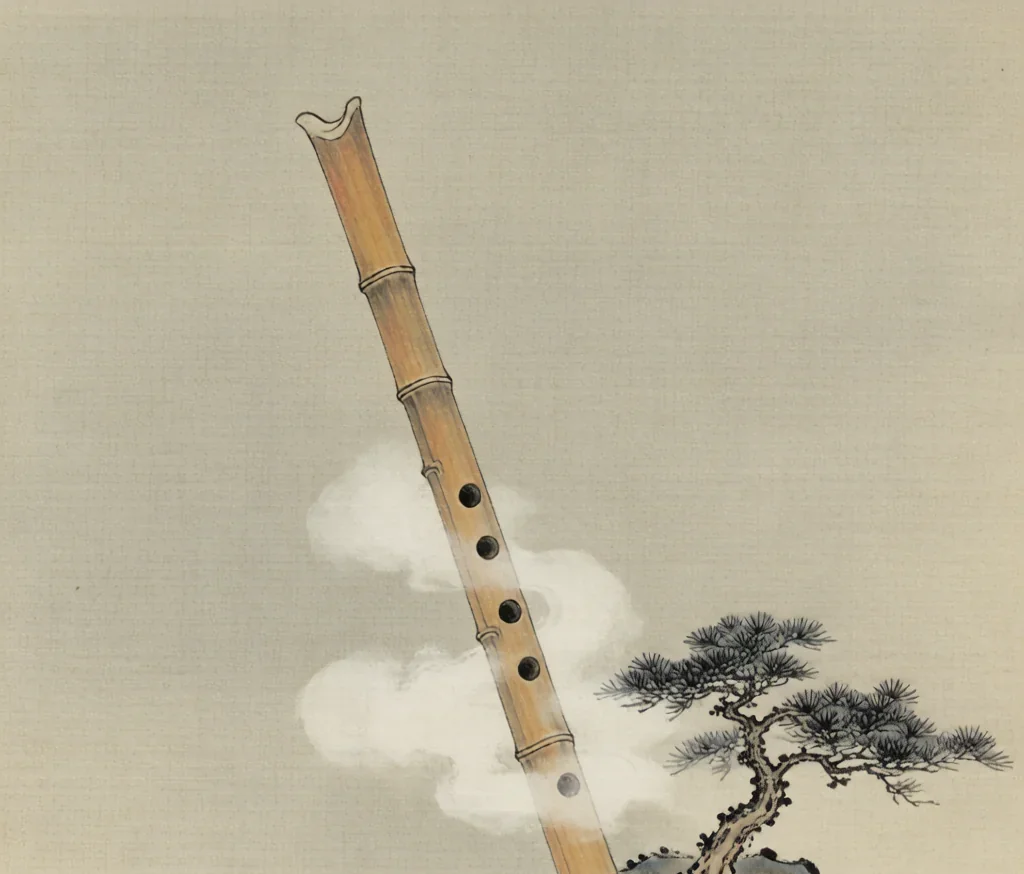
The 箫 (), often called the vertical bamboo flute, is among the quietest yet most profound voices in the Chinese musical tradition. Unlike its brighter, sideways cousin the dizi, the xiao is held straight down and blown across the rim of its top opening, producing a soft, breathy tone that seems to blend with the air itself. For more than a thousand years it has been the companion of poets, scholars, and hermits who sought in its sound a mirror for stillness and solitude. To hear the xiao well is to be invited into a slower kind of attention, one in which a single sustained note can carry as much feeling as an entire orchestra. This article explores where the xiao came from, how it is made, the way it sounds and is played, its place in the life of the Chinese literati, and why it still draws players today.
Origins and a Long Ancestry
The word xiao itself has shifted meaning over the centuries. In the earliest texts the term could refer to a bundle of small vertical flutes played together, related to what we now call the paixiao, or panpipes. Over time the name settled onto the single long vertical tube that we recognize today. Archaeologists have found bone and clay flutes in China dating back several thousand years, and while those instruments are not the xiao exactly, they show that the Chinese have blown across the ends of hollow tubes since deepest antiquity. By the Tang dynasty the vertical bamboo flute was already a familiar solo and ensemble voice, and by the Ming and Qing periods it had become closely associated with the refined amateur music of the scholar class.
What distinguishes the xiao from the more famous dizi is the absence of a membrane. The dizi has a thin rice-paper membrane stretched over a hole that gives it a bright, buzzing, penetrating timbre suited to festive and theatrical music. The xiao has no such membrane, so its voice is mellow, dark, and intimate. This difference in construction mirrors a difference in purpose: the dizi speaks to the crowd, while the xiao speaks to the self. That quiet character is precisely why it became the instrument of meditation and of the solitary evening by a window or a riverside pavilion.
Construction and the Bamboo Itself
The xiao is made from a single length of bamboo, usually between about fifty and eighty centimeters long depending on the pitch. The player chooses a culm that is straight, evenly walled, and free of cracks, because the natural node structure of the bamboo shapes both the strength and the tone of the finished flute. A hole is burned or drilled at the very top where the player blows, and a row of finger holes runs down the front, while one or two thumb holes sit on the back. Most modern xiao have eight holes in total, tuned to a chromatic scale so the player can reach every note, though older and simpler versions might have only six.
The choice of bamboo matters more than a casual listener might guess. A denser, more mature stalk yields a darker, more focused sound, while a younger and lighter stalk gives a softer, airier tone. Some makers prefer the root end of the bamboo, where the fibers are tightest, believing it lends warmth and depth. The outside is often polished and may be left its natural tan color or lacquered; the inside is smoothed so that air moves freely. Because the xiao is fundamentally a tube of air, almost nothing stands between the breath of the player and the sound the listener receives, which is part of its honesty as an instrument.
The Sound and How It Is Played
To play the xiao, the musician holds it nearly vertically and directs a narrow stream of breath across the rim of the top hole, much as one would blow across the mouth of a bottle. The player covers and uncovers the finger holes to change pitch, and by tilting the flute, adjusting breath pressure, and shading holes with the fingertips, can bend notes and produce the gentle slides and wobbles that give Chinese flute music its vocal, speech-like quality. A skilled player can make a single tone swell and fade, tremble, or bloom, turning the simplest melody into something that feels like a slow sentence being spoken.
The xiao's range is usually a little over two octaves, and its dynamic reach runs from the faintest whisper to a clear but never harsh forte. Because it cannot shout, the instrument rewards subtlety: the art lies in controlling the breath so that the tone stays steady and centered. Players often practice long tones first, holding a single note for many seconds to build the calm abdomen-supported breathing that the instrument demands. This patient practice is itself a form of training in concentration, which is one reason the xiao has long been linked with breathing exercises and seated meditation.
The Xiao in Literati and Spiritual Life
For the scholar-officials of imperial China, music was not mainly entertainment but a way to cultivate character. The xiao, with its restrained and introspective voice, fit perfectly into this view. Paintings from the Ming and Qing periods often show a lone figure beneath a pine tree or beside a moonlit river, xiao in hand, sometimes with a friend who plays the qin, the seven-string zither. The pairing of xiao and qin became a classic image of refined friendship and of harmony between two minds that need no words. The flute's quiet tone was thought to cool the heart and settle the spirit after the noise of official business and the city.
The instrument also traveled into Daoist and Buddhist practice. Its slow, even breaths mirror the rhythm of calm breathing taught in those traditions, and its sound was used to mark the pace of certain rituals and to accompany quiet contemplation. In folk belief the xiao could summon the mood of misty mountains and distant cranes, creatures associated with long life and freedom from worldly cares. Whether in a garden, a temple, or a boat on a lake, the xiao supplied a soundtrack for the kind of leisure that the Chinese literati prized above wealth: the leisure to notice the moon, the wind, and one's own breath.
The Xiao in Ensemble and Modern Music
Although best known as a solo instrument, the xiao also joins the modern Chinese orchestra and various regional ensembles. It blends beautifully with stringed instruments such as the erhu and the guzheng, and its soft color allows it to weave around a melody without covering it. In the standard Chinese instrumental ensemble it often doubles or answers the dizi, providing a darker counterweight to that brighter flute. Composers have also written new solo and chamber works for the xiao, expanding its technique while keeping its essential calm.
Beyond China, the xiao has found a small but devoted international audience among players of world and meditative music. Its gentle volume makes it ideal for small rooms, yoga studios, and quiet recordings, and its direct connection between breath and tone appeals to anyone interested in music as a mindful practice. Some makers now produce xiao in alternative materials such as PVC or hardwood for durability and lower cost, though bamboo remains the standard for those who care about sound. The instrument's simplicity means that a beginner can make a pleasant tone within a few hours, yet a lifetime is hardly enough to master its subtleties.
Learning the Xiao Today
Taking up the xiao is unusually welcoming for a traditional instrument. It is light, portable, and inexpensive compared with many others, and because it has no keys or reeds, there is little to break or maintain. A newcomer should begin with a flute in the key of G or F, which sits comfortably in the middle range, and learn to produce a clean, centered tone before attempting melodies. Daily long-tone practice, even for ten minutes, builds the steady breath that everything else depends on, and simple folk tunes offer an early sense of accomplishment.
The deeper reward of the xiao is not technical but atmospheric. Players frequently describe how the act of blowing slowly and listening closely loosens the grip of a busy day, and how a piece practiced alone at night feels less like performing than like thinking out loud. Teachers often stress that one should not rush to play fast or loud; the xiao teaches, almost against a player's will, the value of restraint. In a culture and an age that prize noise and speed, the quiet vertical flute remains a small, durable argument for the opposite: that some of the most important things are best said softly, and best heard when we stop to listen.
❓ Frequently Asked Questions
📝 Chinese Vocabulary
箫 — : the vertical bamboo flute.
笛 — : the transverse bamboo flute, or dizi.
排箫 — : panpipes, an ancestral form of the xiao.
琴箫 — : the pairing of qin zither and xiao flute.
洞箫 — : The 'hole flute,' the common name for the vertical bamboo xiao with a blowing hole at the top.
尺八 — : A taller vertical bamboo flute related to the xiao and ancestor of Japan's shakuhachi.
筒音 — : The fundamental note produced when all finger holes are closed.
泛音 — : An overtone or harmonic, used in xiao technique for a pure, singing tone.
🎉 Fun Facts
- The same Chinese character 箫 once referred to a set of vertical panpipes before it came to mean the single long flute we know today.
- Because the xiao has no reed or membrane, almost nothing lies between the player's breath and the sound, making it one of the most directly expressive of all instruments.
- Classical Chinese paintings frequently show a scholar playing the xiao alone at night by water, an image meant to signal refinement and freedom from worldly care.
- The xiao pairs so naturally with the qin that the two together became a standard emblem of friendship among the educated class.
- Because pitch depends on tube length, a xiao made from a longer bamboo stalk sounds lower, and makers pick the stalk with the target key in mind before any holes are drilled.
- In the traditional eight-material (bayin) system the xiao is classed as a 'bamboo' (竹, zhú) instrument, like every other flute made from the plant.