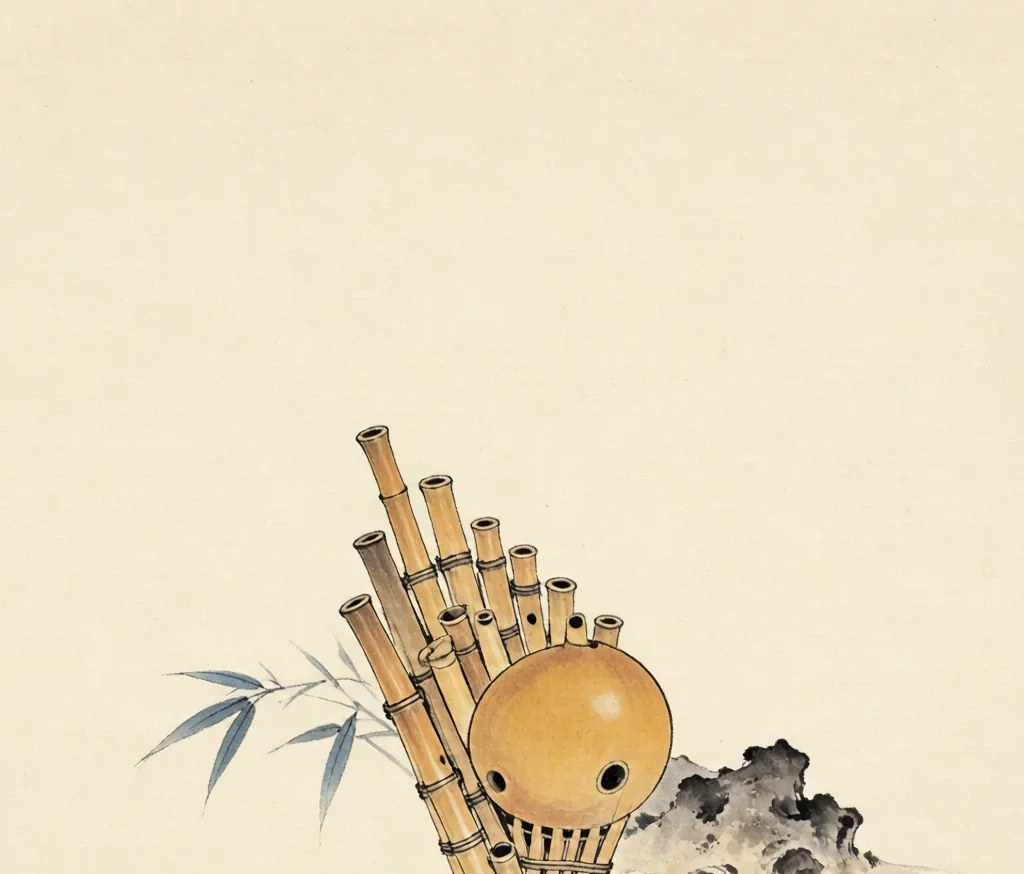
The 笙 () is the ancient Chinese mouth organ, a bundle of bamboo pipes rising from a small wind chest that the player breaths into through a mouthpiece. What makes the sheng extraordinary is that it is one of the very oldest free-reed instruments in the world, capable of sounding several pipes at once to produce chords and a shimmering, sustained tone. More than two millennia before the harmonica or the accordion appeared in the West, Chinese craftsmen had already mastered the free reed, and the sheng carried that knowledge eastward to inspire similar instruments across Asia. This article looks at the sheng's deep history, its clever construction, the way it sounds and is played, its ritual and ensemble roles, and its surprising influence far beyond China.
An Instrument Older Than Empires
The sheng is genuinely ancient. Depictions and references appear in texts and artifacts from the Zhou dynasty more than two thousand years ago, and it was counted among the eight categories of instruments classified by the material of their sounding body, where the sheng belonged to the gourd or reed group. In early ritual music it helped establish the pitch for an entire ensemble, a role so important that the philosopher Mengzi used the image of the master tuning his sheng to speak about moral cultivation and setting a good example for others.
The sheng's most remarkable historical claim is technical. Its pipes use free reeds, thin tongues of metal or reed that vibrate within a slot to set the air moving. This principle is the same one later found in the harmonica, the accordion, and the reed organ. Long before those Western instruments existed, Chinese and then neighboring Asian musicians were building free-reed organs, and scholars widely credit the sheng family as the source from which the idea spread. The sheng is thus not just old but foundational to a whole global family of instruments.
How the Sheng Is Built
A traditional sheng consists of a number of bamboo pipes of different lengths inserted into a rounded wind chest, historically made from a gourd but today usually from a wooden or metal body. Each pipe has a small slot near its base holding a thin reed tongue, and a finger hole higher up the pipe. When the player closes a hole and the reed is free to vibrate, air from the chest sounds that pipe; when the hole is open to the outside, the pipe stays silent. By covering the right combination of holes, the player can sound a single note, a pair, or a full chord.
The number of pipes has varied through history, from as few as a handful in the oldest forms to seventeen, twenty-one, or more in later and modern versions. The pipes are arranged so the player's hands can reach the holes comfortably, and their tips are often cut to different heights so the row looks like a little forest of bamboo. Modern concert shengs may use metal reeds and a more elaborate key mechanism to reach a full chromatic range, but the basic idea of a reed in a pipe above a shared wind chest has changed little in two thousand years.
The Sound and the Art of Chords
The sheng's tone is warm, rounded, and slightly buzzing, with a sustaining quality that few other Chinese instruments can match, since most plucked and bowed strings naturally decay. Because it can sound several pipes together, the sheng is the great chord-maker of the traditional orchestra, able to pad a melody with a held harmony or answer a phrase with a cluster of notes. Its sustain lets it bridge the gaps between the short, plucked attacks of lutes and zithers, giving ensemble music a continuous harmonic floor.
To play, the musician breathes into the mouthpiece and draws air in and out, because the free reed sounds on both inhalation and exhalation; skilled players learn to breathe almost continuously, so the sound never breaks. The fingers open and close holes rapidly to articulate melodies and chords, and the player may use slight breath pressure changes to swell notes. This in-and-out breath control is unusual and takes practice, but it gives the sheng an uncanny ability to sustain long, singing lines without pause.
Ritual, Ensemble, and Story
In imperial ritual the sheng joined the other instruments of the court and temple ensembles, where its function of fixing pitch and supplying harmony made it indispensable. Folk and regional traditions also adopted it, and in some parts of China the sheng appears in small ensembles for weddings, funerals, and seasonal celebrations. A well-known northern tradition pairs the sheng with the guan, a double-reed pipe, in wind bands whose bright, piercing sound carries outdoors better than stringed instruments can.
The sheng also carries beautiful legend. One famous tale links the instrument's shape to the mythical phoenix, with the curved arrangement of pipes likened to the bird's tail and wings, and the varying pipe lengths said to imitate the calls of different creatures. Whether or not the story is literal, it captures how the Chinese imagination has always heard nature in music, and how an instrument made of humble bamboo and gourd could be felt as a small model of the living world.
The Sheng's Long Reach Across Asia
Perhaps the sheng's greatest legacy is how it traveled. From China the free-reed mouth organ spread to neighboring cultures, giving rise to Japan's sho, Korea's saenghwang, and the Lao and Thai khene, each a variation on the same idea of reeds in pipes above a wind chest. These instruments kept the sheng's love of sustained chords and breathy tone, and in Japan the sho in particular became a cherished voice of Gagaku court music. The family is a quiet monument to cultural exchange along Asia's rivers and roads.
The Western free reed tells a related story. While Europe developed its own reed instruments independently in some cases, the Asian mouth organ is widely regarded as the ancestor of the reed organs and eventually the harmonica and accordion that swept the world in the nineteenth century. To hold a sheng today is therefore to hold a link in a chain that connects a Zhou-dynasty court to a Parisian cafe accordionist. Few instruments can claim so direct a line of influence across both time and continents.
The Sheng in Modern Music
Today the sheng enjoys renewed prestige. Composers for the modern Chinese orchestra write concertos and chamber pieces that exploit its chordal and sustained abilities, and improved keyed shengs extend its range and ease of playing. Young performers train at conservatories and tour internationally, and the instrument's gentle, organ-like voice fits beautifully with both traditional melody and contemporary harmony. Some players even blend the sheng with electronic music, using its continuous tone as a bed for synthesized sound.
For listeners new to the sheng, the best first impression is often a slow solo where a single held chord seems to breathe on its own, or an ensemble passage where the sheng ties the other instruments together like a soft golden thread. Its story reminds us that innovation and tradition are not opposites: the sheng is at once one of the oldest instruments on earth and a living, evolving voice. In an age that prizes novelty, there is something steadying about an instrument that has been quietly making chords for more than two thousand years, and that still sounds utterly modern when it does.
❓ Frequently Asked Questions
📝 Chinese Vocabulary
笙 — : the free-reed mouth organ.
簧 — : reed, the vibrating tongue of the pipe.
匏 — : gourd, the traditional material of the wind chest.
芦笙 — : a larger gourd reed pipe of several ethnic minorities.
竽 — : An ancient Chinese mouth organ larger than the sheng, its close relative.
排笙 — : A modern keyed sheng with a fuller chromatic range.
笙斗 — : The wind chest that holds the pipes of the sheng.
笙管 — : A bamboo pipe of the sheng, each carrying its own reed.
🎉 Fun Facts
- The sheng is among the oldest free-reed instruments on earth, predating the harmonica and accordion by more than two thousand years.
- Its reeds sound on both breathing in and breathing out, letting a player sustain a tone almost without pause.
- The sheng inspired mouth organs across Asia, including Japan's sho and Korea's saenghwang.
- A famous tale compares the sheng's shape to the mythical phoenix, with pipes likened to the bird's feathers and tail.
- The sheng is often called the 'organ of the Chinese orchestra' because it is one of the only traditional instruments that can sound sustained chords on its own.
- In many regional ensembles the sheng sits beside the double-reed guan, the two together forming the bright wind core of outdoor festival bands.